
Two different jobs
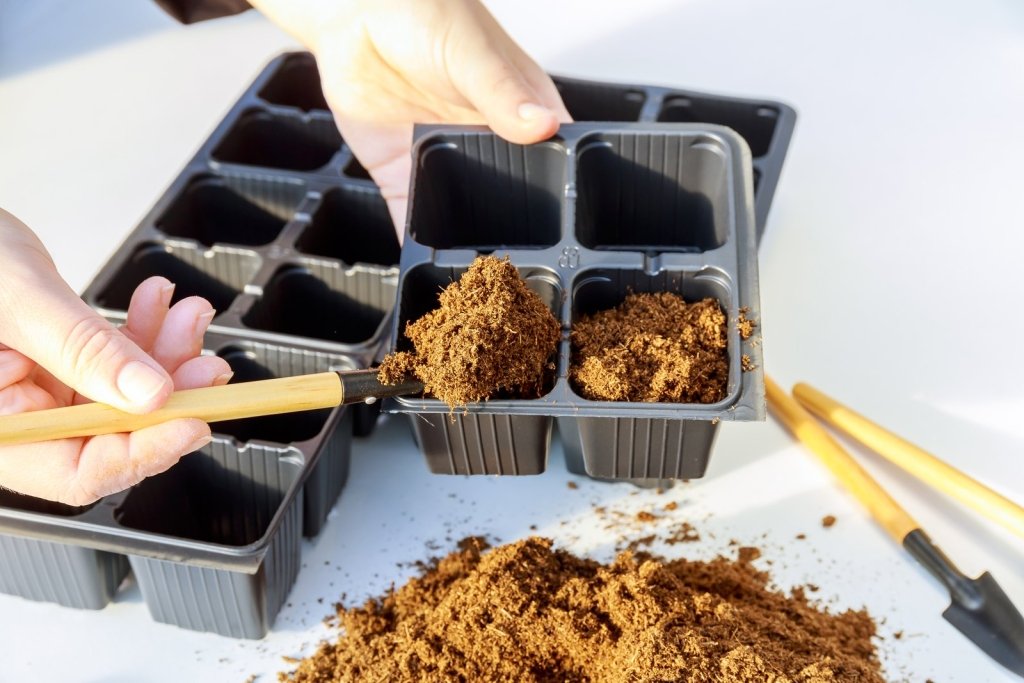
Soil advice gets confusing because two different jobs keep getting mixed together. Improving the ground you grow crops in is one job. Filling a seedling tray is another, and garden soil does not belong in a tray at all: it carries weed seed and soil-borne disease, and it sets hard in a small container. This guide covers both, in that order.
What soil is made of
Soil has four components, not three: mineral particles, organic matter, water and air. Air is the one most often forgotten. Roots breathe, and so does the soil life around them, so soil with no air spaces left in it drowns roots as surely as a bucket of water would. A healthy soil is roughly half solid material and half pore space, with that pore space shared between water and air and shifting back and forth as the bed drains.
Sand, silt and clay
Mineral particles come in three sizes, and the mix of them is what gardeners mean by soil type.
Sand is the largest. Sand grains are ground rock and they do not break down. What they do is leave large pore spaces between them, so sandy soil drains quickly, warms early and holds little water or nutrient.
Clay is the smallest, small enough that the particles hold water and nutrients on their surfaces. Clay soil holds plenty of both, drains slowly, sets hard when dry and smears when it is worked wet.
Silt sits between the two. Silty soil feels floury when dry and slippery when damp, holds moisture well, and tends to crust over and compact under heavy rain or foot traffic.
Loam is not a fourth particle. It is a soil with a workable balance of all three, and it is what most gardeners are quietly aiming for. You do not get there by carting in sand or clay. You get there by adding organic matter year after year, which improves either extreme.
Australian gardens cover the full range. Perth and much of the Adelaide fringe sit on deep coastal sand, large areas inland are cracking clay, and much of the continent carries old, weathered soil that is naturally low in phosphorus, which is why native plants in the protea family, such as banksia, grevillea and hakea, resent phosphorus-rich fertiliser.
Improving the soil you have
Organic matter, whether compost, well aged manure or leaf mould, is the one amendment that helps a sandy soil and a clay soil alike, so start there and keep at it. Spread it over the surface, let worms and rain do the mixing, and mulch on top.
Hard clay also responds to gypsum, but only if it is dispersive. Drop a dry crumb of the soil into a glass of clear water and leave it overnight. If the water clouds around it, gypsum is worth trying. If the crumb simply sits there, gypsum will do nothing and compost is the answer.
Sandy soil that beads water and refuses to wet up is water repellent, which is common through Western Australia and South Australia. A soil wetting agent helps in the short term, and compost, mulch and a cover crop between seasons fix it for longer.
Soil pH, in one figure
Most vegetables, herbs and annual flowers do best between pH 6.0 and 7.0, which is where the main nutrients stay available to roots. Outside that band, nutrients can be sitting in the soil and still be locked away from the plant.
The exceptions are narrower than they are usually made out to be. Blueberries and cranberries want 4.5 to 5.5 and will not thrive above about 6.0. Most other fruit, citrus and strawberries included, sits in the same 6.0 to 7.0 band as the vegetables.
To raise the pH of an acid soil, use agricultural lime, or dolomite where magnesium is low as well. To lower the pH of an alkaline soil, use elemental sulfur, which works slowly as soil bacteria convert it. Move in small steps and retest after a few months rather than trying to swing a bed a whole point in one season. Sphagnum peat also acidifies, but it is slow to renew and coir is the better default for general use. Changing pH is about nutrient availability, not about controlling weeds or pests.
A kit from a garden centre will give you a pH reading, and a commercial soil testing laboratory will give a full nutrient report if you want one.
Nutrients
Nitrogen drives leaf and stem growth, phosphorus supports roots and flowering, and potassium supports fruiting and general hardiness. Those three are used in the largest amounts, which is why they appear on every fertiliser label.
Calcium, magnesium and sulfur are secondary macronutrients, not trace elements. Plants use less of them than nitrogen, phosphorus and potassium, and far more than the true trace elements, which are iron, manganese, zinc, boron, copper and molybdenum. Compost, aged manure, dolomite and gypsum cover most of the secondary needs in a home garden.
Test before you feed, because too much is as easy to do as too little and harder to undo. Aged manure and compost are the safe base. Blood and bone, fish emulsion and sulphate of potash fill specific gaps. Fresh manure and uncomposted material belong in the compost bin first, since they can burn plants and tie up nitrogen while they break down.
A seed raising mix is not soil

Seed raising mix has a different job to do. It has to be fine enough for small seed to sit in contact with it, open enough to drain freely, low in nutrients, and free of weed seed and disease. A workable home blend is two parts coir or finely composted bark, one part sieved mature compost, and one part coarse washed sand or perlite. Sieve the compost, and leave garden soil and clay out of it entirely.
The low nutrient level is deliberate. A seed carries its own food for the first week or two, and a rich mix pushes soft growth and holds too much water. Start weak liquid feeding once the first true leaves open.
Sowing depth and watering

The rule of thumb is to sow to about twice the width of the seed, and the packet takes priority over the rule of thumb. Some fine seed needs light to germinate and is sown on the surface and pressed in rather than covered, including lettuce, celery, poppy, snapdragon and foxglove. There is more on this in our guide to how deep to sow seeds.
Soaking is for large, hard-coated seed only, such as peas, beans, broad beans, nasturtium and sweet pea. Eight to twelve hours is plenty, a full 24 hours can drown the seed, and soaked seed should never go into cold, wet soil.
Water evenly before and after germination. Do not switch to heavier watering once the seedlings appear, because constant wetness in still air is what brings on damping off. Keep the mix evenly damp, water from below where you can, and give the tray some air movement.
Once a bed has been improved, radish makes a good first crop. It is up within days and it tells you plainly whether the soil is loose, damp and open enough for roots to run.
None of this has to be perfect before you start. Feed the soil you have, sow into a clean mix, keep the water even, and one season in the patch will teach you more about your own ground than any amount of reading.
Related growing guides
- Soil pH explained: why it matters and how to nudge it
- Sandy, clay or loam? Understanding and improving your soil type
- What Makes a Good Seed Raising Mix?
Ready to plant? Browse our radish seeds.