
Why bed preparation matters
Bed preparation quietly decides how the rest of the season goes. Plants need soil that holds them upright, lets roots run, and releases water and nutrients at a steady rate. Where the ground is compacted, waterlogged or worn out, roots stay shallow and everything above ground struggles to keep up.

A well prepared bed makes watering easier, keeps weeds in check, evens out the nutrient supply and gives soil life somewhere to work. None of it is complicated, and most of it happens once or twice a year rather than every weekend.
When to prepare a bed in your zone
Bed preparation follows the sowing calendar, so the useful months depend on where you garden.
- Tropical (Darwin, Cairns, Townsville, Mackay, Broome and the Top End): prepare beds in March as the wet winds down, ready for the dry season run from April to October. Drainage is the main job here.
- Subtropical (Brisbane, the Gold and Sunshine Coasts, Bundaberg, Coffs Harbour and the NSW north coast): February, because the autumn window opens in March and carries the best half of the year.
- Arid and semi-arid (Alice Springs, Broken Hill, Kalgoorlie, Mildura, Longreach and Port Augusta): two windows, late February to March for autumn sowing, and July for the September rush.
- Temperate (Sydney, Melbourne, Newcastle, Geelong and most of coastal southern Australia): February for the autumn beds and August for the spring beds, so they are ready for the two strongest sowing seasons of the year.
- Mediterranean (Perth, Adelaide, the south west of Western Australia and the South Australian gulf country): the same months as temperate. Summer is long and dry here, so the autumn bed built in March to May with plenty of compost and mulch is the one that pays.
- Cool and alpine (Hobart, Canberra, Ballarat, Armidale, Katoomba and the tablelands): March and April while the soil is still workable, and again in August and September as the frosts ease.
These are broad groupings. Gardeners who sit between two zones, or higher up in the hills, should lean on local frost dates and on what works a few streets away.
Clearing the previous crop
Pull out spent crops and weeds before they set seed. Old plant material left lying about is where pests and disease wait for the next crop, and weeds left standing will hand you a seed bank to deal with for years.
Hand weeding is easiest when the soil is damp. Take the whole root of perennial weeds such as couch, kikuyu, oxalis and dock, because any piece left behind will regrow.
On a badly weedy bed, smothering beats digging. Cardboard or black plastic laid over the bed for four to six weeks kills most of what is growing without turning the soil over, and a thick mulch afterwards keeps the next lot down. In a home food garden, weeds are best handled without chemicals. If one genuinely warrants a spray, use an APVMA-registered product for that weed, exactly as the label says.
Healthy crop residue can go in the compost. Anything that carried a disease, and any weed already carrying seed, is better out of the system than turned back into the bed.
Feed the soil rather than turning it over
The old advice was to dig a bed deeply, and the deeper the better. Turning soil to 45cm does more harm than good. It breaks the crumb structure and the fungal networks that hold it together, it burns through organic matter, and it lifts buried weed seed into the light, which is what sets off the next flush of weeds.
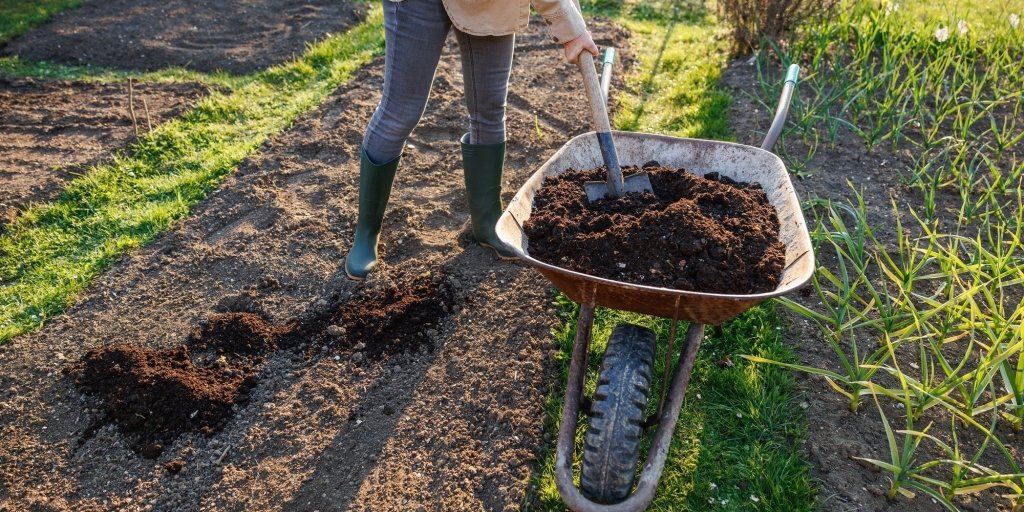
Spread 5cm to 8cm of compost or well aged manure over the surface instead, and let worms and rain carry it down. Where a bed is genuinely compacted, ease a garden fork in to one spit, about 20cm to 30cm, and lever gently without turning the layers over. Beds treated this way need less work each year, not more.
Work damp soil only. Wet soil smears and compacts under a boot or a spade, and that damage takes a season or more to undo. The reason to wait is the soil structure, not the tool.
Any bed with a few spare weeks can grow its own fertility. A quick sowing of a multi species cover crop blend, slashed down before it flowers and left on the surface as mulch, feeds soil life, shades out weeds and holds the bed together between crops. We cannot send this blend to Western Australia or Tasmania.
Organic matter and manures
Organic matter is what makes sandy soil hold water and clay soil drain. Compost, well aged manure, leaf litter, straw, shredded prunings and thin layers of lawn clippings all count, and a mixture is better than any single source.
Poultry manure is the strongest of the common manures and the one most often misused. Use it well aged or composted, because fresh manure is high in nitrogen, can burn roots and young leaves, and can carry pathogens into a salad bed. Blood and bone, fish emulsion and sulphate of potash cover most other gaps. Do not bury raw fish scraps or meat in a bed, since it draws rats, foxes and dogs, and fish emulsion does the same job without the visitors.
Mycorrhizal inoculants are sold as a general soil tonic, and they are not quite that. Many vegetables do form these root associations, but brassicas such as cabbage, broccoli, cauliflower and kale, along with beetroot, silverbeet and spinach, are non-hosts and form none at all. Compost and mulch support the soil life already present more reliably than any inoculant.

Happy Valley Seeds leans on organic inputs in the garden because compost and aged manure build structure and feed soil life at the same time, which a bag of soluble fertiliser cannot do.
Test before you add anything
Adding fertiliser without knowing what the soil already holds is guesswork, and a home bed is easy to push out of balance. A kit from a garden centre will give you pH and a rough reading of the main nutrients, and a commercial soil testing laboratory will give a full report if you want one.
In older suburbs it is worth testing for lead before growing food in the ground, particularly beside a painted weatherboard house, an old fence line or a busy road. VegeSafe, run by Macquarie University, tests garden soil samples for metals, but it pauses new samples from time to time, so check its website before sending one. EPA Victoria runs a similar service for Victorian gardeners called GardenSafe, and elsewhere a commercial soil testing laboratory can test for lead. Where a result comes back high, raised beds filled with clean bought soil are the usual answer.
Raised beds, mulch and water
Raised beds do not save water. They drain and warm faster than the ground around them, so they dry out sooner and need watering more often, especially over summer. What they do offer is drainage on wet or heavy ground, control over the soil you fill them with, soil that warms earlier in spring, and a comfortable working height.
Mulch is the water saver. A layer of 5cm to 7cm of coarse mulch, such as sugar cane, pea straw, lucerne or shredded prunings, slows evaporation, keeps the surface cool and stops heavy rain packing the soil down. Keep it a few centimetres clear of stems so they do not sit wet.
Let the bed settle
Finish preparation about two weeks before sowing or planting out. Amendments settle, manure mellows, and the first flush of weed seedlings comes up where it can be hoed off in a few minutes with the soil barely disturbed. Water the bed once, mulch it, and leave it alone.
A bed that has been cleared, fed from the surface and mulched will grow a better crop in any season, and most of the work carries over into the next one.
Related growing guides
- Sandy, clay or loam? Understanding and improving your soil type
- Getting on top of weeds: organic strategies that actually work
- Raised garden beds in Australia: are they worth it, and how to build one well
Ready to plant? Browse our cover crop and soil builder seeds.
1 comment
Louise Wright
I was wondering if you have orange capsicum seeds and if so are they easy to grow? Is there a better time of year to grow them in the northern rivers