
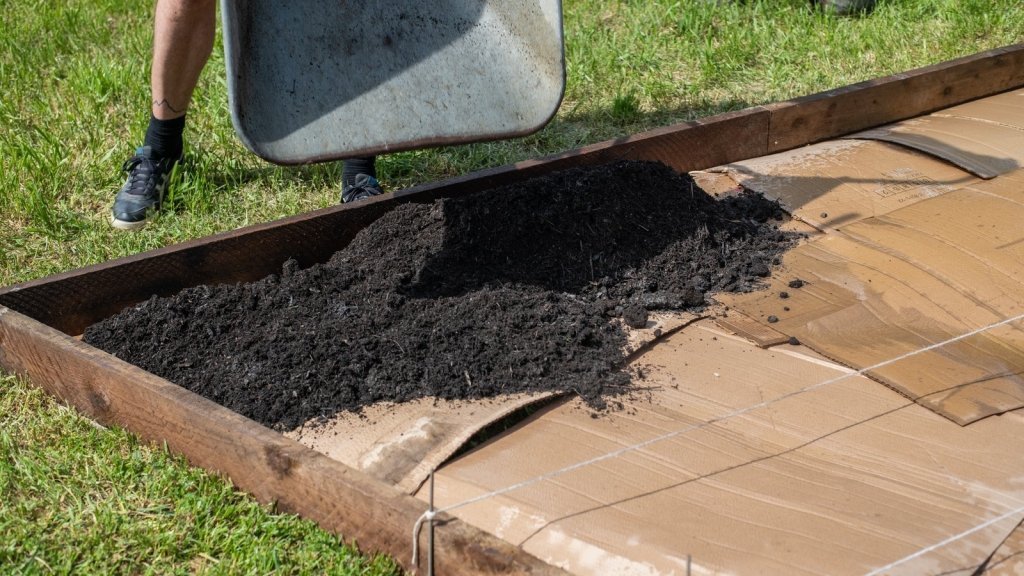
The short version: You do not have to dig up a lawn or a weedy patch to turn it into a vegetable bed. Mow it low, lay plain cardboard four to six sheets thick with generous overlaps, soak it, add a layer of manure or blood and bone, pile on 10 to 30 cm of compost, straw and other organic matter with a coarse layer of straw on top, and water it in. Left for six months or so the whole thing rots into rich soil; planted straight away through holes filled with potting mix, or into a 10 cm compost layer, it grows shallow-rooted crops from day one. It works because it feeds the soil life instead of destroying it. It will not, by itself, beat couch, kikuyu or nutgrass, and the materials you bring in need the same checks as any mulch: no herbicide residue, no weed seed, and a mask on when the bags come open.
No-dig gardening has a long Australian history. Sydney gardener Esther Deans made the layered method famous with her 1977 book Esther Deans' Gardening Book: Growing Without Digging, long before no-dig became fashionable overseas, and Sustainable Gardening Australia still recommends it for the plain reason that much of our soil is hard to work and short of organic matter. This is how to build a no-dig bed by sheet mulching, and how to keep it going.

Why not dig?
Digging is hard work, and it does the soil no favours. Turning a bed buries the surface life, brings weed seed up to the light, breaks the fungal threads that carry water and nutrients to roots, and on clay soils leaves clods that take a season to settle. Sheet mulching goes the other way: it smothers the existing vegetation under cardboard, lets it rot in place, and stacks organic matter on top for worms and microbes to pull down. Within a season the layers have become dark, crumbly soil, and the bed is never dug again, just topped up with compost each year. Charles Dowding, who has trialled dug and undug beds side by side in the United Kingdom for years, reports the undug beds yielding slightly more with far less work.
What you need
- Cardboard or newspaper: plain, matte, uncoated, with all tape, staples and glossy print removed. Large boxes from a retailer or a roll from a packaging supplier are easiest.
- A nitrogen layer: well-rotted manure, pelletised chicken manure or blood and bone.
- Bulk organic matter: compost, pea straw, lucerne, sugarcane mulch, shredded leaves, spent plants, grass clippings, aged manure.
- A coarse top layer: straw or, for a bed that will sit for months, pine bark.
- Water, a lot of it, and a mask and gloves for opening bags.
Buy hay, straw, manure and compost from suppliers who can tell you the spray history, or from certified organic sources. Some pasture herbicides pass through grazing animals into manure and survive composting, and traces will twist and cup the new growth of tomatoes, beans, peas and potatoes for a season or more. ABC Organic Gardener has documented an Australian home garden case, and the best defence is knowing where the material came from; if you cannot, grow a few bean or pea seeds in a pot of the material first and watch for twisted growth before spreading it.

Building the bed
1. Mark out and mow
Choose a spot with six to eight hours of sun. Mark the edges, then mow or brushcut the grass and weeds down hard and leave the clippings in place. Pull any woody weeds and fork out the crowns of the worst perennial ones now, because this is the last chance to reach them.
2. Feed and wet the ground
Scatter a little aged manure over the surface, add gypsum only if a test shows the clay is sodic and disperses in water, and water it in well. Moist ground under the cardboard keeps the worms working from the start.
3. Lay the cardboard
Cover the whole area with cardboard four to six sheets thick, or a thick wad of newspaper, overlapping every join by 15 to 20 cm and running it right to the edges. Any gap is a door for grass. Leave a clear ring around the trunk of any tree or shrub you are keeping. Soak the cardboard until it is limp; wet cardboard lies flat, starts to rot straight away and lets water through to the soil.
4. Add the nitrogen layer
Spread manure, pellets or blood and bone at the rate you would use on an ordinary bed. This layer feeds the microbes that will break down everything above it and stops the carbon-rich layers robbing nitrogen from the soil below.
5. Pile on the organic matter
Build the bed up 10 to 30 cm deep. Either mix the materials or, following Sustainable Gardening Australia's recipe, alternate layers about 6 cm thick of compost, pea straw and aged manure, finishing with compost and a 6 cm layer of straw. Keep woody material such as wood chips low in the stack or out of it; on a vegetable bed it causes nitrogen drawdown unless a manure or compost layer sits between it and the roots. On concrete or a sealed surface, put 7 to 10 cm of coarse screenings down first for drainage.
6. Water and wait, or plant now
Water the finished bed thoroughly. For the richest soil, let it break down for six months or more, so a bed built in autumn is ready for spring. To use it sooner, either scoop holes through the mulch to the cardboard, fill them with potting mix and plant shallow-rooted crops such as lettuce, silverbeet, herbs and brassicas, or build the quicker version: cardboard, a 10 cm layer of mature compost, a light scatter of fertiliser and 5 to 10 cm of straw, and plant directly into the compost, keeping the straw clear of stems. Deep-rooted crops such as carrots and parsnips wait until the cardboard has rotted away and the layers have settled into soil, usually the following season.

What sheet mulching will and will not smother
Annual weeds and ordinary lawn grasses die under wet cardboard within a couple of months and become part of the bed. The tough perennials are another matter. In most gardeners' experience, couch and kikuyu run under and through cardboard and need pulling as they appear for six months or more, oxalis comes back from bulbs for several seasons, and nutgrass tubers push through almost anything, so that patch is better dug out or avoided. If the site is full of these, either fork out as much as you can first, lay the cardboard thicker and wider than the bed, or accept a season of weeding at the edges. A bed built on a bad infestation of nutgrass is a bed you will fight for years.
Keeping a no-dig bed going
The bed settles considerably as it breaks down, so top it up each season with a few centimetres of compost and a fresh layer of mulch, and never walk on it. Pull weeds while they are small, cut spent plants at the base and leave the roots to rot in place, and feed heavy croppers with pelletised manure or a liquid feed as usual. Because nothing is dug, the soil life builds year on year, and after two or three seasons the bed is the easiest in the garden to plant.

Safety and housekeeping
Wear a mask and gloves when opening bags of compost, potting mix or mulch, dampen the contents, and wash your hands afterwards; the bacterium Legionella longbeachae lives in these materials and causes a serious lung infection when inhaled, with New South Wales recording at least 96 cases in 2022, one of them fatal; older people, smokers and anyone with a weakened immune system are most at risk. Keep cardboard and deep mulch well clear of house walls, weep holes and slab edges, because both attract and hide termites. In south-east Queensland and northern New South Wales, check the fire ant biosecurity zone rules before moving soil, mulch, hay, turf or potted plants in or out of a zone. And do not compost the first season's weeds if herbicide residue is suspected.
No-dig beds across Australia's climate zones
- Tropical (Cairns and far north Queensland, Darwin and the Top End of the Northern Territory, the Kimberley in Western Australia): layers rot in weeks, so build higher and top up often; build at the end of the wet season and keep mulch back from stems to limit rot.
- Subtropical (Brisbane and coastal Queensland, Coffs Harbour and northern New South Wales): sugarcane mulch is cheap and local; build in autumn for a winter crop and check the fire ant rules before moving material.
- Arid and semi-arid (inland Queensland, Broken Hill and Dubbo in New South Wales, Mildura in Victoria, inland South Australia and Western Australia, Alice Springs in the Northern Territory): the bed needs watering to break down, so build it where irrigation reaches and use a deep straw top layer against evaporation.
- Temperate (Sydney and New South Wales, Melbourne and Victoria): build in autumn, let winter rain do the rotting, and plant in spring; the classic Esther Deans timetable.
- Mediterranean (Perth and southern Western Australia, Adelaide and the Adelaide Plains in South Australia): autumn building on winter rain works well, and on Perth sand the organic matter transforms water holding within a season.
- Cool and alpine (Hobart and Tasmania, Canberra and the ACT, Ballarat in Victoria, Orange and Armidale on the New South Wales tablelands, and the alpine country of the Snowy Mountains and the Victorian high country): decomposition is slow in the cold, so build in late summer or early autumn and expect the bed to be ready the following spring.
Wherever you are, the bed built on a wet autumn weekend is the one that grows the summer's vegetables.
Frequently asked questions
Can I plant straight into a new sheet-mulched bed?
Yes, shallow-rooted crops, either through holes filled with potting mix or into a 10 cm compost layer. Root crops wait until the cardboard has gone.
Will the cardboard stop water getting through?
Not once it is wet. Soak it when you lay it and it softens within weeks, lets water through and is gone in two or three months.
Do I need a raised bed frame?
No. A frame keeps the edges tidy and the layers in place, but a free-standing mound with a straw edge works just as well.
Does no-dig work on clay?
Very well, which is the point. Gypsum under the cardboard helps on dispersive clay, and after a couple of seasons of organic matter the clay beneath opens up on its own.
Cardboard, compost, straw and patience turn the worst corner of a garden into its best bed, and you never have to dig it. Sustainable Gardening Australia's no-dig vegetable garden guide gives the layer-by-layer recipe used here.
Related growing guides
- Raised garden beds in Australia: are they worth it, and how to build one
- Getting on top of weeds: organic strategies that actually work
- Sandy, clay or loam? Understanding and improving your soil type
Build the bed this weekend and sow it next: browse our vegetable seeds, herb seeds and heirloom seeds.