
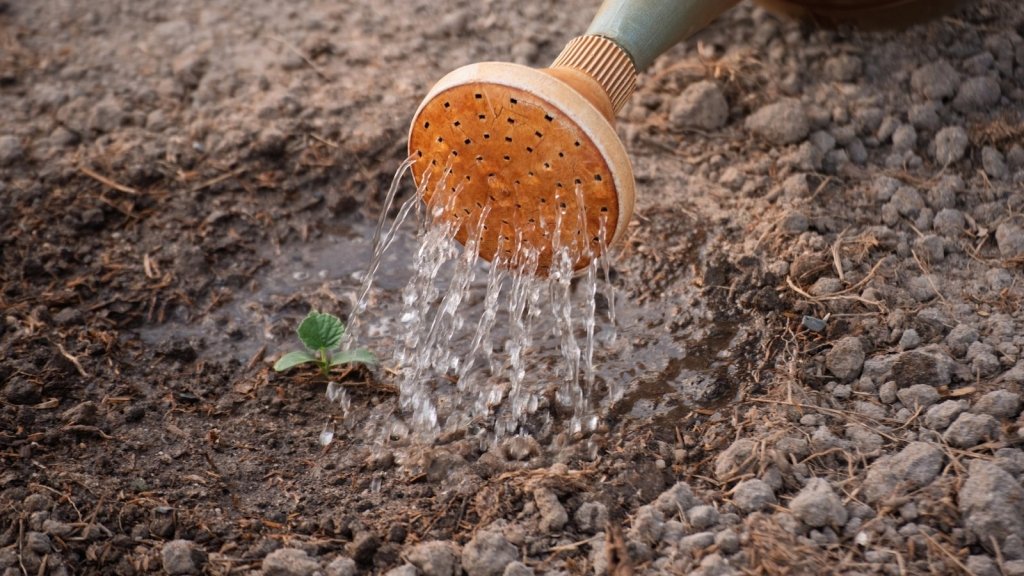
The short version: When water beads on the surface of a bed or runs straight off a pot instead of soaking in, the soil has become hydrophobic, or water repellent. It happens when waxy residues from decomposing plant material coat the grains of sandy soil or old potting mix. A soil wetting agent gets water past the wax and moving again within days, but the lasting fix is to mix clay and compost through the top of the soil, keep it mulched, and never let it dry right out.
You have probably seen it without naming it. The hose runs for a minute, the top of the bed goes dark, and when you push a finger in it is bone dry a centimetre down. Or the water in a neglected pot skates around the edge and pours out the bottom while the root ball stays dusty. That is water repellence, and on Australia's sandy soils it is one of the most common reasons a well-watered garden still wilts.

Why soil starts repelling water
Soil turns hydrophobic when a thin waxy film coats the individual grains. The waxes come from decomposing leaves and roots, from the exudates of some plants and from soil fungi, and they build up over time in any soil that has plenty of organic matter and very little clay to bind it. Sand is the classic case, because sand grains are large and smooth and offer very little surface area for their volume, so a little wax goes a long way. Old potting mix and seed raising mix do the same thing once they dry out completely, because they are mostly organic matter with almost no clay at all.
The problem is worst when the soil is dry, which is why it shows up at the end of a hot summer, in pots that missed a few waterings, and on beds that sat empty under the sun. Water-repellent soils are common across the south and west of the country, and the sandy coastal plain around Perth is the textbook example.
The test is simple. Brush off any loose litter and put a single drop of water on the dry surface, then repeat two or three centimetres down, since repellence is often worst right at the top. If the drop soaks in within about five seconds the soil wets freely, and under a minute is still workable. If it sits there as a bead for a minute or more, you have your answer.

The quick fix: a soil wetting agent
A wetting agent is a surfactant, a soil-safe cousin of detergent, that breaks the surface tension of water and lets it slip past the waxy coating into the pore spaces. It comes as granules to sprinkle or a concentrate to dilute, and in most sandy gardens it turns a repellent bed back into an absorbent one within a watering or two.
- Apply it to dry soil, then water it in thoroughly. In Western Australia the water utility suggests a dose at the start of winter and again in early summer, and the label on any product tells you the rate and the repeat interval.
- Do not substitute dishwashing liquid. Household detergents are made to strip grease, and the synthetic surfactants and salts in them can burn roots and harm soil life in a way a horticultural wetter does not.
- Treat it as a treatment, not a cure. A wetting agent usually fixes the symptom for a season. The soil will repel water again unless you change what it is made of.
For a stubborn pot, sit the whole thing in a bucket of water with a splash of wetting agent until the bubbles stop rising, then let it drain. It is the most reliable way to rewet a root ball that has dried to a brick, short of knocking the plant out and repotting it into fresh mix. Empty the bucket as soon as you are done if there are small children about, and tip the water onto a garden bed rather than down a drain.
The lasting fix: clay, compost and cover
Sand repels water because there is nothing in it to hold the wax in check. The permanent answer is to give it some clay and some humus.
Adding clay is the long-term fix that Western Australian soil scientists recommend for the state's sands, and it usually works in a sandy garden elsewhere too, provided the clay is mixed through properly rather than left as a layer. Kaolin clay or bentonite, sold in bags at garden centres, is mixed through the top 30 cm of soil when a bed is being made or rested. Even a few percent of clay changes how the sand holds water and nutrients. Farm rates run to 100 tonnes a hectare or more, which works out at about 10 kg a square metre, far more than most gardeners would put down at once. In a bed, start at about half a kilo a square metre and build up over a few seasons to one or one and a half kilos, dug through the top 20 to 30 cm. A lot applied in one go can form a layer that stops water penetrating, so spread it over time and follow the guidance on the bag.
Compost, aged manure and worm castings do the other half of the job. Humus holds far more water than the same weight of sand and feeds the soil life that keeps a sandy bed alive. Mix a generous amount through the top 30 cm when you establish a bed, then top it up every season, and mulch on top with a coarse mulch 5 to 10 cm deep. Coarse, chunky mulches save more water than fine ones, and a generous layer of coarse mulch can save up to 20 per cent of the water you put on a garden, so the soil beneath rarely dries to the point where the wax takes over. Our guide to sandy, clay and loam soils covers how to read what you have.

Watering a repellent bed without wasting water
Technique matters while the soil recovers. Water slowly and deeply rather than often and lightly, and water in the early morning so less is lost to the heat of the day. On a bed that is still repellent, give it a light pass to break the surface, wait ten minutes, then water properly. A trickle from a hose left at the base of a plant beats a fast blast that runs straight down the path.
Seed raising mix and coir-based mixes are worth wetting before you sow. Tip the mix into a tub, add water and turn it through by hand until it holds together, then fill your trays. A dry mix sown and watered from the top often stays dry in the middle, and the seeds in the middle simply never start. Put a mask and gloves on before you open the bag, open it away from your face, dampen the mix before you handle it, and wash your hands thoroughly with soap afterwards, since the dust can carry the bacterium Legionella longbeachae.

Keeping it from coming back
- Never let a sandy bed or a pot dry right out. Mulch, shade cloth in the worst of summer, and a cover crop on a resting bed all keep moisture in the soil.
- Keep adding organic matter, every season, not once.
- Add clay to sand once, properly, when you next remake a bed.
- Refresh potting mix rather than reusing tired mix for years, and rewet old mix in a bucket before you plant into it.
- Use a wetting agent in early summer as insurance, then let the soil improvements take over.

Water-repellent soil across Australia's climate zones
- Tropical (Cairns and far north Queensland, Darwin and the Top End of the Northern Territory, the Kimberley in Western Australia): rare in the wet season, but sandy beds and pots can turn repellent in the long dry. Mulch and shade are the answer.
- Subtropical (Brisbane and coastal Queensland, Coffs Harbour and northern New South Wales): coastal sands can repel water after a dry spell. Keep organic matter up and mulch through the dry winter.
- Arid and semi-arid (inland Queensland, Broken Hill and Dubbo in New South Wales, Mildura in Victoria, inland South Australia and Western Australia, Alice Springs in the Northern Territory): rare rain onto bone-dry sand is the classic trigger. A wetting agent before the season and heavy mulch make the most of every drop.
- Temperate (Sydney and New South Wales, Melbourne and Victoria): less common on loams and clays, but old potting mix and sandy coastal gardens still suffer at the end of summer.
- Mediterranean (Perth and southern Western Australia, and Adelaide and the Adelaide Plains in South Australia): the heartland of the problem. Perth's grey sands repel water almost by default, so clay, compost, mulch and a twice-yearly wetting agent are standard practice.
- Cool and alpine (Hobart and Tasmania, Canberra and the ACT, Ballarat in Victoria, Orange and Armidale on the New South Wales tablelands): mostly a pot and seed tray problem in dry spells rather than a garden bed one.
Frequently asked questions
How do I know if my soil is hydrophobic?
Put a drop of water on dry soil. If it beads and sits for a minute or more instead of soaking in, the soil is water repellent. Water pooling on top of a pot and running out the sides is the same thing.
Can I use dishwashing liquid as a wetting agent?
Better not. Detergents are made to strip grease and can harm roots and soil life. A horticultural wetting agent is formulated to be soil-safe and costs little.
Is a wetting agent safe around worms, pets and frogs?
Horticultural wetting agents are designed for soil and used at low rates, and once watered in they are generally regarded as safe for plants and soil life, but they are still surfactants. Keep the concentrate and any runoff out of ponds and away from frogs, which absorb whatever touches their skin, keep pets off a treated area until it has been watered in, and follow the label for the product you have.
Will compost alone fix sandy soil?
It helps a great deal, but organic matter breaks down and has to be replaced every season. Adding clay once gives sand a lasting ability to hold water, and the two together work best.
Does water-repellent soil stop seeds germinating?
It can. Seed sown into dry, repellent mix or sand sits in a pocket the water never reaches, so nothing happens. Wet seed-raising mix thoroughly before you fill the trays, and on a repellent bed apply a wetting agent and water it in before you sow.
Water-repellent soil is not a failing of the gardener. It is what sand does when it is left dry and bare. Get water past the wax with a wetting agent, then give the soil the clay, humus and cover it was missing, and the hose starts doing its job again. CSIRO's short explainer on water repellent soils covers the science behind it.
Related growing guides
- Sandy, clay or loam? Understanding and improving your soil type
- Water-wise gardening in Australia
- Waterlogged soil: what to do when the garden will not drain
Build the soil, then plant it. Browse our cover crop seeds for a resting bed and our vegetable seeds for the season ahead.