
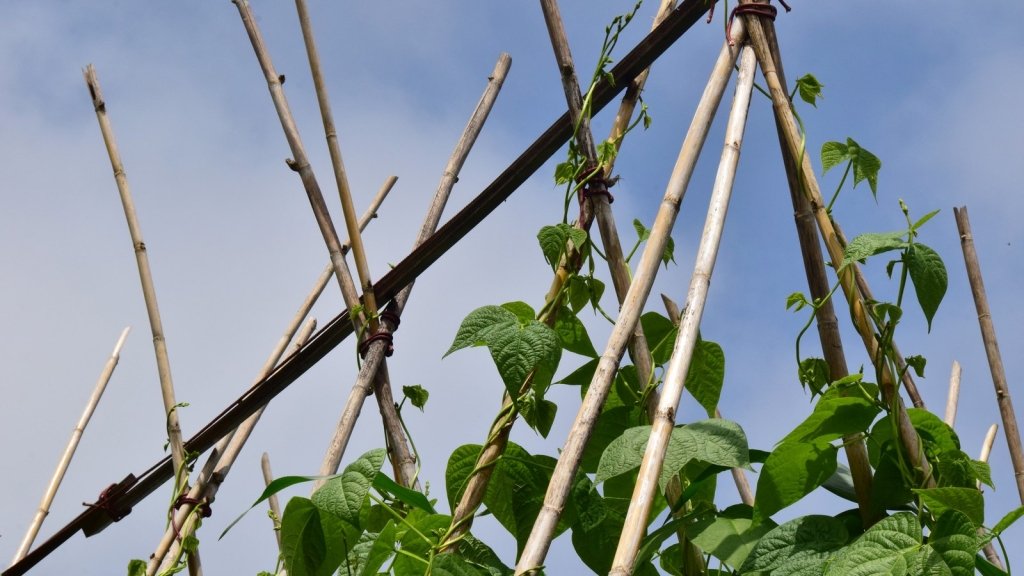
The short version: Climbing vegetables need three different kinds of help. Peas and cucumbers grip with tendrils and only need something thin to grab. Climbing beans twine their whole stem around a pole. Tomatoes and zucchini do not climb at all and must be tied. Match the structure to the habit, build it before you sow, make it tall enough (1.8 to 2 metres for climbing beans and peas) and anchor it against wind, because a wall of leafy pods acts like a sail. Bamboo tepees, double rows of canes, reinforcing mesh panels, A-frames and arches all work; the best one is the one that stands up in February.
Growing upward is the cheapest way to get more food from a small garden. A trellis of beans yields far more per square metre than a bush row, a cucumber off the ground stays cleaner and healthier, and a tomato on a stake is easier to pick and prune. The trick is knowing how each crop climbs, and building for it.

How different vegetables climb
Tendril climbers such as peas, cucumbers, and to a lesser extent pumpkins and melons, send out curling shoots that clasp anything thin they touch: string, wire, netting, twiggy sticks. They cannot grip a thick pole. Once established they need pointing in the right direction rather than tying. Twining climbers, chiefly climbing beans, wrap the whole growing stem around the support, which suits poles, canes and thick string, and they climb fastest on something rough and roughly vertical. Non-climbers that we grow upward anyway, tomatoes and zucchini, have no way of holding on and must be tied to a stake, trellis or spiral at intervals as they grow. Building the wrong structure for the habit is the commonest failure: peas on bare bamboo canes slide off, and beans on chicken wire tangle.
Height and strength
Climbing beans commonly grow to about 1.8 metres and often more in good conditions, and climbing peas want a trellis to about 2 metres. Dwarf peas and bush beans do not climb, but dwarf peas still crop better and stay cleaner with a low support of twiggy sticks or netting to about a metre. Vine tomatoes need a tall stake of around 2 metres driven deep; bush tomatoes need only about a metre. Whatever you build, remember what it will look like in late summer: a full wall of foliage, pods and wet leaves catching every gust. Drive posts at least 30 cm into the ground, brace tall panels, tie tepees firmly at the top, and check the whole thing after the first strong wind.

Structures that work
- Tepee or wigwam: five to ten bamboo poles at least 1.5 metres long pushed into the soil in a circle and tied at the top. The classic support for climbing beans, easy to build and easy to move. Bamboo beats found sticks because it is straight, light and lasts for years.
- Double row of canes: two rows of canes about 30 cm apart, each pair crossed and tied to a horizontal cane along the top. Suits beans and, with string run between the canes, peas.
- Mesh panel: a sheet of steel reinforcing mesh or a panel of welded wire tied to star pickets. Peas, cucumbers and beans all climb it, it lasts for many years, and it is the strongest option for a windy site.
- Netting on a frame: soft trellis netting stretched between posts or over a frame. Ideal for peas and cucumbers; less good for heavy beans, which can pull it down.
- String lines: a top wire or pole with strings running to pegs in the ground. Cheap, compostable at season's end, and good for beans and tomatoes.
- A-frame: two panels of mesh or netting leant together and tied at the top. Stable in wind, and the space underneath grows lettuce in summer shade.
- Arch: mesh bent over a path so cucumbers, beans or small pumpkins hang down where they are easy to pick. Heavy fruit such as pumpkin and melon needs a sling of old stocking or netting tied to the arch.
- Living support: the traditional three sisters planting runs climbing beans up sweet corn stalks with squash sprawling below. It works, but plant the beans a few weeks after the corn so they do not overwhelm it.
Where to put it
Build the support before you sow or plant, so you do not drive stakes through roots later and so seedlings find something to climb as soon as they need it. Run rows roughly north to south where you can, which spreads the sun along both faces of a trellis through the day. Where a trellis runs east to west instead, it has a sunny northern face and a shaded southern face, and there is no fixed rule about which to plant. The sun sits in the northern sky in Australia, so the shadow falls south, and the usual advice is to keep a tall trellis on the southern edge of a bed so it shades the path rather than the crops. One Victorian gardening service's side-by-side planting found the nuance: early legumes did better on the warmer northern face, while summer cucurbits preferred the cooler southern face. Use the shadow deliberately, either to protect summer lettuce or to keep it off sun-loving crops, rather than assuming one answer.

Training the non-climbers
Tie tomatoes to their stake at regular intervals as they grow with a soft tie, old stockings, strips of cotton fabric or thick soft twine, in a loose figure of eight so the stem can thicken. Zucchini can be grown up a single sturdy stake in exactly the same way: sow or plant about 5 cm from the stake, tie the main stem in every 5 to 10 cm of growth, and once flowering starts, remove the leaves below the lowest flower, leaving a stub of each stalk to stop the ties slipping. Grown this way a zucchini takes a fraction of the space, its fruit is easy to find, air moves around the leaves so powdery mildew is slower to take hold, and the harvest period is often extended by a few weeks. Cucumbers on a trellis need tying only at the start, until their tendrils take hold and wind can no longer rock the young vine.
Materials, and two safety notes
Bamboo, hardwood stakes, galvanised mesh and star pickets all last for years; jute string breaks down within a season or two, which suits crop rotation but means replacing it. Older treated pine, the greenish CCA type, contains arsenic. CSIRO considers the ingestion risk small with sensible precautions, while some horticulturists, including ABC Gardening Australia's presenter, still avoid it around food plants; for food beds, untreated hardwood or newer arsenic-free treated timber sidesteps the question, and either way wear gloves when handling it, a mask when cutting, and never burn old treated pine. Check stacked mesh, canes and stored tepee poles for redback spiders before handling them bare-handed. Cap every bare cane or stake top that sits at head or eye height with a cork, a small pot or a purpose-made cane cap, especially where children play; a sharp cane at eye level is one of the garden's genuine hazards. And check that tepees and panels are anchored before the plants leaf up, because a collapsing trellis in a summer storm can hurt a person as well as a crop.

Climbing crops across Australia's climate zones
- Tropical (Cairns and far north Queensland, Darwin and the Top End of the Northern Territory, the Kimberley in Western Australia): snake beans, winged beans and cucumbers climb through the wet; build strong, well-anchored frames for storm winds and keep vines off the wet ground to limit disease.
- Subtropical (Brisbane and coastal Queensland, Coffs Harbour and northern New South Wales): beans and cucumbers most of the year, peas in winter. Airflow on a trellis is the best defence against humid-weather mildew.
- Arid and semi-arid (inland Queensland, Broken Hill and Dubbo in New South Wales, Mildura in Victoria, inland South Australia and Western Australia, Alice Springs in the Northern Territory): trellises double as shade for lower crops; put summer lettuce on the southern side of a bean wall.
- Temperate (Sydney and New South Wales, Melbourne and Victoria): peas on mesh from autumn to spring, beans and cucumbers from late spring. Brace for spring westerlies.
- Mediterranean (Perth and southern Western Australia, Adelaide and the Adelaide Plains in South Australia): the dry summer air suits climbing beans and cucumbers on open frames; sandy soil needs deeper, better-anchored posts.
- Cool and alpine (Hobart and Tasmania, Canberra and the ACT, Ballarat in Victoria, Orange and Armidale on the New South Wales tablelands, and the alpine country of the Snowy Mountains and the Victorian high country): peas and broad beans dominate; a mesh panel against a north-facing wall gives climbing beans the warmth they need in a short summer.
In every zone the structure goes in first and the seed second.
Frequently asked questions
Do I need to tie climbing beans to the pole?
Only at the very start, to point the shoot at the pole. Once it has made a turn or two it climbs on its own.
Why are my peas falling off the trellis?
Tendrils need something thin to grip. Add string, netting or twiggy sticks to a bare frame of canes or thick timber.
Can pumpkins really grow on a trellis?
Small-fruited varieties can, on a strong arch or mesh, with each fruit supported in a sling once it is the size of a fist. Large pumpkins are better left on the ground.
How high should a tomato stake be?
Around 2 metres above ground for vine types, driven in deeply enough to stay rigid under a full plant. A metre is enough for bush types.
Match the support to how the plant climbs, build it strong and build it first, and vertical growing becomes the easiest extra bed in the garden. Yates' bean growing guide covers sowing and support for the most rewarding climber of all.
Related growing guides
- Determinate vs Indeterminate Tomatoes: Which Should You Actually Grow?
- Working with garden microclimates: sun, shade, wind and frost
- Growing Tomatoes in Pots and Containers: The Australian Guide
Grow up, not out: browse our climbing vegetable seeds, bean seeds, pea seeds and cucumber seeds.