
The short version: Whether to prune a tomato depends entirely on its type. Bush (determinate) tomatoes stop at a set size and should be left alone apart from removing leaves that touch the ground. Vine (indeterminate) tomatoes keep growing all season, and pruning them to one, two or three leaders keeps them manageable, gets air through the plant, ripens fruit earlier and makes each fruit larger. It also reduces total yield, sometimes sharply, so it is a choice, not a rule. If you prune, pinch out the side shoots while they are small, strip the leaves from the lowest 30 cm, tie the leaders to a tall stake with soft ties, top the plant when it reaches the top of its support, and work on a dry morning with clean hands and tools.
Few garden jobs attract more folklore than pruning tomatoes. Some gardeners pinch every side shoot religiously; others never touch the plant and still fill the fruit bowl. Both can be right, because the answer depends on the variety, the space, the climate and what you want from the crop. Here is what pruning actually does, and how to do it when it is worth doing.

Bush or vine: the only question that matters
Tomatoes come in two growth habits. Determinate or bush varieties grow to a fixed size, commonly around half a metre and occasionally a metre, set most of their fruit in a flush over a few weeks and then stop. They need at most a short stake, and pruning them only removes fruit and opens wounds. Indeterminate or vine varieties keep producing new stems, leaves and flowers until frost or exhaustion stops them, reaching two or three metres. Left alone they sprawl into a tangle of stems on the ground, where the fruit rots, the leaves stay wet and disease takes hold. These are the plants that benefit from training and, usually, some pruning. The packet or label tells you which you have; our guide to determinate and indeterminate tomatoes goes into the difference.
What pruning does, and what it costs
Pruning a vine tomato concentrates the plant's energy into fewer stems, so the fruit on those stems is larger and ripens earlier, the plant is easier to tie to a single stake, air moves through the foliage so fungal diseases are slower to spread, fruit is easier to find and pick, and each plant takes less room. The cost is yield. Diggers reports a trial in which light pruning cut total yield by about a quarter and heavy pruning by more than three-quarters, and pruning also delayed flowering, which matters in a short season. Fewer leaves also means less photosynthesis and less shade for the fruit, so an over-pruned plant sunscalds its crop in a heatwave. The sensible middle ground for most gardens is a lightly pruned vine on two or three leaders, and, apart from clearing the lowest leaves, no pruning for bush types.

Finding the side shoots
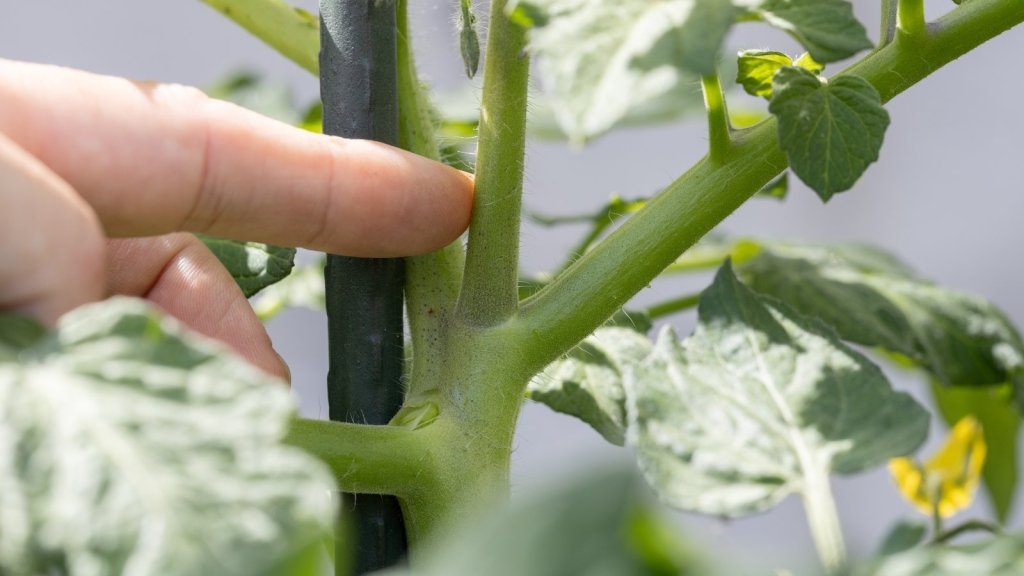
A tomato side shoot, also called a lateral or sucker, grows from the point where a leaf stalk joins the main stem, in the angle between the two. Picture the main stem as a body and the leaf as an arm held out: the side shoot is the sprout in the armpit. Left alone each one becomes a full stem with its own leaves, flowers and further side shoots, which is how one plant becomes ten. Flower trusses grow from the main stem itself, not from a leaf junction, so they are never mistaken for laterals once you have seen both.
How to prune a vine tomato
1. Choose your leaders
A single-leader plant keeps only the main stem and removes every side shoot. A double leader keeps the main stem and the strongest side shoot, often the one just below the first flower truss, which many growers find the most vigorous. A triple leader keeps one more. More leaders mean more fruit, smaller fruit and more tying. Each leader needs its own stake or string.
2. Pinch early and often
Check the plant every few days and pinch out unwanted side shoots while they are small enough to snap off between thumb and finger, which leaves a tiny wound that heals fast. Larger shoots need clean, sharp secateurs cut close to the stem. Some gardeners leave one or two leaves on a cut shoot to add photosynthesis, but the stub then sprouts more shoots and adds to the work.
3. Clear the lowest 30 cm
Remove the leaves and side shoots from the bottom 30 cm or so of the stem on every tomato, bush or vine, as the plant grows. Those leaves sit closest to the soil, where fungal spores splash up in rain and watering, and they rarely contribute much.
4. Leave the rest of the leaves alone
Resist stripping leaves higher up. They feed the fruit and shade it from sunscald. Remove only diseased leaves and the odd one shading a ripening truss late in the season.
5. Top the plant
When a leader reaches the top of its stake, or several weeks before the season ends, pinch out the growing tip. The plant stops making new growth it cannot ripen and puts its sugars into the fruit already set.

Training and tying
Put the support in at planting time so you never drive a stake through established roots. Vine tomatoes need a stake of about 2 metres driven in deeply enough to stay rigid, a tall cage, a tripod or a trellis; bush tomatoes need a metre at most. Tie stems in loosely, in a figure of eight, with soft material that will not cut the thickening stem: old stockings, strips of cotton, thick soft twine or purpose-made soft tie. Add ties regularly as the stem grows. Many growers leave the plant untied until the first flowers appear, so the stem thickens and strengthens with a little movement, then tie regularly from there. Overseas growers commonly train single leaders up a string from an overhead wire, or wind them up spiral steel stakes; both work in Australian gardens but are far less common here than a stake and ties.
Hygiene: the part everyone skips
Every pinch and cut is a wound, and wet foliage and dirty hands spread disease from plant to plant. Prune on a dry morning after the dew has lifted, never straight after rain. Wash your hands before you start and between plants, which also limits the spread of tobacco mosaic virus, a particular risk for anyone who handles cigarettes or other tobacco, and wipe secateurs with methylated spirits between plants if any look unwell. Bin or burn diseased prunings rather than composting them. Light gloves are a reasonable precaution, because the fine hairs on tomato foliage leave a sticky residue that some gardeners find irritates their skin, and they keep the green stain off your hands. Our guide to tomato leaf problems shows what the diseases look like.

Pruning tomatoes across Australia's climate zones
- Tropical (Cairns and far north Queensland, Darwin and the Top End of the Northern Territory, the Kimberley in Western Australia): humidity makes airflow the priority, so prune vine types to one or two leaders and keep the lower stem bare, but leave enough canopy to shade fruit from sunscald.
- Subtropical (Brisbane and coastal Queensland, Coffs Harbour and northern New South Wales): the same rule as the tropics; disease pressure argues for lighter canopies and clean lower stems.
- Arid and semi-arid (inland Queensland, Broken Hill and Dubbo in New South Wales, Mildura in Victoria, inland South Australia and Western Australia, Alice Springs in the Northern Territory): prune lightly or not at all, since leaf cover protects fruit from scald in extreme heat; two or three leaders is plenty.
- Temperate (Sydney and New South Wales, Melbourne and Victoria): the classic two-leader vine on a tall stake suits most gardens, with the lower leaves stripped and the plant topped in March.
- Mediterranean (Perth and southern Western Australia, Adelaide and the Adelaide Plains in South Australia): dry summer air lowers disease risk, so prune for size and convenience rather than airflow, and keep leaf cover over the fruit through heatwaves.
- Cool and alpine (Hobart and Tasmania, Canberra and the ACT, Ballarat in Victoria, Orange and Armidale on the New South Wales tablelands, and the alpine country of the Snowy Mountains and the Victorian high country): a short season rewards a single leader and early topping, so that the few trusses the plant sets actually ripen.
Whatever the zone, a bush tomato is left to its own devices.
Frequently asked questions
Do I have to prune tomatoes at all?
No. Bush types should not be pruned, and vine types will still crop without it, but as a sprawling tangle with smaller, later fruit and more disease. Pruning is a choice about space, tidiness and fruit size.
Which side shoot do I keep for a second leader?
The one growing just below the first flower truss. It is usually the strongest.
Can I root the side shoots I remove?
Yes. A side shoot pushed into moist potting mix will often root within a couple of weeks and gives a late plant, which is useful in long-season areas.
Should I remove leaves to ripen fruit?
Only the odd leaf directly shading a nearly ripe truss late in the season. Fruit ripens on warmth and time, not sunlight on the skin, and bare fruit scalds.
Know the type, keep bush tomatoes untouched, train vines to a few leaders on a tall stake, and keep hands and tools clean, and pruning stops being a mystery. ABC Gardening Australia's demonstration of pruning tomato plants shows the pinch in practice.
Related growing guides
- Determinate vs Indeterminate Tomatoes: Which Should You Actually Grow?
- Tomato Leaf Problems: A Visual Guide to Diagnosing Your Tomatoes
- Growing Tomatoes in Pots and Containers: The Australian Guide
Pick the habit that suits your space: browse our vine tomato seeds, bush tomato seeds and the full range of tomato seeds.