
The short version: Most tomato leaf problems fall into four groups: fungal and bacterial spots and blights, viruses, nutrient and environmental disorders, and sap-sucking pests. The pattern tells you which. Spots with rings or haloes point to disease, uniform yellowing points to feeding or nutrition, and mottling or distortion points to a virus. Good hygiene, airflow, base watering, crop rotation and resistant varieties prevent the great majority, and copper sprays only ever prevent, never cure.
Tomatoes wear their troubles on their leaves, which is handy, because the pattern of damage usually tells you what is going on. The trick is to read the symptom before you reach for a treatment.
This is a diagnostic guide to the common leaf problems on Australian tomatoes, grouped by what you are likely to see, with the prevention that covers most of them at the end.
Spots, rings and blights: the fungal and bacterial group
These are the diseases that make spots, patches and blotches, usually starting on the lower leaves and spreading in warm, humid or wet weather.
- Early blight shows as brown spots with concentric target-like rings and a yellow halo, on the oldest leaves first.
- Septoria leaf spot makes many small grey or tan spots with dark margins and tiny black dots in the centre, again lowest leaves first.
- Late blight makes large, greasy grey-brown blotches with white fuzzy growth on the underside in cool, wet weather, and it can spread fast. It is present in Australia but outbreaks are sporadic and localised, and it is a notifiable pest in Western Australia, so report it there.
- Bacterial spot and speck make small, dark, water-soaked spots with yellow haloes. Many local strains tolerate copper, so clean seed and hygiene matter more than spraying.
- Grey mould (Botrytis) is a fuzzy grey-brown mould on dying tissue and pruning wounds in cool, damp, crowded conditions.
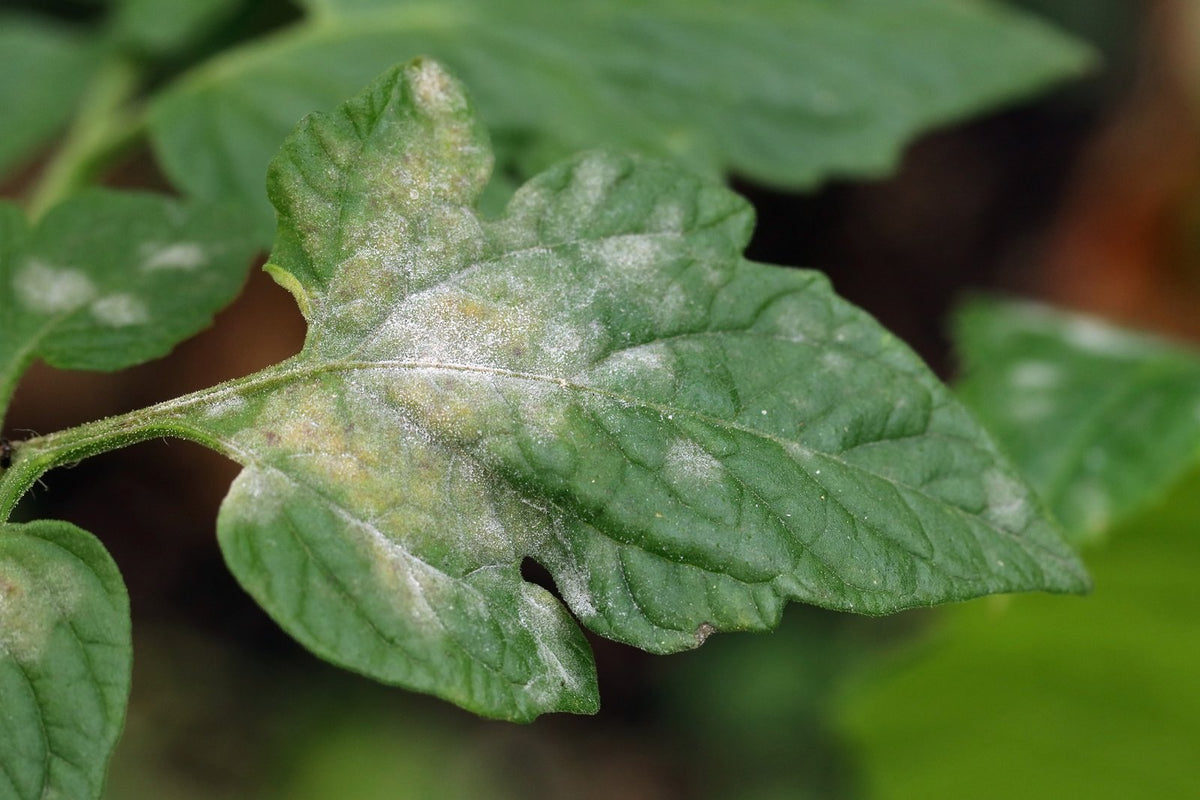
- Powdery mildew is a white powder on the upper surface, covered in our guide to powdery mildew and other common vegetable troubles.
Mottling and distortion: the virus group
Viruses cannot be cured, so the response is to remove and bin infected plants and to control what spreads them.
- Tomato spotted wilt virus causes bronzing, dark necrotic flecks and ringspots, tip dieback and downward cupping. It is spread by thrips, so managing thrips and weeds is the key.
- Mosaic viruses cause mottled light and dark green, distorted, fern-like leaves and stunting. They spread mechanically on hands and tools and by aphids, so hygiene and aphid control both help. See our guide to mosaic virus.
One useful caveat: tomato yellow leaf curl virus is believed to be exotic and not established here, so treat a curling leaf as a physiological issue first, covered below, rather than assuming a virus.
Yellowing, purpling and curling: the nutrient and environmental group
Not every off-colour leaf is a disease. Many are about feeding, weather or water.
- Magnesium deficiency shows as interveinal yellowing on the older, lower leaves, with the veins staying green, and is common in sandy soils and containers.
- Nitrogen deficiency shows as whole older leaves turning uniformly pale, oldest first, with spindly growth.
- Potassium deficiency scorches the margins of older leaves yellow then brown.
- Phosphorus shortage or cold soil tints leaves and stems purple, often on seedlings, and usually resolves as the soil warms.
- Physiological leaf roll is an upward, leathery roll of the lower leaves with no discolouration, caused by heat, water stress or heavy pruning, and is harmless and common in hot summers.
- Herbicide drift or contaminated manure or straw causes cupped, twisted, narrow, strappy new growth, so check any recent spraying or mulch.
Blossom end rot, a dark sunken patch on the base of the fruit, is a fruit disorder linked to calcium and uneven watering rather than a leaf disease, and it is covered in our common vegetable troubles guide.
Pests that show up on the leaves
- Whitefly are tiny white flies under the leaves with yellow mottling and honeydew, covered in our whitefly guide.
- Aphids cluster on new growth, curling and distorting it, and spread virus, covered in our aphids guide.
- Two-spotted mite makes fine pale stippling, bronzing and webbing in hot, dry spells, covered in our spider mites guide.
- Tomato potato psyllid causes yellowing, upward cupping and a waxy residue. It is established in Western Australia and has reached Victoria, though Australia remains free of the bacterium it can carry, so report suspected psyllid outside known areas.
Prevention that covers most of it
Almost all of the above is prevented by the same handful of habits.
- Choose resistant varieties, and rotate three to four years off tomatoes, potatoes, capsicums, chillies and eggplants.
- Mulch to stop soil splash, and water at the base early in the day, never over the leaves.
- Stake, space and prune the lower leaves for airflow.
- Remove and bin diseased material rather than composting it, and clean your tools and hands.
If you do use a copper spray, understand that it is protectant, not curative: it can help prevent new infection but will not cure existing lesions, and it should only be an APVMA-registered product used to the label.
Tomato leaf problems across Australia's climate zones
- Tropical (far north Queensland, the Northern Territory Top End, the Kimberley in Western Australia): heat and wet-season humidity give the worst fungal and bacterial pressure, so grow in the dry season.
- Subtropical (south-east Queensland, the northern New South Wales coast): humid summers favour fungal and bacterial disease and spotted wilt virus.
- Arid and semi-arid (inland New South Wales, Queensland, South Australia and Western Australia, central Northern Territory): dry heat means fewer leaf fungi but more spider mite and heat-driven leaf roll.
- Temperate (southern New South Wales, Victoria, coastal South Australia): the main summer crop, where early blight, septoria, spotted wilt and spider mite dominate.
- Cool and mountain (Tasmania, alpine Victoria and New South Wales, the highlands): cool, wet spells favour late blight and grey mould, in a shorter season.
- Mediterranean (south-west Western Australia, parts of South Australia): dry summers reduce leaf fungi, though the tomato potato psyllid is established in Western Australia.
Frequently asked questions
Are yellow lower leaves always a disease?
No. The oldest leaves naturally yellow and die as the plant ages, so check for a spot pattern or pests before assuming disease.
Can I compost diseased tomato leaves?
No. Bin diseased material rather than composting it, since many pathogens survive a home compost heap.
Will copper cure my blight?
No. Copper is protectant, applied early to prevent spread, so also remove affected leaves and improve airflow.
Do we get late blight in Australia?
Yes, but it is sporadic and localised, and it is a notifiable pest in Western Australia.
My new leaves are twisted and narrow. Is it a virus?
Often it is herbicide drift, contaminated manure or straw, or broad mite, rather than a virus, so check recent spraying and mulch first.
What is the tomato potato psyllid?
A sap-sucking pest established in Western Australia and recently found in Victoria. Report suspected finds, though Australia is still free of the bacterium it can carry.
Read the pattern before you reach for a spray, keep the plants open, mulched and base-watered, and most tomato leaf troubles never get a foothold.
Related growing guides
- Powdery mildew, blossom end rot and common vegetable troubles
- Mosaic virus
- Garden hygiene to reduce pests and disease
Ready to plant? Browse our vegetable seeds, including our wide range of tomatoes.