
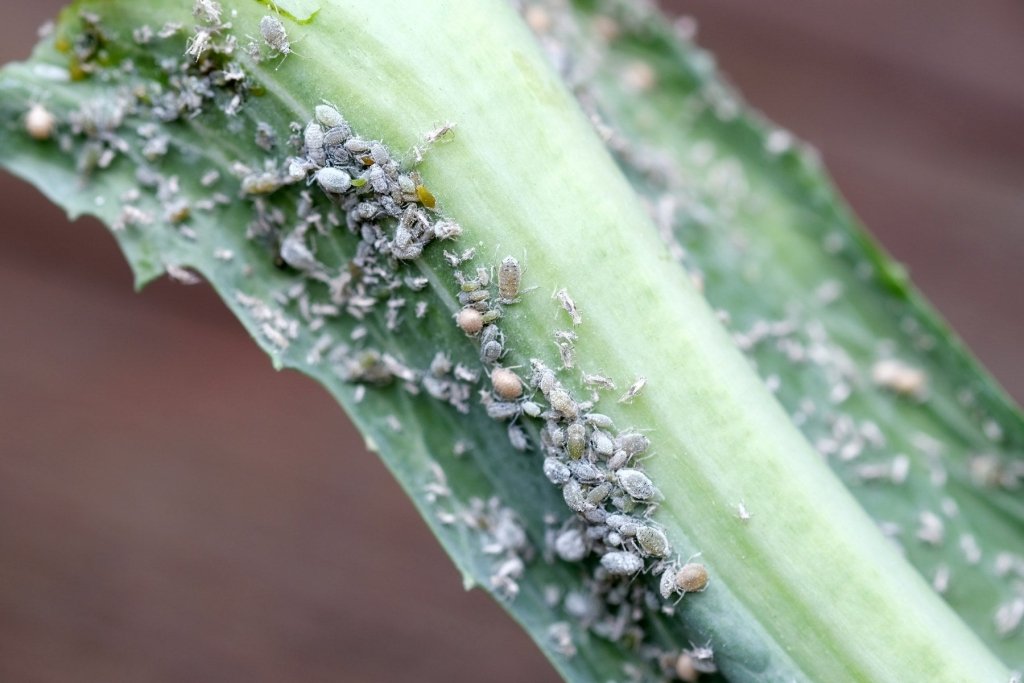

The short version: Aphids are small sap-sucking insects that cluster on soft new growth and under leaves, and they multiply quickly in warm spring weather. Most outbreaks clear with a firm jet of water, a soap or oil spray, and the ladybirds and lacewings that arrive to feed on them, so there is rarely any need for a harsh chemical. Keep an eye on new seedlings, and on the ants that farm and protect the colonies.
Few pests turn up as reliably as aphids. One week the broad beans look perfect, the next there is a grey crust of them on every tip and a line of ants running up the stem.
The good news is that aphids are among the easier pests to manage without much fuss. Understanding why they appear, and who eats them, does most of the work for you.
How to spot aphids

Aphids (superfamily Aphidoidea) are soft-bodied, pear-shaped insects a few millimetres long that gather in dense colonies on the most tender parts of a plant. They come in green, black, grey, yellow, pink and white, so colour alone is not a reliable guide.
The surest identifier is a pair of small tube-like projections, called cornicles, at the rear of the body. These set aphids apart from whitefly, which are pure white and rise in a cloud when disturbed, and from thrips, which are slender and leave silvery scarring rather than clustering.
Look for curling or distorted young leaves, sticky honeydew on the surfaces below a colony, and a black coating of sooty mould growing on that honeydew. A trail of ants moving up and down the stems is often the first clue to a colony you have not yet noticed.
Why they build up so quickly

Aphids multiply fast because the females give birth to live young without needing to mate, a strategy called parthenogenesis. Each daughter can already be carrying the next generation, so a handful of aphids can become a heavy infestation within a couple of weeks of warm weather.
When a colony gets crowded, winged aphids develop and fly off to start again on the next plant, which is how they arrive from a neighbour's garden or a patch of weeds. Warm spring growth, especially the soft growth pushed along by too much nitrogen, is exactly what they are looking for.
Two side effects matter as much as the feeding. The honeydew they excrete feeds sooty mould, which coats leaves and slows the plant down. And aphids can carry many plant viruses from plant to plant as they probe, which is the more serious long-term risk, particularly on cucurbits, beans and lettuce. Ants add to the trouble by farming aphids for their honeydew and driving off the predators that would otherwise clean them up, a relationship the Sustainable Gardening Australia guide to ants and aphids explains well.
How to control aphids organically

Start with the gentlest method and only step up if you need to. For most outbreaks the first two are enough.
- Knock them off with water. A firm jet from the hose, aimed under the leaves and at the shoot tips, dislodges most of a colony, and few aphids find their way back. Repeat every few days for a week or two to break the cycle, and go gently on soft seedlings.
- Spray insecticidal soap. Soap works on contact, so coat the undersides of the leaves where the aphids sit, and spray in the cool of the morning rather than in hot sun. Reapply every five to seven days until numbers drop.
- Use horticultural oil for stubborn colonies. A registered horticultural oil smothers aphids and can help on heavier infestations. Avoid spraying open flowers, and do not spray in extreme heat.
The real workhorses are the predators. Australian gardens already hold the common spotted ladybird (Harmonia conformis), the brown lacewing (Micromus tasmaniae) and tiny parasitic wasps such as Aphidius, whose larvae hollow the aphids out and leave papery brown mummies behind. Every harsh spray sets these helpers back, so the more you can lean on them, the less work there is for you. A short band of sticky material around a stem or trunk keeps the ants off and lets the predators back in.
How to prevent aphids
You will never keep aphids out entirely, but you can make the patch far less inviting.
- Go easy on high-nitrogen feeding, which pushes out the soft growth aphids love.
- Grow flowers among the vegetables. Alyssum, dill, yarrow and coriander left to flower feed the ladybirds, lacewings and hoverflies that keep aphids in check. Our guide to companion planting in Australia covers what really helps.
- Check new seedlings and transplants before they go in, since aphids often arrive on bought plants.
- Keep weeds such as sowthistle down, as aphid numbers build on them before moving across.
Aphids across Australia's climate zones
Aphids turn up everywhere, but the timing shifts with the climate.
- Tropical (Darwin, Cairns): active for most of the year, easing only in the wettest, hottest weeks.
- Subtropical (Brisbane, Coffs Harbour): strong pushes in spring and again in autumn.
- Arid and semi-arid (Alice Springs, Mildura): quieter overall, but an irrigated garden draws winged aphids in from the drier surrounds.
- Temperate (Sydney, Melbourne): the classic spring flush, roughly September to December, is the main event.
- Mediterranean (Perth, southern WA and Adelaide): numbers build through the mild, wet winter and into spring, then fall away as summer dries off.
- Cool and alpine (Tasmanian highlands, Canberra, the southern tablelands): a shorter season, mostly late spring into summer.
Frequently asked questions
Are aphids harmful to people?
No. Aphids do not bite or sting, and they carry no diseases that affect people. The honeydew they leave is sticky but harmless, and the sooty mould that grows on it is a surface fungus on the plant only.
Can I still eat vegetables that had aphids on them?
Yes. Wash produce under running water to shift any remaining aphids and honeydew, and soak leafy greens for a few minutes to float out the ones tucked into the folds. The vegetables are fine to eat once cleaned.
What is the best organic spray for aphids?
A simple insecticidal soap, sprayed straight onto the colonies and repeated every few days, is the most useful first spray. A registered horticultural oil is a good follow-up for heavier infestations. Both work best with thorough coverage of the leaf undersides.
Why are there so many ants on my plants?
Ants feed on the sugary honeydew that aphids produce, and in return they protect the colony from ladybirds and lacewings. Keeping ants off the plant with a sticky band lets the natural predators do their job.
Will aphids kill my plants?
Established plants rarely die from aphids alone, though a heavy infestation can stunt growth and distort leaves. Young seedlings are more vulnerable. The bigger long-term risk is the plant viruses aphids can spread as they feed.
How do I tell aphids from whitefly?
Whitefly are pure white and flutter up in a cloud when you disturb the plant. Aphids come in many colours, tend to stay put, and have the two small cornicles at the rear that whitefly lack.
Catch them early, back the predators that are already on your side, and aphids stay a minor and passing nuisance rather than a season-long battle.
Related growing guides
- Organic pest control in Australia
- What is actually in a beneficial bug mix
- Powdery mildew, blossom end rot and other common vegetable troubles
Ready to plant? Browse our vegetable seeds, and the flower seeds that bring the aphid-eaters in.