
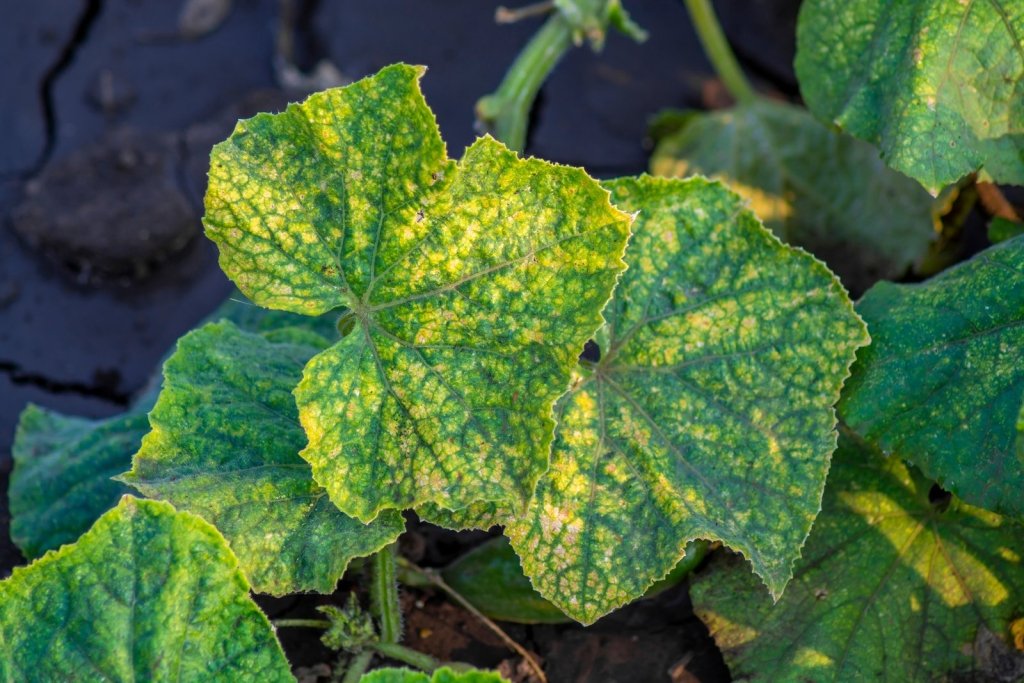
The short version: Mosaic virus is not one disease but a group of plant viruses that leave a mottled light and dark green or yellow pattern on the leaves, along with distortion and stunting. There is no cure once a plant is infected, so the answer is prevention: remove and destroy affected plants, control the aphids and weeds that spread it, keep hands and tools clean, and start with resistant varieties and clean seed. The fruit is still safe to eat, even if it looks mottled or misshapen.
Mosaic virus is one of the more unsettling problems to find, partly because there is nothing to spray and no quick fix. A cucumber or zucchini leaf turns strangely patchy, the new growth puckers, and the fruit comes out warty and small.
The good news is that it is largely preventable once you understand how it moves, and a few simple habits keep it from spreading through the patch.
What mosaic virus is
Mosaic virus is a family of unrelated plant viruses named for the mottled pattern they leave on foliage, and none of them can be cured once a plant is infected. A handful turn up often enough for home gardeners to meet by name.
Cucumber mosaic virus (CMV) has the widest host range of any known plant virus. Tobacco mosaic virus and tomato mosaic virus (TMV and ToMV) are very stable, spread by contact, and can persist for a long time on surfaces and in debris. Zucchini yellow mosaic virus and other cucurbit mosaics hit the pumpkin family, and bean common mosaic virus affects beans.
How to recognise it
The signature is a patchy mottle of light and dark green, or yellow, on the leaves, usually worst on the newest growth. Alongside it you often see leaf distortion, curling, puckering or blistering, and overall stunting of the plant. The fruit can be mottled, misshapen or warty, which is a classic look on zucchini and pumpkin, and infected tomatoes can carry sunken brown patches under the skin.
Two look-alikes are worth ruling out. A nutrient deficiency tends to yellow the leaf more evenly, often following the veins, and improves when you feed the plant. Herbicide drift causes twisting and cupping, usually across several plants at once. Mosaic patterning is irregular and sharply two-toned, and feeding will not shift it.
Which crops are affected
Mosaic viruses turn up on cucurbits such as cucumber, zucchini, pumpkin, squash and melon, on tomato, capsicum and chilli, on beans and other legumes, and on lettuce, spinach and silverbeet, as well as many ornamentals. Weeds are important reservoirs that carry the viruses over between crops, which is one reason a weedy patch stays at higher risk.
How it spreads
Different mosaics travel in different ways, and knowing which is which shapes how you respond.
- Aphids carry CMV and the cucurbit mosaics from plant to plant, picking them up and passing them on within minutes, so controlling aphids and weeds is central. Our guide to aphids covers keeping them down.
- Contact spreads the very stable TMV and ToMV, on hands, tools, clothing and in plant debris. Tobacco products can carry tobacco mosaic virus, so do not smoke or handle tobacco around tomatoes, capsicums or other members of that family.
- Seed can carry several mosaics, which is why clean, fresh seed matters.
How to manage it
Since there is no cure, management is about removing sources and cutting the spread. No spray, tonic or biological product will cure an infected plant, so do not waste money chasing one.
- Remove and destroy infected plants promptly. Bin or burn them where that is allowed, and do not put them in a home compost heap.
- Control aphids and keep the bed weed-free to strip out the reservoirs the viruses live in.
- Wash your hands and disinfect tools with methylated spirits between plants, and avoid handling plants when they are wet.
- Start clean and stay clean: buy fresh seed, choose resistant varieties where they are offered, and keep tobacco away from your solanums.
Sustainable Gardening Australia's guidance on plant virus control makes the same point, that hygiene and resistant varieties do the heavy lifting once a virus is about.
Mosaic virus across Australia's climate zones
Because aphids drive most of the spread, the risk follows aphid pressure through the seasons.
- Tropical (Darwin, Cairns): aphids are active all year, so both the wet-season flush and dry-season plant stress can spread virus.
- Subtropical (Brisbane, northern NSW): near year-round aphid activity, with the late-winter to spring flush worth watching.
- Arid and semi-arid (Alice Springs, Mildura): winged aphids arrive after rain or under irrigation, and weeds bridge the dry spells.
- Temperate (Sydney, Melbourne, Canberra): the main aphid peaks come in spring and in a mild autumn, so time plantings and remove infected plants accordingly.
- Mediterranean (Perth, southern WA and Adelaide): aphids build through the mild, wet winter into spring, then summer heat suppresses them, with green weeds the key reservoir.
- Cool and alpine (Tasmanian highlands, the tablelands): cold winters knock aphids back, so the aphid-spread risk is a shorter late-spring to summer window, though the contact viruses still spread by hand whatever the temperature.
Frequently asked questions
Can I eat fruit from an infected plant?
Yes. These viruses do not affect people, so the fruit is safe to eat, though it may be smaller, mottled or misshapen, and the overall yield usually drops.
Will it spread to my other plants?
Yes, readily, by aphids in the case of cucumber and cucurbit mosaics, or by touch, tools and hands for the tomato and tobacco mosaics. Remove infected plants early, since there is no cure.
Is the soil contaminated?
The aphid-spread mosaics are not soil-borne. The tomato and tobacco mosaics are not true soil dwellers either, but they are so stable that they persist in root and plant debris and on surfaces, so clear all debris before replanting.
Can I save seed from an infected plant?
No. Several mosaics are carried on seed, so start again with fresh, clean seed rather than risk passing the virus on.
Can I compost infected plants?
It is better not to. A home compost heap rarely runs hot enough to reliably kill stable viruses or the infected root and weed debris, so bin or burn the material instead.
Do resistant varieties help?
Yes, they are one of the most reliable tools, particularly for the cucurbit and bean mosaics and tomato mosaic. It is worth checking the variety description before you buy.
You cannot cure a mosaic virus, but you can stop it in its tracks: pull the affected plants, keep the aphids and weeds down, and start each season with clean seed and clean hands.
Related growing guides
- Aphids: how to spot, control and prevent them
- Powdery mildew, blossom end rot and other common vegetable troubles
- Organic pest control in Australia
Ready to plant? Browse our cucumber seeds, zucchini seeds and tomato seeds.