
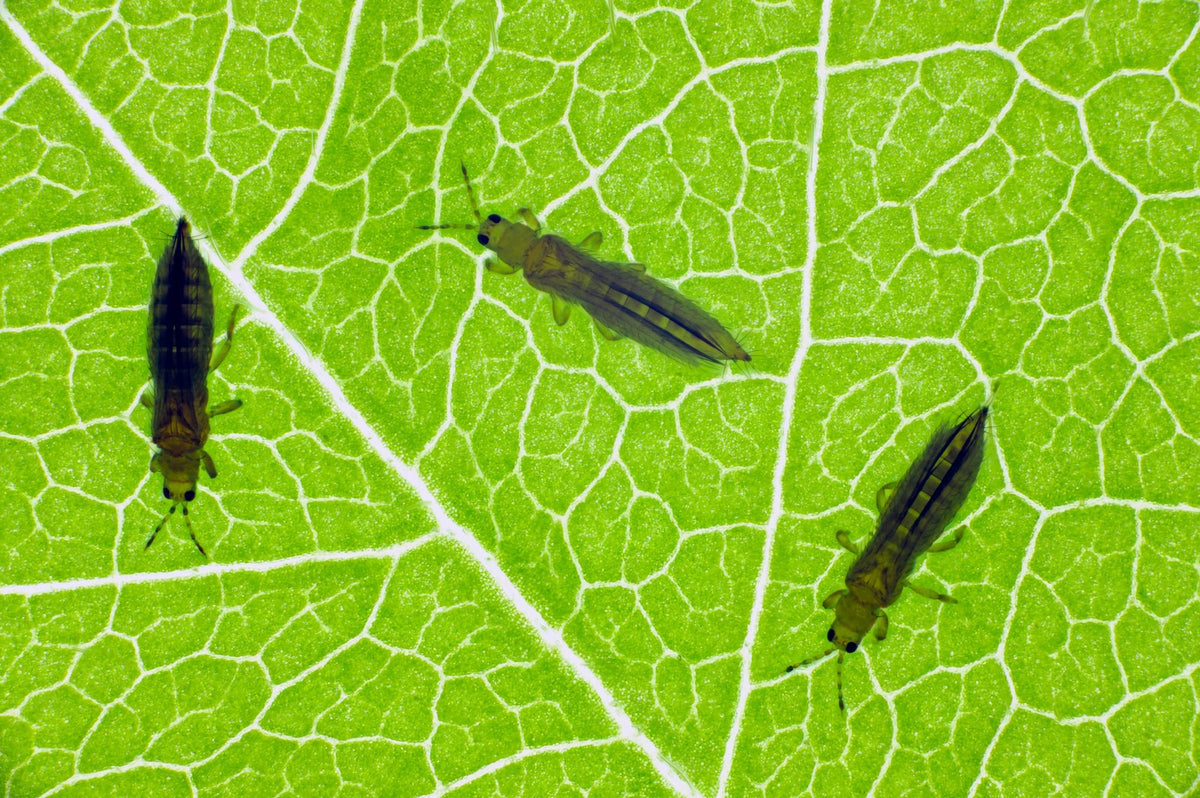
The short version: Thrips are tiny, slender insects that rasp at leaves and flowers, leaving silvery streaks and stippling, tiny black specks of droppings, and distorted new growth. Most outbreaks ease with good hygiene, blue sticky traps, reflective mulch and the predators that arrive to feed on them, so reach for a harsh spray only as a last resort. The bigger worry is that some thrips spread tomato spotted wilt virus, which has no cure once a plant is infected.
Thrips are easy to miss until the damage shows. By the time leaves look silvered and flowers come out flecked and deformed, the insects doing it are barely a millimetre long and tucked deep in the buds.
The word is both singular and plural, so it is one thrips and many thrips. Getting to know the signs early is the difference between a passing blemish and a virus problem.
How to spot thrips
Thrips (order Thysanoptera) are very small and slender, roughly a millimetre long, and range from pale yellow-orange to grey-black. Their rasping, sucking mouthparts rupture the surface cells of leaves and petals, which then reflect the light as silvery or whitish streaking and stippling. Later that damage turns bronzed and scarred, and new growth comes through puckered and distorted.
Look for tiny black specks of frass, or droppings, which show up clearly on pale flowers. The key way to tell thrips from spider mites is the webbing: thrips leave black frass and no webbing, while two-spotted mites leave fine webbing along with yellow mottling.
Which thrips you are likely to meet
Most of the thousands of thrips species are harmless, but a few matter in the garden. Plague thrips (Thrips imaginis) is a native and the most common in spring. Western flower thrips (Frankliniella occidentalis) is an introduced species, now found nationwide, and it is the major pest, partly because it resists many insecticides. Onion thrips and tomato thrips turn up as well.
The reason to take western flower thrips seriously is disease. Several thrips species transmit tomato spotted wilt virus as they feed, and there is no cure once a plant is infected. That is why prevention and removing infected plants matter more than any spray.
How to control thrips organically
Start with monitoring and cultural steps, which do most of the work.
- Hang blue sticky traps. Thrips are drawn to blue more strongly than to yellow, so blue traps both monitor and catch them. Yellow traps still help.
- Lay reflective mulch. A silver or reflective mulch confuses thrips looking for a place to land and can noticeably reduce numbers on low crops.
- Keep the area clean. Remove weeds, spent flowers and self-sown plants that harbour thrips, and avoid pushing soft growth with too much nitrogen.
- Spray oil or soap if needed. Horticultural oil or insecticidal soap can knock numbers back, but only with thorough coverage into the buds and leaf undersides where thrips shelter, and repeated.
The predators are worth protecting. Predatory mites, lacewings, ladybirds, predatory thrips and the fungus Beauveria bassiana all help keep numbers down. The trap to avoid is the broad-spectrum insecticide: western flower thrips resists many chemicals, and a broad spray usually makes things worse by killing the natural enemies and selecting for resistance. If you do reach for a spray, use only a product registered for home garden use in Australia.
How to prevent thrips trouble
- Pull out and bin, rather than compost, any plant you suspect has tomato spotted wilt virus.
- Keep weeds down, since thrips build up on them before moving across to your crops.
- Water and feed steadily, because stressed and over-fed plants both attract more thrips.
- Check bought seedlings before planting, as thrips travel in on new plants.
Thrips across Australia's climate zones
- Tropical (far north Queensland and the Northern Territory Top End, including Cairns and Darwin): year-round warmth means continuous breeding, so watch for melon thrips and the viruses they carry.
- Subtropical (Brisbane and northern New South Wales): a long warm season brings sustained pressure from western flower thrips and virus.
- Arid and semi-arid (inland New South Wales, South Australia and Western Australia, and the Northern Territory around Alice Springs): hot dry conditions suit thrips, and an irrigated garden acts as a green refuge that draws them in on the wind.
- Temperate (New South Wales, Victoria and the ACT, including Sydney, Melbourne and Canberra): the main flush runs spring into summer, with plague thrips peaking at flowering.
- Mediterranean (Perth and southern Western Australia, and Adelaide in South Australia): hot dry summers are ideal, and western flower thrips is well established, with a spring influx off drying pasture.
- Cool and alpine (Tasmania, the highlands): a shorter season and fewer generations, and the cool-preferring predatory mites suit these areas well.
Frequently asked questions
Is it thrips or spider mite?
Both cause fine pale stippling, but thrips leave tiny black specks of frass and no webbing, while spider mites leave fine webbing and yellow mottling on the leaf undersides.
Do thrips spread plant viruses?
Yes. Several species carry tomato spotted wilt virus, spread mainly by western flower thrips, and there is no cure once a plant is infected, so remove infected plants promptly.
What causes the silvery streaks on my leaves?
Thrips rasp and suck out the contents of the surface cells, and the emptied cells reflect light, which reads as a silvery sheen.
Do thrips bite people?
They can give a harmless nip that feels like a brief prickle, but they carry no human disease and are only a nuisance.
What is the best organic control for thrips?
A combination works best: blue sticky traps, reflective mulch, weed hygiene, oil or soap sprays and predatory mites, rather than relying on any one method.
Why can spraying make thrips worse?
Broad-spectrum sprays kill the predators that keep thrips down and drive resistance in western flower thrips, so populations rebound stronger than before.
Catch them at the trap-and-tidy stage, protect the predators, and remove any virus-struck plant early, and thrips are far more likely to stay a cosmetic nuisance than become a season-ending problem.
Related growing guides
- Spider mites and how to tell them apart
- Mosaic virus and other plant viruses
- Organic pest control in Australia
Ready to plant? Browse our vegetable seeds, and the flower seeds that bring the good bugs in.