
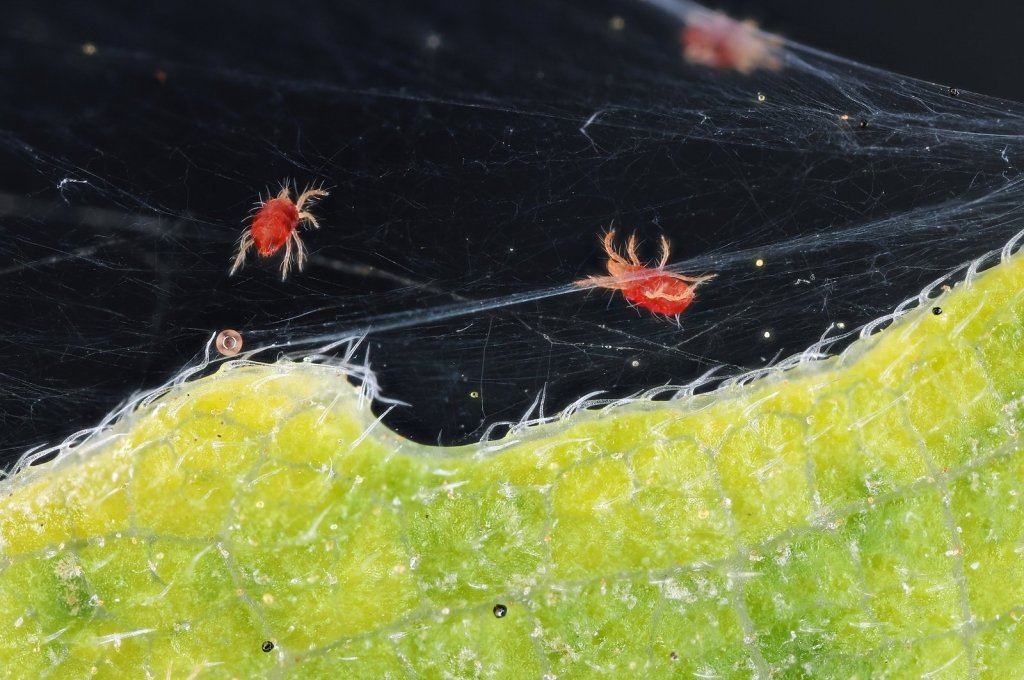
The short version: Spider mites, usually the two-spotted mite, show up as fine pale speckling on leaves in hot, dry, dusty weather, with fine webbing on the undersides once numbers get high. They are mites, not insects, so keeping plants well-watered and unstressed, hosing the undersides, and using horticultural oil or soap works far better than a general insecticide. In fact, broad-spectrum sprays often make an outbreak worse by killing the mites' natural predators.
Spider mites have a way of appearing out of nowhere. A plant looks a little dull and dusty one week, then bronzed and failing the next, and only under a hand lens do you find what has been at work.
They thrive on heat, dust and stressed plants, which is the clue to keeping them in check.
How to spot spider mites
The first sign is fine, pale stippling on the leaves, a scatter of tiny yellow or white speckles, which spreads until the leaf yellows, then bronzes, then drops. In a bad infestation you will see fine webbing on the undersides of the leaves, which is where the name comes from.
The mites themselves are under half a millimetre across, so a hand lens helps. The two-spotted mite (Tetranychus urticae) is translucent to greenish with two dark spots, and it clusters on the leaf undersides. A quick way to confirm them is the paper test: hold a sheet of white paper under a leaf and tap it, and any mites fall as slow-moving specks. Smear them, and mites leave a faint greenish or reddish streak.
They are worth telling apart from look-alikes. Thrips leave silvery scarring with tiny black specks of frass but no webbing, and lace bugs cause similar stippling but leave dark droppings under the leaf. On tomatoes, the separate tomato russet mite causes a bronzing that starts low on the plant.
Why they explode in the heat
Spider mites are arachnids, relatives of spiders, rather than insects, which is why many insect sprays do little to them. They breed fastest in hot, dry, dusty, low-humidity conditions, and in real heat a generation can complete in a bit over a week, so numbers go from invisible to serious very quickly.
Two things reliably tip a garden into an outbreak: drought-stressed, dusty plants, and a spray that has wiped out the mites' natural predators. Keeping plants healthy and unstressed is genuinely the first line of defence, not an afterthought.
How to control spider mites organically
The approach is to lift the plant's condition and the humidity around it, then treat directly if you need to.
- Keep plants watered and unstressed, and cut the dust. Mites love a dry, dusty leaf, so steady watering and a rinse of dusty foliage make the plant a poorer host. Our guide to water-wise gardening covers keeping plants unstressed through a dry spell.
- Hose the undersides of the leaves. A firm jet aimed underneath, ideally three mornings running, knocks mites off and raises the humidity they dislike. This alone often clears a light infestation.
- Prune out and bin badly affected leaves to take out the worst of the colony.
- Spray horticultural oil or insecticidal soap for heavier outbreaks. Coat the undersides thoroughly, apply in the cool of the day rather than above about 30 degrees, and avoid stressed plants, or the spray can burn. Repeat every five to seven days. Wettable sulphur also works, but only in cool weather.
The predators matter as much here as with any pest. Predatory mites such as Phytoseiulus persimilis, sold by Australian suppliers, are the standard biological control, and resident helpers do a lot when you leave them be. The single most important thing to avoid is a broad-spectrum insecticide: it kills the predators that hold mites down, and some sprays even stimulate mite breeding, so the outbreak rebounds harder than before. The Queensland Government guide to two-spotted mite makes the same point about spraying and resistance.
Spider mites across Australia's climate zones
The risk tracks heat and dryness, so it is highest where summers are hot and dry.
- Tropical (Darwin, Cairns): wet-season humidity holds outdoor outbreaks down, so watch the dry season and plants under cover.
- Subtropical (Brisbane, northern NSW): flares in hot, dry spells and in dusty or sheltered spots.
- Arid and semi-arid (Alice Springs, Mildura): high risk, since hot, dry, dusty conditions are ideal for them.
- Temperate (Sydney, Melbourne, Canberra): the main risk comes in hot, dry summer spells.
- Mediterranean (Perth, southern WA and Adelaide): high risk through the hot, dry summers.
- Cool and alpine (Tasmanian highlands, the tablelands): the lowest outdoor risk, mainly in warm summer periods and in greenhouses.
Frequently asked questions
Are spider mites the same as spiders?
No. They are tiny plant-feeding mites, related to spiders as fellow arachnids but not spiders themselves. The name comes from the fine webbing they spin, not from being spiders.
Why did they suddenly explode?
Hot, dry, dusty weather lets them breed within days, so numbers can go from unnoticed to serious in a week or two. Drought-stressed plants and a spray that killed their predators both speed it up.
Does spraying insecticide make it worse?
Often, yes. Broad-spectrum insecticides kill the natural predators that keep mites in check, and some can even boost mite breeding, so the outbreak comes back harder. Oils, soaps and predators are the better path.
How do I know it is mites and not something else?
Check the leaf undersides with a hand lens for moving specks and fine webbing, and do the white-paper tap test. Webbing rules out thrips, while upper-leaf stippling with dark droppings underneath points to lace bug instead.
Will hosing really help?
Yes, for light infestations. A firm jet to the undersides on several mornings in a row knocks mites off and lifts the humidity, which they dislike. It also washes off the dust they thrive in.
Are the sprays safe for food crops and bees?
Horticultural oil, insecticidal soap and wettable sulphur are the low-toxicity choices. Follow the label withholding period, spray in the cool of the day, and keep spray off open flowers while bees are about.
Keep the plants watered, the leaves rinsed and the predators alive, and spider mites rarely get the chance to take hold.
Related growing guides
- Organic pest control in Australia
- Water-wise gardening in a dry climate
- What is actually in a beneficial bug mix
Ready to plant? Browse our bean seeds, tomato seeds and strawberry seeds.