
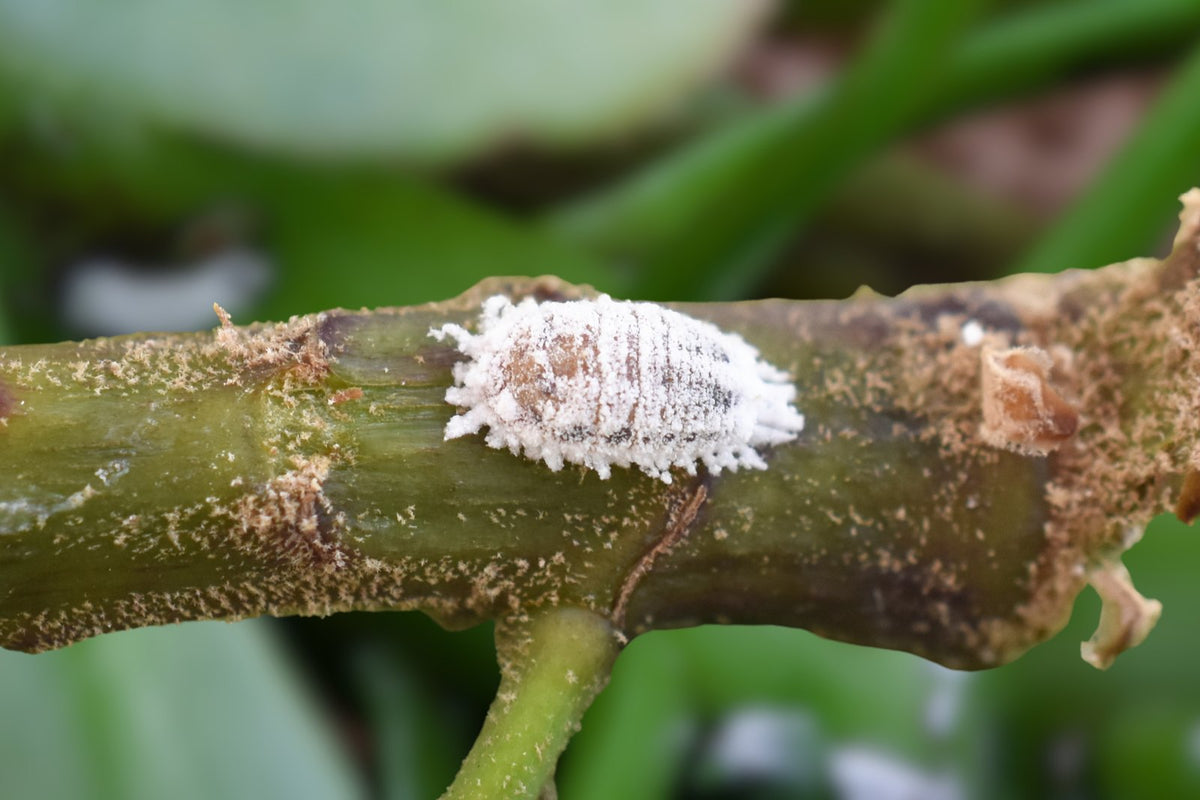
The short version: Mealybugs are soft, sap-sucking insects that look like small blobs of white cotton wool tucked into leaf joints, stems and the undersides of leaves. They breed fast and are stubborn, so persistence is the key: dab colonies with methylated spirits, spray horticultural oil or soap with thorough coverage, keep ants off, and bring in the mealybug ladybird and parasitic wasps that feed on them. They are a very common problem on indoor plants, and a regular one on citrus and orchids too.
Mealybugs are one of those pests that seem to appear from nowhere, especially on pot plants and citrus. A few white specks in a leaf axil can build into a cottony crust, and the leaves start to yellow and drop.
They are close relatives of scale, and like scale they reward patience. One treatment is rarely enough, but a steady hand clears them.
How to spot mealybugs
Mealybugs are soft, oval, sap-sucking insects a few millimetres long, coated in a white mealy or cottony wax. The long-tailed kinds carry tail-like waxy filaments. They gather in sheltered spots: leaf axils, the joints of stems and leaves, leaf undersides, under the calyx of fruit, and even on roots and in potting mix.
The tell-tale signs are the sticky honeydew they excrete, the black sooty mould that grows on it, and the ants that come for the honeydew. Heavy feeding shows as wilting, yellowing, stunted or distorted growth, tip dieback and premature leaf drop. It is easy to confuse mealybugs with woolly aphids, which are pear-shaped and sit on woody stems and roots, and with scale, which settles as fixed hard or soft bumps.
Why they are so persistent
A female mealybug lays her eggs in a protective sac of cottony wax, and some kinds bear live young instead. The mobile young, called crawlers, spread the infestation from plant to plant. With several overlapping generations through a warm season, and even faster breeding indoors and in a glasshouse, numbers build quickly.
That waxy coat is what makes them hard to shift, because it repels water and many sprays. They also travel readily on new plants, tools, hands and clothing, and ants farm and protect them just as they do scale and aphids. This is why isolating a new or infested plant and dealing with the ants both make a real difference.
How to control mealybugs organically
- Dab colonies with methylated spirits. A cotton bud dipped in metho, touched onto each cluster, strips the wax and dehydrates them. It is ideal for spot-treating pot plants and orchids. A diluted metho spray works too, but test it first, as too strong a mix can scorch leaves.
- Spray oil or soap, thoroughly. Horticultural or white oil and insecticidal soap both help, but only with complete coverage, since the wax protects any insect you miss. Repeat, and a strong jet of water helps dislodge them first.
- Prune and isolate. Cut off and bag badly infested parts, and keep any new or affected plant away from the rest until it is clean.
- Keep the ants off. A sticky band on the stem stops ants protecting the colony, so the predators can get to work.
The biological helpers are excellent here. The mealybug ladybird (Cryptolaemus montrouzieri), a native beetle whose fluffy white larvae are often mistaken for mealybugs themselves, eats them at every stage, and parasitic wasps such as Leptomastix dactylopii target citrus mealybug. Both are sold by Australian beneficial-insect suppliers. Because broad-spectrum sprays kill these allies, avoid them. For root mealybugs in a pot, rinse the roots, discard the old mix, repot into fresh mix and sterilise the pot.
How to keep mealybugs down
- Inspect new plants closely, including leaf joints and roots, and isolate them before adding them to a collection.
- Check the sheltered spots on citrus and indoor plants regularly, so you catch a colony while it is small.
- Keep ants in check, since they shield mealybugs from predators.
- Keep plants healthy, but avoid lush, over-fed growth, which sap-suckers favour.
Mealybugs across Australia's climate zones
- Tropical (far north Queensland and the Northern Territory Top End, including Cairns and Darwin): warm and humid year round, so breeding is near continuous and pressure is high.
- Subtropical (Brisbane and northern New South Wales): populations build fast from spring to autumn, and mild winters help them survive.
- Arid and semi-arid (the Riverland in South Australia, Sunraysia in Victoria and New South Wales, and the New South Wales Riverina): they thrive in sheltered, irrigated citrus and vines despite the dry air.
- Temperate (New South Wales, Victoria and the ACT, including Sydney, Melbourne and Canberra): mainly a spring to autumn problem outdoors, overwintering in sheltered spots, and a major pest of indoor plants.
- Mediterranean (Perth and southern Western Australia, and Adelaide in South Australia): a long, warm, dry season sustains pressure on citrus, vines and ornamentals.
- Cool and alpine (the Tasmanian highlands, alpine areas): the lowest outdoor pressure, as cold limits the number of generations. Indoors, they breed year round in every zone.
Frequently asked questions
What is the white cottony stuff on my plant?
It is the waxy coating mealybugs secrete over themselves and their eggs. Underneath the fluff are the soft, oval insects.
How does the methylated spirits method work?
Touching each insect with an alcohol-dipped cotton bud strips its protective wax and dries it out. Spot-treat the colonies and then check again the following week.
How do I tell a mealybug from a woolly aphid or scale?
Mealybugs are soft, oval, mobile and powdery-waxy. Woolly aphids are pear-shaped with small tail tubes and sit on woody stems and roots, and scale settles as fixed hard or soft bumps.
Will they spread to my other plants?
Yes, easily, through the mobile crawlers, touching foliage and shared tools, so isolate an infested plant while you clear it.
What is the mealybug ladybird?
Cryptolaemus montrouzieri is a native beetle whose larvae and adults eat mealybug eggs, young and adults. The larvae wear a white waxy coat, so do not mistake them for the pest.
There are mealybugs on the roots in my pot. What do I do?
Unpot the plant, rinse the roots clean, repot into fresh mix, sterilise the pot, and keep the plant isolated until you are sure it is clear.
Treat little and often, back the mealybug ladybird, and keep the ants at bay, and even a stubborn infestation should ease.
Related growing guides
Ready to plant? Browse our vegetable seeds, and the flower seeds that bring the good bugs in.