
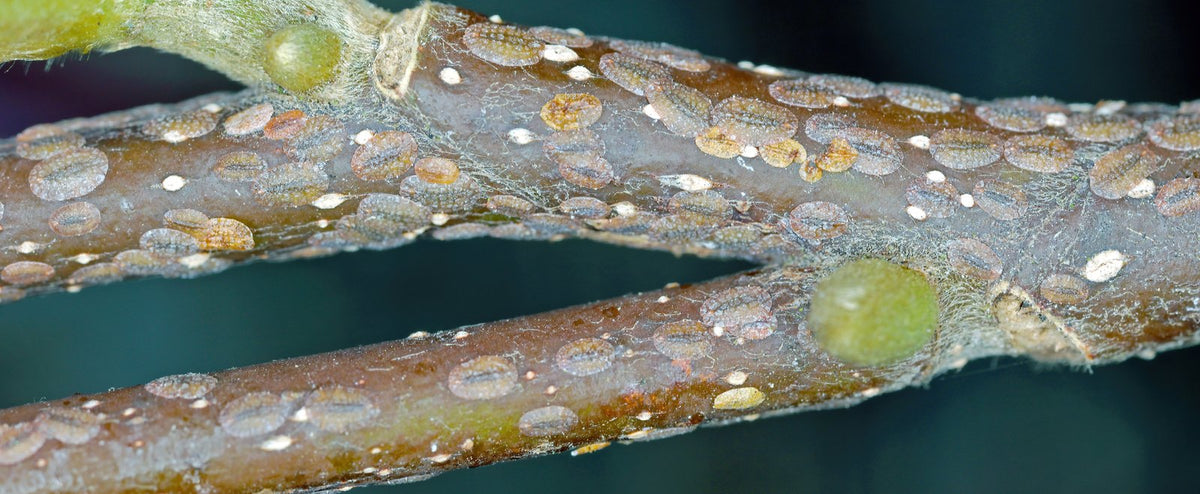
The short version: Scale insects are sap-suckers that sit still on stems and leaves like small fixed bumps or discs, so they are easy to mistake for part of the plant. The soft kinds also drip sticky honeydew that grows black sooty mould and draws ants. The reliable approach is to prune out the worst, wipe or spray horticultural oil timed to the mobile crawler stage, keep ants off so predators can work, and lean on the ladybirds and parasitic wasps that feed on scale.
Scale can go unnoticed for a while because it does not look like an insect. What catches the eye first is often the sticky sheen on the leaves below, or the ants running up and down the stems.
Once you know what to look for, scale is manageable, and the timing of one well-aimed oil spray matters more than how often you spray.
How to spot scale insects
Scale insects are sap-sucking bugs, and there are hundreds of species in Australia. They appear as immobile bumps or discs, usually one to five millimetres across, clustered on stems, leaf undersides, leaf joints and fruit. They are very common on citrus and on woody ornamentals.
It helps to know which of two groups you have. Soft scale keep their waxy cover attached to the body and excrete sticky honeydew, so you see the honeydew, the black sooty mould that grows on it, and ant activity. Armoured, or hard, scale sit under a separate waxy cover that lifts off, make no honeydew, and instead show as yellow spots and general decline. Either way, the stage that matters for control is the crawler, the tiny mobile newly hatched young, which is the only stage without the protective cover.
Why scale builds up
Crawlers hatch, walk a short way, settle at a feeding spot, secrete their cover and then stay put for life. They spread on the wind, on ants and birds, and on plants you move around the garden. In warm districts there are often two or more overlapping generations through the season, which is why numbers can climb steadily if nothing eats them.
Two things make an infestation worse. Ants farm soft scale for honeydew and drive off the predators that would otherwise clean them up, and a coating of dust suppresses those same natural enemies. Sort out the ants and hose off the dust, and the balance often tips back in your favour.
How to control scale insects organically
- Prune out the worst. Cut off and bin heavily encrusted wood, and on a small plant simply wipe or brush the scale off with a soft cloth or brush.
- Use horticultural oil, timed to the crawlers. A horticultural or white oil smothers scale, so it needs thorough coverage including the leaf undersides, and it works best sprayed when crawlers are about. Do not spray in extreme heat, above about 30 degrees, or on a stressed plant.
- Keep the ants off. A sticky or grease band around the trunk stops ants reaching the colony, which lets the predators and parasites back in.
- Back the natural enemies. Ladybirds, tiny parasitoid wasps and lacewings all feed on scale, and some scale is largely kept in check by them, so avoid the broad-spectrum sprays that wipe them out.
Australian gardens hold some notable helpers, including the Aphytis wasps that parasitise citrus red scale and the vedalia ladybird (Rodolia cardinalis) that made its name controlling cottony cushion scale. Every harsh spray sets these workers back, so the more you can rely on them, the less scale you will see.
How to keep scale down
- Check new growth and the undersides of leaves regularly, especially on citrus, so you catch a colony while it is small.
- Inspect and isolate new plants before adding them, since scale often arrives on bought stock.
- Hose dust off foliage in dry, dusty spots to keep the predators working.
- Keep plants healthy and well watered, as vigorous plants shrug off light infestations.
Scale insects across Australia's climate zones
- Tropical (far north Queensland and the Northern Territory Top End, including Cairns and Darwin): warmth and humidity allow near year-round breeding and heavy sooty mould, so treat crawlers whenever they appear.
- Subtropical (Brisbane and northern New South Wales): a long warm season and multiple generations, so keep ants down and check new growth often.
- Arid and semi-arid (inland New South Wales, South Australia and Western Australia, and the Northern Territory around Alice Springs): dust suppresses predators, so hose foliage clean and watch irrigated citrus.
- Temperate (New South Wales, Victoria and the ACT, including Sydney, Melbourne and Canberra): usually spring and summer crawler flushes, so time your oil then.
- Mediterranean (Perth and southern Western Australia, and Adelaide in South Australia): hot dry summers mean it is best to treat in spring and autumn, not in the summer heat.
- Cool and alpine (Tasmania, the highlands): fewer generations, with scale overwintering and the main crawler emergence from late spring.
Frequently asked questions
What is the difference between soft and hard scale?
Soft scale makes sticky honeydew and its cover is attached to the body. Armoured, or hard, scale makes no honeydew and sits under a separate waxy shield that lifts away.
What is the sticky stuff and black coating on my plant?
The sticky film is honeydew excreted by soft scale, and the black coating is sooty mould, a surface fungus that grows on the honeydew and blocks light from the leaf.
Why should I control the ants?
Ants farm scale for honeydew and chase off the ladybirds and wasps that eat it, so banding the trunk to keep ants off lets those predators cut scale numbers for you.
When and how do I use white oil on scale?
Spray at the crawler stage for full coverage including the leaf undersides, on a mild day, and never in extreme heat or on a stressed plant.
Will scale spread to my other plants?
Yes. Crawlers travel on the wind, on ants and birds, and on handled or moved plants, so isolate an infested plant and prune out the worst of it.
Is scale on citrus a real problem?
Heavy infestations can cause leaf and fruit drop and coat a tree in sooty mould, and they can set back a young tree, though light levels do little harm.
Time one good oil spray to the crawlers, keep the ants off, and leave the predators to it, and scale usually settles back into the background where it belongs.
Related growing guides
Ready to plant? Browse our vegetable seeds, and the flower seeds that bring the scale-eaters in.