


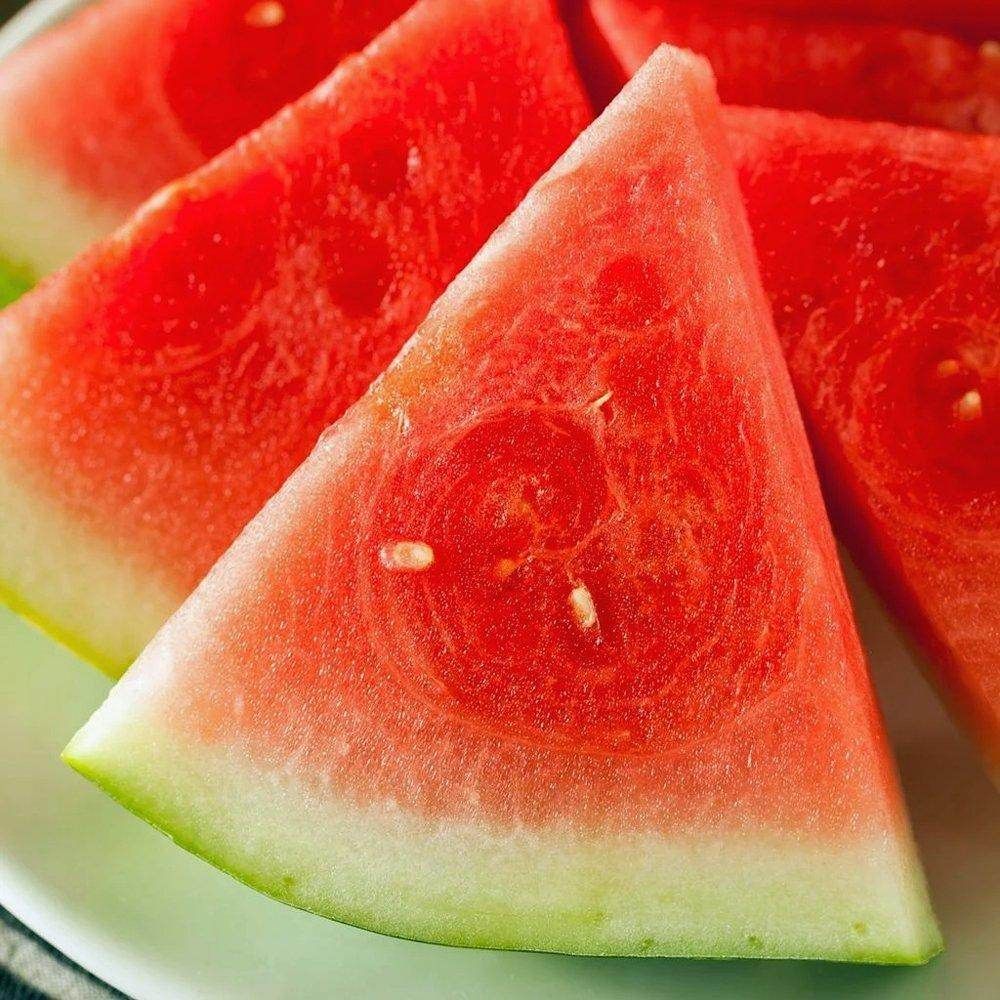
Watermelon Seedless F1 seeds
Citrullus lanatus
3.646 reviewsA seedless F1 hybrid watermelon: a triploid whose fruit holds soft white seed coats, eaten with the flesh, in place of hard seeds.
| How it grows | |
|---|---|
| Seed |
Hybrid. A cross of two selected parent plants, often labelled F1, bred for traits such as vigour or an even crop. Seed you save will not grow true to the parent.
See all hybrid vegetables seedsTreated seed. Given a protective treatment before packing, usually a fungicide. Do not eat the seed or feed it to animals or birds. Keep it away from children and pets, and wear gloves when handling or sowing it.
See all treated seedsPrompt dispatch from Sydney. Postage costs and delivery times
What to expect from Seedless F1
This is a seedless watermelon, an F1 hybrid of the type called a triploid. Every seedless watermelon is a hybrid, bred by crossing a line that carries four sets of chromosomes, used as the mother, with an ordinary watermelon line that carries two. Each plant of the cross carries three sets. The plant is a trailing vine.
With an odd number of chromosome sets, the plant is largely sterile and seldom makes mature seed. The fruit holds small white seed coats from seeds that never fully formed, in place of the hard-coated seeds of a seeded watermelon. These seed coats are soft and are eaten along with the flesh. Seedless is not absolute: a few hard seeds can still form in some fruit.
Seedless watermelons go back to Japan, where the scientist Hitoshi Kihara began the work behind them in 1939.
In the packet: seed of a seeded watermelon variety as well as the seedless seed, because seedless plants make little or no viable pollen of their own.
When to sow Watermelon Seedless F1 seeds
Sowing months for Seedless F1 in each of the six climate zones.
- Tropical: sow April to August
- Subtropical: sow August to December
- Arid and semi‑arid: sow September to December
- Temperate: sow October to December
- Mediterranean: sow September to December
- Cool and alpine: sow October to November
Every zone in words
| Zone | Sow | Pick |
|---|---|---|
| TropicalDarwin, Katherine NT; Cairns, Townsville QLD; Broome WA | Apr to Aug | Jul to Nov |
| SubtropicalBrisbane, Gold Coast, Bundaberg QLD; Coffs Harbour, Lismore NSW | Aug to Dec | Nov to Mar |
| Arid and semi-aridAlice Springs NT; Broken Hill, Dubbo NSW; Mildura VIC; Kalgoorlie WA; Port Augusta SA; Longreach QLD | Sep to Dec | Dec to Mar |
| TemperateSydney, Newcastle, Wollongong NSW; Melbourne, Geelong VIC | Oct to Dec | Jan to Apr |
| MediterraneanPerth, Bunbury and southern WA; Adelaide and the SA coast | Sep to Dec | Dec to Mar |
| Cool and alpineHobart, Launceston TAS; Canberra ACT; Ballarat VIC; Orange, Armidale NSW; Stanthorpe QLD | Oct to Nov | Feb to Apr |
The line marks this month. Sowing months are for this variety. Picking months and notes are for the crop in general, from our guide, How to Grow Watermelons in Australia. Zones are broad groupings: if you garden between two, go by your local last frost.
How to grow Watermelon Seedless F1
| How to start | Sow direct |
|---|---|
| Sowing depth | 20 mm |
| Comes up in | 5 to 14 days at 21 to 35°C |
| Frost | Tender, plant out after the last frost |
| From our guide, How to Grow Watermelons in Australia | |
| Sunlight | Full sun, warm and sheltered |
| Water | Deep and steady; ease off before picking |
| Soil | Rich, free-draining mounds, pH 6.0 to 6.5 |
| Pots | Not suited to pots |
Questions gardeners ask
When should I plant watermelon in Australia?
Sow once the soil holds at least 21°C and frost has passed. Tropical gardens sow April to August, in the dry season. Subtropical gardens sow August to December. Arid and Mediterranean gardens sow September to December, and temperate gardens October to December. Cool gardens raise seedlings indoors in October and plant out in November.
How do I know when a watermelon is ripe?
Look for several signs together. The curly tendril nearest the fruit turns brown and dry, and the ground spot changes from white to creamy yellow. The rind resists a fingernail, and a tap sounds dull and hollow. A watermelon does not ripen after picking, so wait for the signs.
Why are my watermelon flowers not making fruit?
The female flowers, the ones with a tiny fruit behind the petals, are not getting enough pollen. Each needs several bee visits on the morning it opens. Rain, wind, cold mornings and insecticide sprays all cut bee visits. Where bees are scarce, brush pollen from a male flower onto each new female flower early in the morning.
Do seedless watermelons need a pollinator plant?
Yes. Seedless watermelons make no viable pollen, so they need a seeded variety growing close by. Plant one seeded vine for every two seedless vines, near enough for bees to work both. Seedless seed also needs a warm start, at 29 to 32°C, in pots.
How much space does a watermelon plant need?
Allow about 1 m between plants, in rows 1.5 to 2 m apart, because the vines ramble widely. The bush variety 'Bush Jubilee' spreads only about 1 to 2 metres. Small varieties such as 'Sugar Baby' can climb a sturdy frame, with each fruit supported in a sling.
From our guide, How to Grow Watermelons in Australia.