
How to Grow Watermelons in Australia
Watermelon needs full sun, rich free-draining mounds and warm soil. Sow 15 to 25 mm deep once the soil holds 21°C and frost has passed, about 1 m apart. Bees must pollinate every fruit, and seedless types need a seeded partner. Water deeply and evenly, easing off in the final week. Pick when the nearest tendril is dry and the ground spot creamy yellow.

| Sun | Full sun, warm and sheltered |
|---|---|
| Water | Deep and steady; ease off before picking |
| Soil | Rich, free-draining mounds, pH 6.0 to 6.5 |
| Feed | Heavy; potash from first flowers |
| Spacing | About 1 m apart |
| Depth | 15 to 25 mm |
| Germination | 7 to 14 days in soil above 21°C |
| Harvest | 10 to 16 weeks |
| Container | Not suited to pots |
| Frost | Frost tender; plant after the last frost |
| Use | Fresh slices, fruit salads and chilled drinks |
Watermelon (Citrullus lanatus) is a frost-tender annual vine in the cucurbit family, Cucurbitaceae, grown for its sweet, juicy fruit. Long, hot Australian summers suit it, from the Top End dry season to the melon paddocks around Chinchilla in Queensland. The error most gardeners make is picking too soon.
Three mistakes that matter
- Sowing into cold soil. Seed sits idle or rots in cool, wet ground, and chilled seedlings stall. Wait for the soil temperature given in When to plant, or raise seedlings in pots somewhere warm.
- Growing seedless without a seeded partner. Seedless plants make no viable pollen, so their flowers fail unless a seeded variety grows right beside them; Pollination gives the ratio.
- Picking by the calendar. A watermelon does not ripen or sweeten after picking, so an early fruit stays pale and bland. Wait for the dry tendril and yellow ground spot described in Harvesting Fruit.
When to plant
Sow once the soil holds at least 21°C at sowing depth and frost has passed; seed germinates best between 21 and 35°C. Seedless seed needs 29 to 32°C. Vines grow fastest with days around 30°C, and cool nights slow them. One sowing is usually enough, since a planting's fruit ripens over two to four weeks.
| Zone | Example cities | Sow | Harvest | Notes |
|---|---|---|---|---|
| Tropical | Darwin, Katherine NT; Cairns, Townsville QLD; Kununurra WA | Apr-Aug | Jul-Nov | Sow through the dry season; wet-season rain and humidity bring leaf disease and rotting fruit. |
| Subtropical | Brisbane, Bundaberg, Rockhampton QLD; Coffs Harbour, Lismore NSW | Aug-Dec | Nov-Mar | Sow early so fruit ripens before summer humidity; NSW north coast gardeners aim to pick by Christmas. |
| Arid and semi-arid | Alice Springs NT; Mildura VIC; Broken Hill, Dubbo NSW | Sep-Dec | Dec-Mar | Sow once frost has passed and the soil is warm; mulch deeply against heat and fast evaporation. |
| Temperate | Sydney, Newcastle, Wollongong NSW; Melbourne, Geelong VIC | Oct-Dec | Jan-Apr | Sydney starts seed in pots from September; Melbourne sows outside around Melbourne Cup weekend in early November. |
| Mediterranean | Perth, Bunbury WA; Adelaide and the SA coast | Sep-Dec | Dec-Mar | Perth can start under cover in late August, Adelaide from September; mulch and water deeply through dry heat. |
| Cool and alpine | Canberra ACT; Hobart, Launceston TAS; Orange, Armidale NSW; Ballarat VIC | Oct-Nov | Feb-Apr | Marginal: raise seedlings indoors in October, plant out after the last frost, and grow quick types like 'Sugar Baby'. |
At the cool edge of a window, start seed in pots on a seedling heat mat. Cover young plants with fleece on cold nights, and remove it once flowers open. At the late edge, choose a quick, small variety such as 'Sugar Baby'.
Site, soil and setup
| Get the bed right | What to do |
|---|---|
| Sun | Full sun in an open, warm spot, sheltered from strong wind |
| Soil | Free-draining and rich; dig in 5 to 10 cm of well-rotted cow or horse manure and a 5 cm layer of compost 4 to 6 weeks ahead, loosening hard subsoil |
| pH | 6.0 to 6.5; below 6.0, dolomite lime at 100 to 200 g per square metre, 4 weeks before planting |
| Mounds | About 1 m wide and up to 30 cm high, with a shallow dish on top to hold water; essential on clay |
| Base feed | Blood and bone at 100 to 150 g per square metre plus pelletised chicken manure at 100 g per square metre, mixed into each mound at planting |
| Room | Mounds about 1 m apart in rows 1.5 to 2 m apart; bush types need less |
Rotate beds: do not follow pumpkin, cucumber, zucchini or another melon, which share soil-borne diseases with watermelon.
Sowing Seeds
Sow direct into warm mounds where the vines will grow, because the roots resent disturbance; in short or cool seasons, start seed in pots instead.
Sowing direct
- Sow two or three seeds per mound, 15 to 25 mm deep.
- Water in well once, then hold off until shoots show unless the surface dries, since cool, soggy soil rots seed.
- Seedlings usually appear in 7 to 14 days.
- At two or three true leaves, keep the strongest seedling and snip the rest at soil level.
- Guard young seedlings from slugs and snails.
The F1 hybrids, including the seedless variety, come as fungicide-treated seed. Wear gloves, wash your hands after sowing, keep the seed away from children and animals, and never eat it.

Starting in pots
- Sow two seeds per biodegradable pot, 4 to 6 weeks before the last frost, and keep the mix warm.
- For seedless seed, hold the mix at the warmth When to plant gives, set each seed pointed end up, and keep it barely moist.
- Thin to one seedling, and plant out at 3 to 5 weeks old with three or four true leaves; older seedlings establish slowly.
- Harden off (accustom seedlings to sun and wind outdoors) for about a week first.
- Plant the pot whole, at the spacing in Site, soil and setup, so the roots are never disturbed.
Pollination
Each vine carries separate male and female flowers, and only the female, with a tiny fruit behind its petals, can set fruit. The pollen is sticky, so bees must carry it from male to female. A female flower is receptive only for a few hours on the morning it opens, and less in great heat.
| Type | Store varieties | What changes |
|---|---|---|
| Icebox, small fruit | 'Sugar Baby' | Quick to mature, fruit up to about 4 kg; the choice for cool gardens |
| Bush | 'Bush Jubilee' | Spreads about 1 to 2 m rather than rambling, so it suits a small bed |
| Large open-pollinated | 'Crimson Sweet', 'Charleston Grey', 'Moon and Stars', 'Golden Honey' | Large fruit on long vines that need full spacing. 'Moon and Stars' has yellow-speckled leaves, which is normal, not disease |
| Mixed | 'Heirloom Mix' | A random mix of icebox, bush and large types in one packet; give every plant full spacing and expect a spread of sizes and picking times |
| Seeded F1 hybrids | 'Wildcat' F1, 'Sweet Caroline' F1 | Treated seed, handled as in Sowing Seeds; grown like the open-pollinated types |
| Seedless F1, triploid | 'Seedless F1' | No viable pollen; plant one seeded vine for every two seedless, close together; raise the seed in warm pots |
A well-shaped fruit needs about 1,000 pollen grains spread over all three lobes of the stigma, which takes at least eight bee visits. Seedless flowers need more, because bees arrive carrying a mix of good and useless pollen. Rain, wind, cloud and cold mornings keep bees home, and insecticide sprays kill them.

Where bees are scarce, pollinate by hand early in the morning, while the flowers are fresh and dry.
- Pick an open male flower from a seeded vine, or dab its pollen-covered centre with a small soft brush.
- Brush the pollen evenly over the sticky centre of a newly opened female flower.
Care by growth stage
Steady water and potassium decide the crop, and easing off water at the end lifts sweetness. Weeks count from sowing and vary with variety and heat.
| Stage | Water | Feed | Watch for |
|---|---|---|---|
| Seedling, weeks 1 to 4 | Only when the top few centimetres dry; water the soil, not the leaves | Nothing until the first true leaves, then seaweed solution at half strength, 15 mL per 9 L, fortnightly | Slugs and snails; pumpkin beetles (Aulacophora hilaris) on seed leaves; damping off (a fungal rot of young stems) |
| Runners, weeks 4 to 7 | Deep soaks two or three times a week in dry weather, keeping soil moist but not wet | Fish emulsion at half strength fortnightly | Melon aphids (Aphis gossypii) on runner tips; two-spotted mite (Tetranychus urticae) in hot, dry spells; 28-spotted ladybirds (Epilachna vigintioctopunctata), orange-brown and many-spotted, skeletonising leaves |
| Flowering and fruit set, weeks 7 to 10 | Steady; never let vines wilt | Sulphate of potash at 30 to 50 g per square metre once, at first flowers, then fish and seaweed blend at 25 mL per 9 L fortnightly | Few bees; small fruit yellowing and dropping; powdery mildew (Podosphaera xanthii) |
| Fruit swelling, weeks 10 to 14 | Deep and even, since irregular watering splits fruit and dulls flavour | Liquid potash at the label rate, fortnightly | Downy mildew (Pseudoperonospora cubensis) in humid weather; anthracnose (Colletotrichum orbiculare), round sunken fruit spots in wet weather; rot where fruit touches soil; sunburn on exposed fruit, so shade it |
| Ripening, the last week before picking | Reduce to just enough to stop wilting, which concentrates the sugar | Nothing | Rats and possums at ripening fruit |
Once three or four fruits have set, pinch out the runner tips so the vine feeds those fruits. Slide straw, a board or a tile under each fruit to keep it off damp soil.
If you prefer a conventional feed, mix a controlled release granular (NPK around 14-5-10) into each mound at planting. Water on an all-purpose soluble (NPK around 23-4-18) fortnightly while the runners grow. From first flowers, switch to a fruiting and flowering soluble (NPK around 15-4-26). Use all three at their label rates.

Companion planting
Watermelon does well beside tall or flowering neighbours and badly beside its own relatives.
Grows well with
- Corn, with the vine rambling underneath as a living mulch in the classic three sisters planting.
- Sunflower, whose flowers draw bees into the patch.
- Calendula, which attracts pollinating insects to the melon flowers.
Keep apart
- Pumpkin, zucchini and squash, which share pumpkin beetles and powdery mildew.
- Cucumber and rockmelon, which share downy mildew and the aphid-borne mosaic viruses.
Harvesting Fruit
Most watermelons ripen 10 to 16 weeks after sowing, and a ripe fruit shows several signs at once.
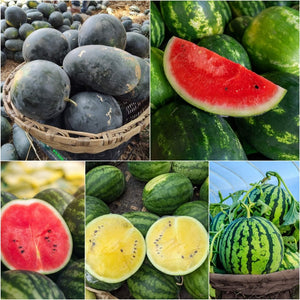
- The curly tendril nearest the fruit has dried and browned right to its base.
- The ground spot, where the fruit rests, has turned from white to creamy yellow.
- The rind resists a fingernail.
- A firm tap gives a dull, hollow sound; use this to confirm, not on its own.
- Cut the stalk with secateurs, leaving a few centimetres attached, in the cool of the morning.

Store whole fruit somewhere cool and shaded, ideally 10 to 15°C, where it keeps for about two weeks. The fridge suits a few days only, because long spells below 7°C pit the rind and dull the flavour. Keep watermelon away from ethylene-releasing fruit, which softens the flesh, and refrigerate cut pieces, covered. Eat it fresh in slices, fruit salads and chilled drinks.
Common problems
Flowers but no fruit, or tiny fruit that yellows and drops. The female flower caught too little pollen, from few bees, bad weather or a missing seeded partner; see Pollination.
Lopsided or pinched fruit. Pollen reached only part of the stigma, so one side of the fruit failed to fill; hand-pollinate in poor bee weather.
Rot on the underside. Fruit lying on wet soil decays where it touches; lift it as Care by growth stage describes.
Dark, sunken patch at the flower end. This is blossom end rot: calcium reaches the fruit only in water, so swings in soil moisture starve it, and even watering is the fix. Read more
Split or bland fruit. Irregular watering, or heavy rain and generous watering as fruit ripens; see the last two rows of Care by growth stage.
Seedlings collapse at soil level. Damping off strikes in cool, wet soil; sow only into warm ground. Read more
Pests and diseases
Before any spray, check that its label covers melons or cucurbits, and keep to its withholding period.
Pumpkin beetle (Aulacophora hilaris). Found in eastern and northern Australia, these leaf beetles chew leaves and flowers of melons, often cutting neat circles, and seedlings suffer most. Catch them by hand in the early morning or evening, and keep young plants growing strongly.
Melon aphid (Aphis gossypii). Colonies curl and wrinkle young leaves at the runner tips. The greater harm is the viruses they spread, papaya ringspot virus type W and zucchini yellow mosaic virus, which mottle leaves and distort fruit. No spray cures a virus, so pull and bin infected plants. Read more
Two-spotted mite (Tetranychus urticae). Fine yellow stippling spreads from the main veins, with webbing under the leaves, and numbers climb fast in hot, dry weather. Spray leaf undersides with water, or with horticultural oil in cool weather. Avoid broad-spectrum sprays that kill the predatory mites and ladybirds that eat them. Read more
Powdery mildew (Podosphaera xanthii). White powdery spots start on older, shaded leaves and spread fast in humid weather without rain. Leaves lost early leave fruit sunburnt and poorly flavoured. At the first spots, spray 1 part full-cream milk to 10 parts water. Read more
Fusarium wilt (Fusarium oxysporum f. sp. niveum). One runner wilts in the heat and recovers overnight, then the plant yellows and dies, with browning inside the stem. Its spores can last 15 to 20 years in soil. Bin affected plants, grow the next crop elsewhere, and choose a variety bred for resistance, such as 'Charleston Grey' or 'Crimson Sweet'. Both are also bred to resist anthracnose. Gummy stem blight (Stagonosporopsis cucurbitacearum), worst in warm, wet weather, looks similar, but its bleached crown canker oozes red-brown gum. Treat it the same way, and sow only clean seed.
Cucumber green mottle mosaic (Cucumber green mottle mosaic virus). Watermelon is its most severely affected host, showing mottled young leaves, brown lesions on stems and fruit stalks, and misshapen fruit with spongy flesh. It travels on seed, hands, tools, soil and water. It has been found in the Northern Territory, New South Wales, Queensland, South Australia and Western Australia. Outside New South Wales, report a suspect plant to your state biosecurity agency.
Prevention first
- Pull and bin old vines after harvest, and rotate beds as Site, soil and setup describes.
- Water at the base in the morning, keeping leaves dry, and give vines room for air to move.
- Check leaf undersides and runner tips twice a week, and treat as the entries above describe.
- Spare the bees: if you must use pyrethrum, spray late in the day, away from open flowers.
Tips
- Short of space, grow 'Sugar Baby' up an A-frame of two steel mesh panels tied at the top. Cradle each fruit in a sling of old stockings.
- Leave two or three fruits on a small-fruited vine and one or two on a large one, removing later ones so those left fill well.
- To save seed, grow one open-pollinated variety, since watermelons cross only with other watermelons. Wash seed from a fully ripe fruit, dry it until it snaps, and store it cool and dry. Save seed only from healthy plants, because some diseases travel on seed.
Questions
When should I plant watermelon in Australia?
Sow once the soil holds at least 21°C and frost has passed. Tropical gardens sow April to August, in the dry season. Subtropical gardens sow August to December. Arid and Mediterranean gardens sow September to December, and temperate gardens October to December. Cool gardens raise seedlings indoors in October and plant out in November.
How do I know when a watermelon is ripe?
Look for several signs together. The curly tendril nearest the fruit turns brown and dry, and the ground spot changes from white to creamy yellow. The rind resists a fingernail, and a tap sounds dull and hollow. A watermelon does not ripen after picking, so wait for the signs.
Why are my watermelon flowers not making fruit?
The female flowers, the ones with a tiny fruit behind the petals, are not getting enough pollen. Each needs several bee visits on the morning it opens. Rain, wind, cold mornings and insecticide sprays all cut bee visits. Where bees are scarce, brush pollen from a male flower onto each new female flower early in the morning.
Do seedless watermelons need a pollinator plant?
Yes. Seedless watermelons make no viable pollen, so they need a seeded variety growing close by. Plant one seeded vine for every two seedless vines, near enough for bees to work both. Seedless seed also needs a warm start, at 29 to 32°C, in pots.
How much space does a watermelon plant need?
Allow about 1 m between plants, in rows 1.5 to 2 m apart, because the vines ramble widely. The bush variety 'Bush Jubilee' spreads only about 1 to 2 metres. Small varieties such as 'Sugar Baby' can climb a sturdy frame, with each fruit supported in a sling.
Grow it



More vegetable guides
All vegetables
Amaranth
How to grow leaf amaranth, or Chinese spinach, in Australia: sowing months for six climate zones, warm soil, thinning, picking, pests and cooking the leaves.
| Position | Full sun |
|---|---|
| Depth | 3 to 6 mm |
| Spacing | 15 cm apart |
| First pick | 4 to 8 weeks |

Artichoke
How to grow globe artichokes from seed in Australia: sowing, spacing, feeding, when to cut the buds, cutting back, cardoon, and sowing months for every zone.
| Position | Full sun |
|---|---|
| Depth | 10 mm |
| Spacing | 1 to 1.5 m apart |
| First pick | About 42 to 57 weeks |

Bean
How to grow beans in Australia: sowing months by climate zone, bush and climbing types, low-nitrogen feeding, watering, picking pods, plus bean fly and rust.
| Position | Full sun, at least six hours |
|---|---|
| Depth | 25 to 30 mm |
| Spacing | Bush 10 to 15, climbing 15 to 20 cm |
| First pick | 7 to 14 weeks |

Beetroot
How to grow beetroot in Australia: sowing months for all six climate zones, thinning the seed clusters, steady watering, harvest size and the pests that matter.
| Position | Full sun or part shade |
|---|---|
| Depth | 10 to 20 mm |
| Spacing | 10 cm apart after thinning |
| First pick | 7 to 12 weeks |