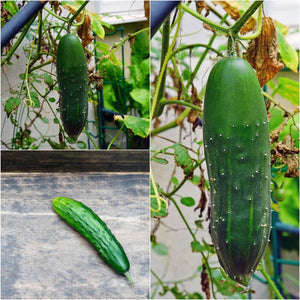
How to Grow Cucumbers in Australia
Cucumbers are a warm-season vine for full sun, rich soil and a trellis. Sow 10 to 20 mm deep once the soil holds 16°C. Tropical gardens sow April to August, subtropical August to February, arid September to February. Temperate gardens sow September to January and cool gardens October to December. Water steadily, feed potash from flowering and pick every two to three days from 8 to 10 weeks.
| Sun | Full sun; afternoon shade inland |
|---|---|
| Water | About 25 mm a week; never dry out |
| Soil | Rich, free-draining, pH 6.0 to 6.5 |
| Feed | Heavy; potash from the first flowers |
| Spacing | 30 to 60 cm |
| Depth | 10 to 20 mm |
| Germination | 4 to 10 days in 16 to 35°C soil |
| Harvest | 8 to 10 weeks |
| Container | Yes, 40 cm pot, about 28 L |
| Frost | Frost tender; sow after the last frost |
| Support | Trellis or mesh 1.2 to 2 m tall |
| Use | Fresh, pickled, tzatziki and cold soups |
Cucumber (Cucumis sativus) is a frost-tender annual vine in the gourd family, Cucurbitaceae, grown for fruit picked young and crisp. It suits Australian summers, with two crops a year in the subtropics and a full season in cool gardens. Uneven watering is the usual failure, because it turns fruit bitter and misshapen.
Three mistakes that matter
- Sowing into cold soil. Seed sown before the soil reaches 16°C often rots, and seedlings set out into cold ground stall. Wait for soil of 16°C to 21°C, or start seed in pots no more than four weeks ahead.
- Letting the soil dry out. Water stress makes fruit bitter, curved and hollow, and flowers drop. Give plants about 25 mm a week from rain and hose together, more in heat, under straw mulch.
- Leaving fruit to fatten. A fruit left to swell and yellow tells the plant its season is done, and new fruit stops setting. Pick every two to three days at eating size.
When to plant
Cucumber seed germinates in soil between 16°C and 35°C. Sow direct into warm soil, or start seed in pots so plants go out with the taproot undisturbed. A second batch sown in January can keep fruit coming into autumn.
| Zone | Example cities | Sow | Harvest | Notes |
|---|---|---|---|---|
| Tropical | Darwin, Cairns, Townsville | Apr-Aug | Jun-Nov | Sow through the dry season once the rains ease; wet-season plants often fail through mildew and poor fruit set. |
| Subtropical | Brisbane, Gold Coast, Coffs Harbour | Aug-Feb | Oct-May | Start August seed in pots; sow direct from September once soil holds 16°C, and again in January for autumn. |
| Arid | Alice Springs, Mildura, Broken Hill | Sep-Feb | Nov-Apr | Sow after the last frost in September, and again in late January; shadecloth carries plants through heatwaves. |
| Temperate | Sydney, Melbourne, Adelaide, Perth | Sep-Jan | Nov-Apr | Start seed in pots in August; sow direct from September in Sydney and Perth, October in Melbourne and Adelaide. |
| Cool | Canberra, Hobart, Ballarat, Stanthorpe | Oct-Dec | Dec-Mar | Start seed indoors in October, plant out after the last frost around Melbourne Cup weekend, sow direct from November. |
At the cold edge of the window, a seedling heat mat gives pots the 21°C that seed prefers. At the hot edge, shadecloth over the trellis carries plants through an Alice Springs or Perth heatwave.
Site, soil and setup
Cucumbers want full sun, shelter from wind, and rich, free-draining soil that never dries right out. Their roots run close to the surface, so fix the trellis before sowing rather than driving stakes through them later.
| Get the bed right | What to do |
|---|---|
| Sun | Full sun; light afternoon shade in hot inland summers |
| Soil | Friable and compost-rich: dig in 5 to 10 cm of well-rotted cow or horse manure 4 to 6 weeks ahead, or a 5 cm layer of compost |
| pH | 6.0 to 6.5; below that, dolomite lime at 100 to 200 g per square metre, 4 weeks ahead |
| Drainage | On heavy clay, a mound about 40 cm across or a raised bed |
| Base feed | Pelletised chicken manure at 100 g per square metre plus blood and bone at 100 to 150 g per square metre, at planting |
| Support | A trellis, mesh or strings 1.2 to 2 m tall, in place before sowing |
| Rotation | Not where cucumber, pumpkin, zucchini or melon grew in the past two years |
Fresh manure burns young roots, and old cucurbit vines carry gummy stem blight into the next season, so rotate beds.
Container growing
One plant needs a pot at least 40 cm across, holding about 28 L, with a trellis or tripod fixed in it. Fill it with premium potting mix blended with compost. Bush types suit pots best: 'Spacemaster' keeps its vines under 1 m and 'Richmond Green' stays fairly compact.
- Water: daily in summer heat, until it runs from the base.
- Feed: fish and seaweed blend at 25 mL per 9 L fortnightly, then liquid potash per label from the first flowers.
- Position: full sun out of the wind, where the vine can climb rather than trail.
Sowing Seeds
Sow direct once the soil is warm, or start in pots where spring is slow or slugs are thick.
Sowing direct
- Sow 10 to 20 mm deep, two or three seeds to a station.
- On a trellis, space stations 30 to 40 cm apart; on the ground, 40 to 60 cm apart in rows 1.2 to 1.5 m apart.
- Keep the surface moist; seedlings show in 4 to 10 days, then thin each station to the strongest.
- Mulch with 5 to 7 cm of straw once the soil is warm, clear of the stems.
Starting in pots
- Sow one seed per small pot and keep it at about 21°C.
- Plant out 3 to 4 weeks after sowing, once nights are warm, without breaking the root ball.
- Harden off (accustom seedlings to sun and wind over about a week) before planting at the spacing above.

Pollination
Cucumbers carry separate male and female flowers on one plant, and bees move the pollen. Male flowers open first on thin stalks, often 10 to 20 before the first female, which sits on a tiny fruit. Flowers without fruit in the first weeks are normal, and cold, wet or cloudy weather keeps bees home.

Gynoecious (all-female) F1 types set more fruit but need pollen, so the packet holds a few seeds of a standard variety. Parthenocarpic types set seedless fruit without pollination, which suits greenhouses and insect netting. Where bees are scarce, pollinate by hand in the morning, before the female flowers close.
- Pick a freshly opened male flower and strip its petals to expose the pollen-coated centre.
- Press it into the centre of each open female flower; one male can serve several females.
Care by growth stage
Water and potassium decide this crop. Weeks count from sowing direct or from planting out.
| Stage | Water | Feed | Watch for |
|---|---|---|---|
| Establishment, weeks 1 to 3 | Surface moist until seedlings show, then a deep soak twice a week | Seaweed solution at half strength, 15 mL per 9 L, at planting out and a fortnight later | Slugs and snails; 28-spotted ladybird on the first leaves |
| Vining, weeks 3 to 6 | About 25 mm a week, soaking the soil and keeping leaves dry | Fish emulsion at half strength, fortnightly | Aphids on shoot tips; the first male flowers |
| Flowering, weeks 6 to 8 | The same, and daily for pots in heat | Sulphate of potash at 30 to 50 g per square metre once, then liquid potash per label fortnightly | Female flowers and bee visits; powdery mildew on the lowest leaves |
| Picking, weeks 8 to 16 | Steady right through picking; never let plants dry out between drinks | Pelletised chicken manure at 100 g per square metre mid-season, with fish and seaweed blend at 25 mL per 9 L fortnightly | Bitter or curved fruit, fruit fly stings, mildew after rain |
That 25 mm is 25 L per square metre; sandy soils take less at a time, more often. If you prefer a conventional feed, mix a controlled release granular (NPK around 14-5-10) into the bed at planting. Water on an all-purpose soluble (NPK around 23-4-18) fortnightly while vines grow, then a fruiting and flowering soluble (NPK around 15-4-26) from the first flowers.
Pruning and Training
A trellis beats sprawling on every count. Vines go 30 to 40 cm apart instead of a metre, leaves dry fast so mildew spreads slower, and fruit hangs straight and clean. Tie the young stem loosely to the trellis until the tendrils take hold.
- Standard vines ('Marketmore', 'Lemon', Lebanese types): pinch the tip after 5 to 7 leaves, since these fruit on laterals, not the leader.
- Laterals: pinch two leaves past a female flower; remove any lateral reaching 8 to 10 leaves without one.
- Parthenocarpic hybrids: train to a single leader like a tomato, removing side shoots, because they flower at each leaf joint on the main stem.
- Bush types such as 'Spacemaster': no pruning and no trellis.
Companion planting
Good partners feed the insects that protect cucumbers, or lend shade and support.
Grows well with
- Dill and coriander left to flower, whose umbels feed hoverflies, and hoverfly larvae eat aphids.
- Nasturtium, a trap crop that draws aphids off the vines; squash the colonies it collects.
- Sweet corn or sunflower on the western side, a living stake and afternoon shade.
Keep apart
- Potato, which hosts the same 28-spotted ladybird.
- Pumpkin and zucchini, which share cucumber fly, both mildews and mosaic virus, and swamp a bed.
- Tomato, another host of cucumber fly and cucumber mosaic virus.
Harvesting Fruit
Pick from 8 to 10 weeks after sowing, while the skin is glossy and firm and before the seeds harden. Lebanese types are ready at 10 to 12 cm, gherkins at 5 to 6 cm and slicing types at 15 to 20 cm. Apple types are picked at tennis-ball size.
- Cut the stalk with secateurs; pulling tears the vine and the fruit.
- Remove any fruit that has yellowed or swollen, so the plant keeps setting.

Cucumbers keep 10 to 14 days at 10 to 12°C, in a cool room or the warmest part of the fridge. Colder than that for more than two or three days, they pit and turn watery. Bananas and tomatoes stored nearby turn them yellow.
Eat them fresh, pickle the small ones, or grate them into tzatziki.
Common problems
Bitter fruit. Cucurbitacin, the bitter compound, rises when plants are stressed by heat, drought, uneven watering or poor soil. It sits mostly under the skin and towards the stem end, so peel and trim a mildly bitter fruit. Nearby pumpkins or melons are not the cause, since they cannot cross with cucumbers. Burpless types carry little of it.
Flowers but no fruit. The first flush is male, and cold, wet or cloudy weather keeps bees away; small fruit that yellow and drop were never fertilised. See Pollination.
Curved, tapered or hollow fruit. Poor pollination, or a dry spell while the fruit filled; keep water steady and hand-pollinate when bees are scarce.
Leaves wilting on hot afternoons. Heat and dry soil; water deeply in the morning, and see When to plant for shade.
Pests and diseases
Three insects and three diseases matter.
Cucumber fly (Zeugodacus cucumis). Native to Queensland, the Northern Territory and northern New South Wales, and a major pest of cucurbits there. Maggots tunnel through young fruit, which rots or drops. Net or bag fruit once pollinated, pick often, and freeze or boil stung fruit rather than composting it. It ignores the male lures in Queensland fruit fly (Bactrocera tryoni) traps, and cucumber is not on that fly's host lists. Read more
28-spotted ladybird (Epilachna vigintioctopunctata). Dull orange, 7 to 10 mm, with 28 black spots and a fine downy coat, unlike the glossy beneficial ladybirds. Adults chew holes and the yellow, spiny larvae graze leaf undersides; squash both, and the yellow egg clusters under leaves.
Green peach aphid (Myzus persicae) and melon aphid (Aphis gossypii). Both suck sap from shoot tips, but their real damage is the virus they carry. Hose small colonies off or use insecticidal soap, and pull sowthistle and nightshade, which host both. Read more
Cucumber mosaic virus (CMV). An aphid picks it up in under a minute and spreads it for a few hours, so no spray stops it. Infected plants stunt, with mottled, curled leaves and small, distorted fruit; pull and bin them, wash hands and secateurs, and grow resistant varieties like 'Marketmore'. Read more
Powdery mildew (Podosphaera xanthii). White powder on the older, shaded leaves first, spreading in warm weather whether leaves are wet or not. Cut out the worst leaves and spray 1 part full-cream milk to 10 parts water in the morning, repeating after rain. Resistant types include 'Marketmore' and 'Burpless Tasty Green F1'. Read more
Downy mildew (Pseudoperonospora cubensis). Angular yellow patches boxed in by the leaf veins, with grey-purple fuzz beneath on damp mornings. It needs 6 to 12 hours of wet leaf, so it follows rain and evening sprinklers. Thin the canopy and remove affected leaves; copper fungicide protects new growth in a wet spell. Read more
Prevention first
- Grow on a trellis with space between plants, so leaves dry by mid-morning.
- Keep netting clear of the fruit, since fruit fly can sting through it.
- Turn leaves every few days for ladybird eggs, aphids and the first mildew spots.
- Bin spent vines and stung fruit rather than composting them.
Tips
- Where cucumber fly is bad, grow a parthenocarpic type under fine insect mesh from planting, since it sets fruit without bees.
- To save seed, use an open-pollinated variety such as 'Marketmore', since F1 seed does not come true, and leave a fruit until yellow and soft. Soak the scooped seed for 2 to 4 days, skim the pulp and dry the seed that sinks.
- African Horned cucumber (Cucumis metuliferus) is a different species, a scrambling annual to 2.5 m whose horned fruit ripens golden yellow.
Questions
Why are my cucumbers bitter?
Heat, drought and uneven watering raise cucurbitacin, the bitter compound, which sits under the skin and near the stem end. Water steadily, mulch, and shade plants through heatwaves. Peel and trim a mildly bitter fruit. Pumpkins or melons nearby are not the cause, since they cannot cross with cucumbers.
Why does my cucumber plant have flowers but no fruit?
The first flowers are male and cannot set fruit. Female flowers, with a tiny cucumber behind the petals, follow within a few weeks. Cold, wet or cloudy weather keeps bees away. Pollinate by hand in the morning: strip a male flower and press it into each open female.
When should I plant cucumbers in Australia?
Once the soil holds 16°C to 35°C. Tropical gardens sow April to August, in the dry season. Subtropical gardens sow August to February and arid gardens September to February. Temperate gardens sow September to January, and cool gardens October to December, after the last frost.
Do cucumbers need a trellis?
No, but a trellis pays. Vines go 30 to 40 cm apart instead of a metre, leaves dry faster so mildew spreads slower, and fruit hangs straight and clean. Fix it before sowing so stakes do not cut the shallow roots later. Bush types such as 'Spacemaster' need no support.
Can I grow cucumbers in a pot?
Yes. Give one plant a pot at least 40 cm across, about 28 L, with a trellis fixed in it and premium potting mix. Water daily in summer heat, feed fish and seaweed blend fortnightly, then liquid potash from flowering. 'Spacemaster' and 'Richmond Green' stay compact.
How often should I water cucumbers?
Give about 25 mm a week from rain and hose together, as deep soaks rather than sprinkles, and more in hot wind. Pots need water daily in summer. Water the soil, not the leaves, in the morning. Dry spells between drinks cause bitter, curved fruit and dropped flowers.
Grow it