
How to Grow Broad Beans in Australia
Broad beans want full sun and soil around pH 7. Sow seed 30 to 50 mm deep and 15 to 20 cm apart as autumn cools. Brisbane sows April to June; inland gardens, Perth and Adelaide April to July; Sydney and Melbourne March to July. Canberra and Hobart sow in autumn or late winter, and the tropics are too warm. Stake tall lines and pick from 14 to 20 weeks.
| Sun | Full sun, sheltered from wind |
|---|---|
| Water | Once at sowing, then steady from flowering |
| Soil | Free-draining, pH around 7, no fresh manure |
| Feed | Light; potash at first flowers |
| Spacing | 15 to 20 cm |
| Depth | 30 to 50 mm |
| Germination | 8 to 14 days in 6 to 24°C soil |
| Harvest | 14 to 20 weeks |
| Container | 'Coles Dwarf' in a 40 cm pot, 28 L |
| Frost | Plants hardy; frost damages open flowers |
| Support | Stakes and string for tall lines |
| Use | Steamed beans, young whole pods, tips, dried beans |
Broad bean (Vicia faba), also called fava bean, is a cool-season legume in the pea family, Fabaceae, grown for plump beans and young pods. Unlike the warm-season French and runner beans in How to Grow Beans, broad beans go in as autumn cools. A common failure is sowing too early, which gives tall plants that set few pods.
Three mistakes that matter
- Sowing too early. Seed sown into warm late-summer soil grows tall and leafy, and the top flowers may not set until spring. Sow inside your zone's months in When to plant, so plants flower in mild weather.
- Feeding for leaves. The roots make much of their own nitrogen, so rich manure or a high-nitrogen feed gives soft, top-heavy plants with few pods. That sappy growth also blows over, catches fungal disease and feeds aphids.
- Leaving tall plants unstaked. One gusty spell can snap a block of brittle stems just as the pods fill. Put stakes and string around tall lines early, as Care by growth stage describes, or grow 'Coles Dwarf' in exposed beds.
When to plant
Broad bean seed germinates in soil from 6°C to 24°C, so sow as autumn cools rather than in late-summer heat. Aim for flowering in late winter and spring, when lengthening days and air near 20°C let pods set. Sow two or three batches about three weeks apart to spread the picking.
| Zone | Example cities | Sow | Harvest | Notes |
|---|---|---|---|---|
| Tropical | Darwin NT; Cairns, Townsville QLD; Broome WA | Not recommended | Not recommended | Not practical: even dry-season days run too warm for flowers to set pods, which need about 20°C. |
| Subtropical | Brisbane, Bundaberg QLD; Coffs Harbour, Lismore NSW | Apr-Jun | Aug-Oct | Near the northern limit: sow once autumn cools, by June, so pods set before spring heat. |
| Arid and semi-arid | Alice Springs NT; Mildura VIC; Broken Hill NSW; Kalgoorlie WA | Apr-Jul | Aug-Nov | Sow direct from April; inland frosts can damage open flowers, and late-spring heat ends the crop. |
| Temperate | Sydney, Newcastle NSW; Melbourne, Geelong VIC | Mar-Jul | Aug-Nov | Sow two or three batches three weeks apart; March sowings grow tallest and need firm staking. |
| Mediterranean | Perth, Bunbury WA; Adelaide and the SA coast | Apr-Jul | Aug-Nov | Perth sows late April to June, Adelaide April to July; pods set from August as days lengthen. |
| Cool and alpine | Canberra ACT; Hobart TAS; Ballarat VIC; Orange NSW | Mar-May and Aug-Sep | Sep-Jan | Sow in autumn, or in August and September as soil warms; frost on open flowers costs pods. |
Across the south, Anzac Day falls in the heart of the window. Late sowings run into hot late-spring days that cut the crop short, so finish by the last month listed for your zone.
Site, soil and setup
Full sun and shelter from strong wind suit broad beans best, since wind lowers the crop and flattens tall plants. They cope with heavier soil and brief waterlogging better than most vegetables, though free-draining soil is still the ideal.
| Get the bed right | What to do |
|---|---|
| Sun | Full winter sun; in warmer climates, some afternoon shade is welcome |
| Shelter | A fence, hedge or windbreak on the windy side |
| Soil | Fork in a 5 cm layer of compost; skip fresh or heavy manure, which drives leaf rather than pods |
| pH | Neutral to slightly alkaline, around 7; on acid soil, garden lime at 100 to 200 g per square metre, 4 weeks before sowing |
| Drainage | On soggy clay, mound the soil or build a raised bed |
| Room | 15 to 20 cm between plants in a block, or double rows 20 cm apart with about 1 m between each pair |
| Rotation | Not where broad beans grew in the past two to three years |
Chocolate spot survives in the soil for several years, and rust lives on in old bean stems and self-sown plants. That is why the bed moves each year.
Container growing
The short 'Coles Dwarf' is the line for pots. Give it a pot at least 40 cm across, which holds about 28 L, filled with premium potting mix. Taller lines need a frame and room to lean, so they belong in the ground.
- Water: when the surface of the mix feels dry, and never let it dry out once flowers open.
- Feed: liquid potash at the rate on the label, fortnightly from the first flowers.
- Position: full sun out of the wind, with a short stake or two to steady the plants.
Sowing Seeds
Sow broad beans straight into the bed: the big seed handles easily, and seedlings dislike being moved.
Choosing a line
| Line | Plant and pod | What it changes |
|---|---|---|
| 'Aquadulce' | About 90 to 100 cm tall; purple and white flowers; pods near 15 cm | Stake and string the block |
| 'Coles Dwarf' | Short and compact; pods 13 to 15 cm | Suits pots and windy beds; may still want string between stakes |
| 'Tripoli' | Large pods, often holding 6 or 7 beans | Sold as coping with warm spells better than 'Aquadulce' |
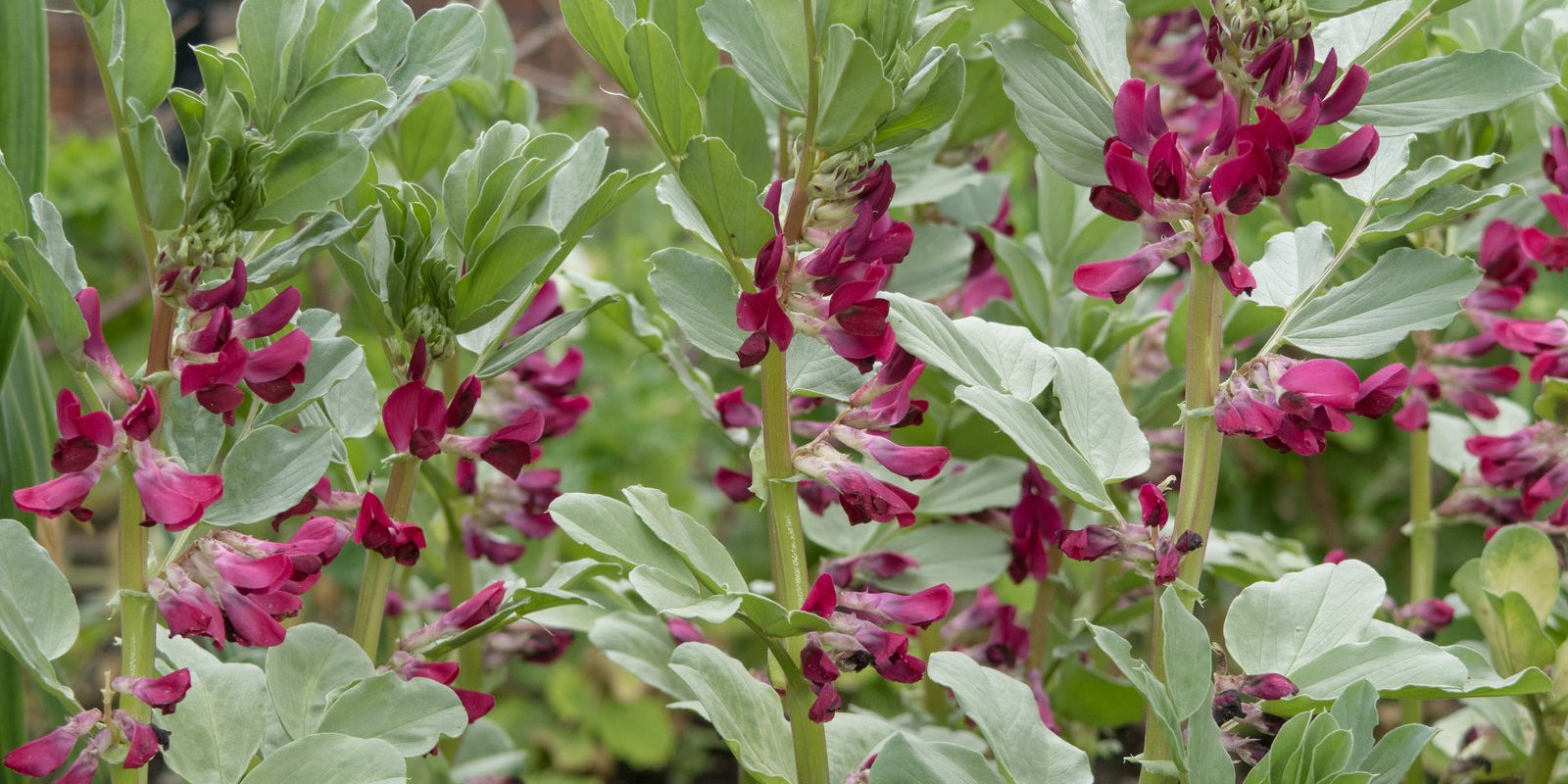
| 'Crimson Flowered' | Bright crimson flowers; smallish, irregular beans | Grown as much for the flowers as the beans |
| 'Egyptian (Fava)' | About 100 cm tall; long pods | Needs support; beans suit soups and stews |
Sowing direct
- Push seed 30 to 50 mm deep, at the spacing in Site, soil and setup.
- Water well once at sowing, then hold off until shoots show, because cold, wet soil rots the seed.
- Seedlings usually emerge in 8 to 14 days, slower in cold soil.
- Sow a few spare seeds at the end of the row to fill any gaps.
- Where mice dig up seed or the soil stays sodden, start seed in small pots and plant out while young.
Care by growth stage
Steady moisture and mild weather at flowering decide the crop. Feed lightly, because the root nodules supply much of the nitrogen.
| Stage | Water | Feed | Watch for |
|---|---|---|---|
| Seedling, weeks 1 to 4 | One soak at sowing, then only once shoots show and the surface dries | Nothing until true leaves form, then seaweed solution at half strength, 15 mL per 9 L, fortnightly | Snails and slugs at night; silvered leaves from redlegged earth mite |
| Leafy growth, weeks 4 to 10 | A deep soak whenever rain fails; never let plants dry out | Seaweed solution at 30 mL per 9 L fortnightly; fish emulsion at half strength fortnightly only if leaves pale | Wind rocking tall stems; put up stakes and string |
| Flowering, weeks 10 to 14 | Steady; a dry spell or a sudden swing in temperature can stall pod set | Sulphate of potash at 30 to 50 g per square metre, once at first flowers, watered in | Frost on open flowers; aphids on the tips; first chocolate spot |
| Podding and picking, weeks 14 to 20 | Keep it steady right through picking | None needed | Native budworm in pods; rust as pods fill |
Tall lines need support while they are still short. Drive a stake at each corner of the block and run string around the outside at two or three heights as the plants grow. If growth stalls in poor soil, a light dose of all-purpose controlled release granular (NPK around 14-5-10) scratched into the soil can help.

Pinching Out Tips
Once the lowest flowers have set small pods, pinch the soft top out of each tall stem. The plant then puts its effort into pods, and the tender tips aphids crowd onto are gone.
- Nip off the top few centimetres of each stem with finger and thumb.
- Steam clean tips as a leafy green.
- Drop tips already crusted with aphids into a bag for the bin.
- In warmer areas, pinch dwarf plants as well, to help pods set.
Companion planting
Good partners use the nitrogen broad beans leave behind or share their bed and stakes; the plants to keep apart harbour their diseases and pests.
Grows well with
- Kale and lettuce, hungry leaf crops that draw on the nitrogen the bean roots add.
- Peas, which like the same limed bed and can climb the same stakes.
Keep apart
- Vetch and lentils, hosts of the chocolate spot fungi.
- Capeweed, which harbours redlegged earth mite.
Harvesting Pods
Pods ripen from the base of the stem upwards, so check the lowest ones first as they begin to swell.
- For eating whole, pick pods small and young, before the beans fill out.
- For shelled beans, pick pods longer than 15 cm, with beans about the size of a five-cent coin.
- Pick before the tissue joining each bean to the pod turns black and the skins toughen.
- Pick often, since regular picking keeps new pods coming.
- Harvest in the cool of the morning and keep the pods cool.

Fresh broad beans keep only briefly, so refrigerate the pods and use them soon. For longer keeping, shell the beans, blanch them and freeze.
Steam or boil the beans, and slip older ones out of their tough outer skins after cooking. Beans of 'Coles Dwarf' and 'Egyptian (Fava)' can also be dried for soups and stews.
Common problems
Flowers but no pods. Frost damages open flowers, and heat or dry spells stall pod set; keep water steady at flowering and sow on time.
Tall, leafy plants with few pods. Too much nitrogen or too early a start; see Three mistakes that matter.
Gaps in the row. Seed rotted in cold, wet soil or mice took it; resow the spares and water less until shoots appear.
Tough, floury beans. The pods stayed on too long; pick at the signs in Harvesting Pods.
Silvery patches on seedling leaves. Redlegged earth mite feeding, often mistaken for frost or chocolate spot; see Pests and diseases.
Pests and diseases
Most trouble arrives in spring, when warm, humid days meet a dense block of flowers and pods.
Cowpea aphid (Aphis craccivora). Black or dark grey aphids that crowd densely onto legume stems and soft tips. Faba bean aphid (Megoura crassicauda), dark green with a black head, also turns up in New South Wales and Victoria. Pinch out infested tips, hose off small colonies or spray insecticidal soap. Read more
Native budworm (Helicoverpa punctigera). A native moth whose caterpillars feed on pods and the seeds inside in late winter and spring. Cotton bollworm (Helicoverpa armigera) looks alike and is managed the same way. Check pods weekly and pick off caterpillars. Read more
Redlegged earth mite (Halotydeus destructor). About 1 mm long, with a velvety black body and eight orange-red legs, active from autumn to late spring in southern Australia. Feeding silvers the leaves and can kill seedlings at emergence. Clear nearby capeweed and check young plants often.
Chocolate spot (Botrytis fabae). Reddish-brown spots peppered over leaves, flowers and stems, which can darken and merge into grey-brown patches. It spreads fastest in humid weather at flowering, and spores blow in from old bean residue. Dense sowing makes it worse.
Rust (Uromyces viciae-fabae). Small orange-brown pustules ringed with pale yellow, mostly late in the season as pods fill. It spreads in humid weather above 20°C, and badly hit leaves wither and fall.
Prevention first
- Sow clean seed, since chocolate spot can be carried on it.
- Pull self-sown bean seedlings as they appear.
- Hunt snails and slugs at night, and leave the bed unmulched until seedlings are growing strongly.
- Bin diseased plants rather than composting them or digging them in.
Tips
- After the last picking, dig healthy plants and roots back into the soil and let them rot for a few weeks. The nitrogen in the root nodules then feeds the next crop.
- To save seed, grow one line only, since bees cross-pollinate broad beans and the lines can mix.
- Along a sunny fence, sow a single row and tie the plants to the fence instead of building a frame.
Questions
When do you plant broad beans in Australia?
Sow in autumn and early winter, once the soil cools below 24°C, so plants flower in late winter and spring. Most southern gardens sow from March or April to July. Brisbane sows April to June, and the tropics are too warm for a reliable crop. The When to plant table gives each zone its months.
Why are my broad beans flowering but not making pods?
Frost damages open flowers, and heat or dry spells stall pod set. Plants sown too early in warm weather also grow tall and set poorly. Keep the soil steadily moist from flowering, sow within your zone's months, and pinch out the tips once the lowest pods form.
Should I pinch out the tops of broad beans?
Yes, for tall lines. Once the lowest flowers have set small pods, nip out the soft top of each stem. The plant puts its effort into pods, and the tips that aphids crowd onto are gone. Clean tips can be steamed as a green.
Do broad beans need staking?
Tall lines such as 'Aquadulce' and 'Egyptian (Fava)' do, because their brittle stems snap in wind. Drive a stake at each corner of the block. Run string around the stakes at two or three heights. A sheltered bed of 'Coles Dwarf' often stands alone.
When are broad beans ready to pick?
From about 14 to 20 weeks after sowing. Pick young pods whole, or shell pods longer than 15 cm with beans about the size of a five-cent coin. Start with the lowest pods, and pick before the tissue joining each bean to the pod turns black.
Are broad beans safe for everyone to eat?
No. People with G6PD deficiency, an inherited condition, can have a serious and sometimes life-threatening reaction to broad beans, called favism. Some react to the pollen too. If you or your child has the condition, do not eat them, and ask your doctor before growing them.
Grow it
Tap Add beside a size to put it in your cart. You stay on this page.
- Bean Broad - Aquadulce seedsFrom $2.99
- Bean Broad - Coles Dwarf seedsFrom $2.99
- Bean Broad - Tripoli seedsFrom $2.99


More vegetables to sow in October
All vegetables
Amaranth
How to grow leaf amaranth, or Chinese spinach, in Australia: sowing months for six climate zones, warm soil, thinning, picking, pests and cooking the leaves.
| Position | Full sun |
|---|---|
| Depth | 3 to 6 mm |
| Spacing | 15 cm apart |
| First pick | 4 to 8 weeks |

Artichoke
How to grow globe artichokes from seed in Australia: sowing, spacing, feeding, when to cut the buds, cutting back, cardoon, and sowing months for every zone.
| Position | Full sun |
|---|---|
| Depth | 10 mm |
| Spacing | 1 to 1.5 m apart |
| First pick | About 42 to 57 weeks |

Bean
How to grow beans in Australia: sowing months by climate zone, bush and climbing types, low-nitrogen feeding, watering, picking pods, plus bean fly and rust.
| Position | Full sun, at least six hours |
|---|---|
| Depth | 25 to 30 mm |
| Spacing | Bush 10 to 15, climbing 15 to 20 cm |
| First pick | 7 to 14 weeks |

Beetroot
How to grow beetroot in Australia: sowing months for all six climate zones, thinning the seed clusters, steady watering, harvest size and the pests that matter.
| Position | Full sun or part shade |
|---|---|
| Depth | 10 to 20 mm |
| Spacing | 10 cm apart after thinning |
| First pick | 7 to 12 weeks |