
How to Grow Eggplant in Australia
Eggplant is a warm-season fruiting crop for full sun, rich free-draining soil and a stake. Sow seed 5 mm deep in trays kept at 24°C to 32°C. Plant out once the soil holds 20°C and nights stay above 10°C. Tropical gardens sow April to August, subtropical August to January, cool gardens September to October and the rest from August. Water steadily, feed potash from flowering and pick glossy fruit.
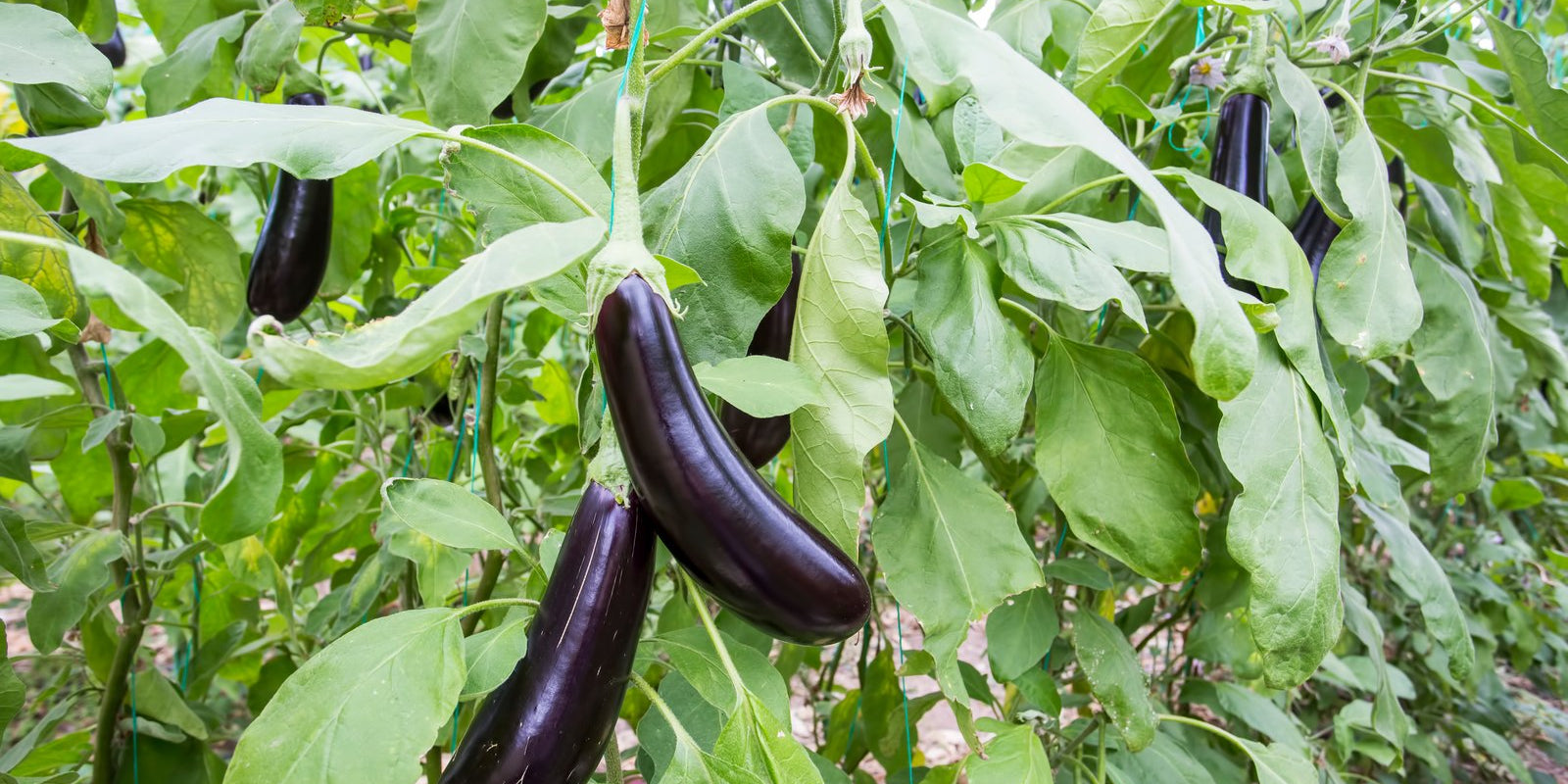
| Sun | Full sun, sheltered from wind |
|---|---|
| Water | About 25 mm a week; never dry out |
| Soil | Deep, free-draining, pH 6.0 to 6.8 |
| Feed | Heavy; potash from the first flowers |
| Spacing | 45 to 70 cm |
| Depth | 5 mm, in trays |
| Germination | 7 to 14 days at 24 to 32°C |
| Harvest | 8 to 12 weeks after transplant |
| Container | Yes, 40 cm pot, about 28 L |
| Frost | Frost tender; plant out when nights exceed 10°C |
| Support | Hardwood stake about 1 m, set at planting |
| Use | Grilled, baked, curries, dips and moussaka |
Eggplant (Solanum melongena) is a frost-tender member of the nightshade family, Solanaceae, grown for its glossy fruit. It loves the long, hot summers of northern and inland Australia, and still crops in the south when raised early under cover. The usual failure is planting out too soon, because a chilled plant seldom recovers.
Three mistakes that matter
- Planting out into cold ground. Seedlings set out into cold soil or chilly nights stall and seldom recover. Keep them growing in pots under cover until the cue in When to plant.
- Letting the soil dry out between drinks. Dry spells make the plant shed flowers and young fruit, and uneven moisture brings bitter fruit and blossom end rot. Mulch, and water deeply on a regular schedule, as set out in Care by growth stage.
- Leaving fruit on the bush too long. Once the skin dulls, the seeds harden and the flesh turns spongy and bitter. Pick at about two-thirds of full size while the skin still shines, and the plant keeps flowering.
When to plant
Eggplant seed germinates in soil at 24°C to 32°C, so sow in trays on a heat mat and plant out 8 to 10 weeks later. Plant out once the soil holds 20°C and nights stay above 10°C. In the tropics and subtropics, a second sowing a month after the first can stretch the picking season.
| Zone | Example cities | Sow | Harvest | Notes |
|---|---|---|---|---|
| Tropical | Darwin, Katherine NT; Cairns, Townsville QLD; Broome WA | Apr-Aug | Jul-Jan | Sow for the dry season; wet-season plants grow leafy and crop less, so plant them on mounds. |
| Subtropical | Brisbane, Bundaberg QLD; Coffs Harbour, Lismore NSW | Aug-Jan | Nov-May | Start August seed on a heat mat; late sowings crop into autumn but meet humid-season leaf disease. |
| Arid and semi-arid | Alice Springs NT; Mildura VIC; Broken Hill NSW; Kalgoorlie WA | Aug-Nov | Dec-Apr | Raise seed under cover; plant out after the last frost, then mulch deeply and shade through heatwaves. |
| Temperate | Sydney, Newcastle NSW; Melbourne, Geelong VIC | Aug-Oct | Jan-Apr | Raise seed under cover; plant out from October in Sydney, around Melbourne Cup weekend in Melbourne. |
| Mediterranean | Perth, Bunbury WA; Adelaide and the SA coast | Aug-Oct | Dec-Apr | Plant out October to December once nights stay above 10°C; dry heat calls for deep mulch. |
| Cool and alpine | Hobart TAS; Canberra ACT; Ballarat VIC; Stanthorpe QLD | Sep-Oct | Feb-Apr | Sow indoors with bottom heat, plant out after frost from November, and favour early slim types. |
In Hobart, Canberra and the tablelands, long slim and small-fruited types crop earlier than big globes, which makes them the safer choice.
Site, soil and setup
Eggplants want full sun and deep, free-draining soil that warms quickly in spring. Sandy loams suit them best; heavy clay stays cold and wet.
| Get the bed right | What to do |
|---|---|
| Sun | Full sun, sheltered from strong wind, which topples plants heavy with fruit |
| Soil | Dig in 5 to 10 cm of well-rotted cow or horse manure 4 to 6 weeks ahead, or a 5 cm layer of compost |
| pH | 6.0 to 6.8; below that, dolomite lime at 100 to 200 g per square metre, 4 weeks ahead |
| Drainage | Raised beds on heavy soil; in the tropical wet season, mounds 30 to 50 cm high |
| Base feed | Pelletised chicken manure at 100 g per square metre plus blood and bone at 100 to 150 g per square metre, at planting |
| Support | One hardwood stake about 1 m long per plant, pushed 30 cm deep and 5 to 10 cm from the stem at planting |
| Rotation | Not where tomato, potato, capsicum, chilli or eggplant grew in the past three years |
Rotation matters more for eggplant than for most crops, because verticillium wilt survives in soil for years. Peas and beans make good crops to rotate with.
Container growing
One plant needs a pot at least 40 cm across, holding about 28 L, with a stake or small tomato cage set in at planting. Fill it with premium potting mix, or 3 parts potting mix to 1 part coir peat and 1 part washed river sand. Compact types suit pots best: the container-bred 'Kaberi F1' needs no stake, and 'Mini Lebanese', 'Rosalina F1' and 'Turkish Orange' stay small.
- Water: check every day in summer and water until it drains; dry mix spoils the fruit.
- Feed: fish and seaweed blend at 25 mL per 9 L fortnightly, then liquid potash per label fortnightly from the first flowers.
- Position: full sun out of strong wind; a pot can move to shelter when a cold snap threatens.
- Fresh mix: fresh potting mix in a clean pot each season lowers the risk of soilborne wilt.
Sowing Seeds
Start seed in trays under cover, where bottom heat holds the soil warmth germination needs.
Starting under cover
- Sow 5 mm deep in punnets or cells of seed-raising mix.
- Keep the mix warm on a heat mat, as in When to plant, and moist but not wet; seedlings appear in 7 to 14 days.
- Give bright light from directly overhead, or the stems stretch and lean.
- Once true leaves show, keep the strongest seedling in each cell.
- Feed weekly with worm casting liquid diluted to weak tea colour.
- Some F1 seed, such as 'Midnight F1', is fungicide-coated: never eat it, wear gloves, wash afterwards and keep it from children and animals.

Planting out
- Plant out 8 to 10 weeks after sowing, at 10 to 12 cm tall with six or seven leaves.
- Harden off (accustom seedlings to sun, wind and less water over one to two weeks) first.
- Space plants 45 to 70 cm apart, closer for small types, in rows 80 to 100 cm apart.
- Set each plant at the depth it grew in its pot, not deeper.
- Plant in the late afternoon or on an overcast day, and water in with seaweed solution at 30 mL per 9 L.
- Mulch with straw once the soil is warm, keeping it 5 to 7 cm clear of the stem.
Pollination
Eggplant flowers pollinate themselves, though bees buzzing the pollen loose help. Flowers that drop without setting fruit usually point to heat above 32°C, cold nights, dry soil or too much nitrogen. Thrips feeding in the flowers cause the same loss.

Under insect netting, or when fruit set is poor, pollinate by hand.
- Lift the netting every few days while flowers are open, and reseal it each time.
- Dab the centre of each open flower with a soft, dry artist's brush.
Care by growth stage
Warmth, steady water and potassium decide this crop. Weeks count from planting out.
| Stage | Water | Feed | Watch for |
|---|---|---|---|
| Establishment, weeks 1 to 3 | Deep soak at planting, then keep the soil evenly moist, never soggy | Seaweed solution at 30 mL per 9 L at planting and a fortnight later | Cutworms at the stem; aphids on shoot tips; 28-spotted ladybird on the first leaves |
| Branching, until the first flowers, about weeks 3 to 6 | About 25 mm a week from rain and hose together, as one or two deep soaks | Fish emulsion at half strength, fortnightly; no more, as excess nitrogen delays fruit | Two-spotted mite and flea beetle in hot, dry spells |
| Flowering, from the first flowers, about weeks 6 to 8 | The same, and more in hot wind; never let the soil dry out | Sulphate of potash at 30 to 50 g per square metre once, then liquid potash per label fortnightly | Flower drop, thrips, silverleaf whitefly |
| Picking, from week 8 | Steady right through picking | Pelletised chicken manure at 100 g per square metre mid-season, with fish and seaweed blend at 25 mL per 9 L fortnightly | Fruit fly stings, caterpillar exit holes, blossom end rot, sunscald |
That 25 mm is 25 L per square metre; sandy soils take less at a time, more often. If you prefer a conventional feed, use each at its label rate. Mix a controlled release granular (NPK around 14-5-10) into the bed at planting. Water on an all-purpose soluble (NPK around 23-4-18) fortnightly while plants branch. From the first flowers, switch to a fruiting and flowering soluble (NPK around 15-4-26).

Pruning and Training
Eggplants need little pruning: in a university trial, cutting plants to two or four stems gave no consistent gain over staked, unpruned plants.
- Pinch off any flowers that open on seedlings before planting out.
- On large-fruited types, keep three main stems forking from the base and rub out weaker shoots.
- On long types such as 'Long Purple', pinch the tip at about 45 cm to encourage branching.
- Tie each main stem to the stake with soft ties as the fruit loads up.
- Remove pale, spotted or yellowing leaves and bin them rather than composting them.
- Leave enough leaf over the fruit to shade it from sunscald.
Companion planting
Short crops and pollinator flowers suit eggplant; nightshades and other wilt hosts belong elsewhere.
Grows well with
- Dwarf beans, a low crop for the gaps between young plants.
- Lettuce, picked from between the rows before the eggplant canopy closes.
- Mexican marigold (Tagetes lemmonii) nearby, whose flowers draw pollinators and whose scented leaves confuse some flying pests.
Keep apart
- Potato, which shares 28-spotted ladybird and verticillium wilt.
- Strawberries, another host of verticillium wilt.
- Thornapple and other nightshade weeds, which carry eggfruit caterpillar between crops.
Harvesting Fruit
Picking starts 8 to 12 weeks after planting out, once the fruit is full-coloured, firm and glossy.
| Type | Store varieties | Pick when |
|---|---|---|
| Large globe and teardrop | 'Black Beauty', 'Florida Market', 'Market Supreme', 'Rosa Bianca', 'Listada da Gandia' | Glossy and firm, usually 15 to 25 cm long, before the skin dulls |
| Long Lebanese, Japanese and Chinese | 'Long Purple', 'Lebanese F1', 'Midnight F1', 'Ping Tung Long', 'Japanese Pickling', 'Little Fingers' | Slim and shiny; take them young, as older fruit turns spongy ('Little Fingers' at about 10 cm) |
| Thai round and long | 'Thai Round Green', 'Thai Purple Ball', 'Thai Long Green' | Rounds at up to 5 cm across; long green types at 24 to 30 cm, still pale lime |
| Japanese round | 'Japanese Kamo', 'Japanese Kyoto Egg F1', 'Japanese E-Star F1', 'Japanese Konasu' | Round and glossy: 'Japanese Kyoto Egg F1' at about 8 cm, 'Japanese E-Star F1' at 7 to 10 cm |
| White and green | 'Casper', 'Snowy', 'White Egg', 'Oriental White F1', 'Louisiana' | Smooth and bright; white fruit turning yellow is past its best |
| Scarlet eggplant, a separate species (Solanum aethiopicum) | 'Turkish Orange' | As the skin turns from green to cream, before it colours fully orange |
- Cut the stalk with secateurs, leaving a short stub on the fruit; pulling damages fruit and plant.
- Wear gloves, since many types carry sharp spines on the calyx, stems and leaves.
- Pick in the cool of the morning, at least once a week.
- Remove old, dull or yellowing fruit so the plant keeps flowering.

Eggplant does not store well. It keeps 5 to 7 days at 7°C to 10°C in a humid crisper, and longer chilling pits the skin.
Grill, bake or fry slices, add small types to curries, or char whole fruit for dips. Plain eggplant bottled at home has caused botulism, so freeze blanched slices, or pickle only by a tested method such as CSIRO's preserving advice.
Common problems
Flowers fall without setting fruit. A stressed plant drops its flowers; see Pollination for the causes and the fix.
Dark, sunken patch at the flower end. Blossom end rot: uneven watering starves the swelling fruit of calcium, so steady water prevents it, and lime does not cure an outbreak. Read more
Patches or spots on the fruit. Pale, dry patches are sunscald on fruit left bare by sparse leaves in hot, dry weather; shade plants through a heatwave. Round, sunken spots on ripening fruit are anthracnose (Colletotrichum species), a wet-weather fungus; bin spotted fruit.
Small round holes in the leaves. Flea beetles, tiny beetles with a dark blue metallic sheen that jump when disturbed; a fine insect net keeps them off young plants.
Sudden wilt and collapse in the Top End. Bacterial wilt (Ralstonia solanacearum) lives in red soils around Darwin and light soils near Katherine. Bin affected plants and grow on in clean pots.
Plants wilt, yellow and stay stunted. Root-knot nematode (Meloidogyne species) knots the roots, worst in sandy soil. Bin affected roots, never compost them, and rotate beds. Read more
Pests and diseases
Eggplant shares most of its pests with tomato and capsicum.
Queensland fruit fly (Bactrocera tryoni). Eggplant is on its host lists. Females lay eggs through the skin, leaving pin-prick marks, and maggots rot the flesh. Freeze stung fruit in a sealed bag for two days before binning it. Read more
Eggfruit caterpillar (Sceliodes cordalis). A moth found throughout Australia that lays eggs mainly on the calyx. Its larvae, up to 20 mm long, tunnel through the fruit, often showing only as a 3 to 4 mm exit hole. Bin infested fruit.
28-spotted ladybird (Epilachna vigintioctopunctata). Orange-brown, 6 to 10 mm long, with 28 black spots; adults and spiny, creamy-yellow larvae chew the leaves. Squash them, and the yellow egg clusters under leaves.
Two-spotted mite (Tetranychus urticae). Tiny sap-suckers that multiply in hot, dry weather, leaving pale mottling and fine webbing under leaves. Hose both sides of the leaves, and avoid sprays that kill predatory ladybirds and mites. Read more
Silverleaf whitefly (Bemisia tabaci). Tiny white-winged insects suck sap under the leaves and leave sticky honeydew that grows sooty mould. Numbers climb fast in spring and summer, so act early. Read more
Verticillium wilt (Verticillium dahliae). Often the most serious eggplant disease: leaves yellow, curl inward and wilt, and a cut lower stem shows brown streaks. Nothing cures it, so bin the plant and rotate beds.
Prevention first
- Net plants with fine insect mesh from fruit set, sealed to the ground and held clear of the fruit.
- Check under the leaves weekly for eggs, mites and whitefly, and the shoot tips for aphids.
- Pick up fallen and stung fruit, and never compost it untreated.
- Pull spent plants after the last pick, and clear the weeds named under Companion planting.
Tips
- To save seed, leave a fruit of an open-pollinated variety until it turns yellow, since F1 seed gives variable plants. Blend it with water, let the seed sink, then sieve and dry it.
- Salting is worth the trouble only for big purple fruit left past its best; young fruit of most types cooks well without it.
- Where wilt keeps returning, grafted seedlings on resistant rootstock are said to be more vigorous and disease resistant.
Questions
When should I plant eggplant in Australia?
Sow seed in trays kept at 24°C to 32°C, then plant out once the soil holds 20°C and nights stay above 10°C. Tropical gardens sow April to August, subtropical August to January and arid August to November. Temperate and Mediterranean gardens sow August to October, and cool gardens September to October.
Why are my eggplant flowers falling off without fruit?
Stress stops the fruit setting. Heat above 32°C, cold nights, dry soil and too much nitrogen all cause it. Thrips feeding in the flowers do the same. Water deeply and steadily under mulch, and switch to potassium feeds once flowers appear.
How do I know when an eggplant is ready to pick?
Pick while the skin is glossy and the fruit is firm, at about two-thirds of full size. A dull, wrinkled or yellowing skin means the seeds have hardened and the flesh is turning spongy and bitter. Cut the stalk with secateurs and wear gloves, because the calyx spines are sharp.
Can I grow eggplant in a pot?
Yes. Give one plant a pot at least 40 cm across, about 28 L, filled with premium potting mix, with a stake set in at planting. Check the water daily in summer. Compact types such as 'Kaberi F1', 'Mini Lebanese' and 'Rosalina F1' suit pots best.
Do eggplants need staking?
Most do, because a bush carrying several large fruit leans or snaps in wind. At planting, push a hardwood stake about 1 m long 30 cm into the ground, 5 to 10 cm from the stem. Tie the main stems to it with soft ties. The container-bred 'Kaberi F1' needs no stake.
Why is my eggplant bitter?
Usually the fruit stayed on the plant too long, or the plant went short of water. Pick young, while the skin shines, and keep the soil evenly moist under mulch. Salting is worth the trouble only for big purple fruit left past its best.
Grow it


More vegetable guides
All vegetables
Amaranth
How to grow leaf amaranth, or Chinese spinach, in Australia: sowing months for six climate zones, warm soil, thinning, picking, pests and cooking the leaves.
| Position | Full sun |
|---|---|
| Depth | 3 to 6 mm |
| Spacing | 15 cm apart |
| First pick | 4 to 8 weeks |

Artichoke
How to grow globe artichokes from seed in Australia: sowing, spacing, feeding, when to cut the buds, cutting back, cardoon, and sowing months for every zone.
| Position | Full sun |
|---|---|
| Depth | 10 mm |
| Spacing | 1 to 1.5 m apart |
| First pick | About 42 to 57 weeks |

Bean
How to grow beans in Australia: sowing months by climate zone, bush and climbing types, low-nitrogen feeding, watering, picking pods, plus bean fly and rust.
| Position | Full sun, at least six hours |
|---|---|
| Depth | 25 to 30 mm |
| Spacing | Bush 10 to 15, climbing 15 to 20 cm |
| First pick | 7 to 14 weeks |

Beetroot
How to grow beetroot in Australia: sowing months for all six climate zones, thinning the seed clusters, steady watering, harvest size and the pests that matter.
| Position | Full sun or part shade |
|---|---|
| Depth | 10 to 20 mm |
| Spacing | 10 cm apart after thinning |
| First pick | 7 to 12 weeks |