
How to Grow Spring Onions in Australia
Sow spring onion seed about 5 mm deep along drills 15 to 30 cm apart, whenever your zone's window is open. Seedlings show in 7 to 14 days. Thin to 2 to 10 cm, keep the row weeded and the soil evenly moist, and feed lightly. Start pulling at 15 to 20 cm tall, usually 8 to 14 weeks from sowing. Sow again every three to four weeks.

| Sun | Full sun, out of wind |
|---|---|
| Water | Keep evenly moist; roots are small |
| Soil | Light, free-draining, pH about 6.1 to 6.6 |
| Feed | Light; seaweed or fish blend fortnightly |
| Spacing | 2 to 10 cm apart |
| Depth | 5 to 15 mm |
| Germination | 7 to 14 days; soil 10°C to 29°C |
| Harvest | 8 to 14 weeks |
| Container | Pot 20 cm wide, 15 to 20 cm deep |
| Frost | Frost hardy |
| Use | Stalks and leaves, raw or cooked |
Spring onion is mostly the bunching onion (Allium fistulosum), with a few bulb onion (Allium cepa) varieties sown thickly and pulled young. Both belong to the onion family, Amaryllidaceae, and are grown for green stalks and slim white shanks. Day length does not govern the bunching onion, so a pinch of seed every few weeks can keep the kitchen supplied most of the year. What trips gardeners up is the first month, when thread-thin seedlings vanish under weeds or dry soil.
Three mistakes that matter
- Letting weeds into the row. Spring onions are poor competitors, and seedlings as fine as grass are smothered within weeks. Weed by hand every few days for the first month, then mulch: see Care by growth stage.
- Letting the soil dry out. The roots are small, so a dry spell quickly stalls growth. Keep the soil evenly moist from sowing right through harvest.
- Sowing the whole packet at once. A single big sowing gives a glut, then nothing. Sow a short row or a pot every three to four weeks through your window for a steady supply.
When to plant
Seed comes up in soil from about 10°C to 29°C, and quickest at 18°C to 25°C. Cold soil in a cool-zone winter and the heat of a tropical wet season are the real limits, not the month.
| Zone | Example cities | Sow | Harvest | Notes |
|---|---|---|---|---|
| Tropical | Darwin, Katherine NT; Cairns, Townsville QLD; Broome WA | Apr-Aug | Jun-Nov | Sow through the dry season; wet season heat and humidity bring rot and downy mildew. |
| Subtropical | Brisbane, Bundaberg QLD; Coffs Harbour, Lismore NSW | Feb-Oct | Apr-Jan | Sow from autumn to spring; skip the humid summer months, when leaf diseases peak. |
| Arid and semi-arid | Alice Springs NT; Broken Hill, Dubbo NSW; Mildura VIC; Kalgoorlie WA | Feb-Apr and Aug-Oct | Apr-Jul and Oct-Jan | Sow either side of summer and mulch well; planners disagree on autumn, so start small then. |
| Temperate | Sydney, Newcastle, Wollongong NSW; Melbourne, Geelong VIC | Jul-May | Sep-Aug | Sow small batches most of the year; July and May sowings go in trays and grow slowly. |
| Mediterranean | Perth, Bunbury WA; Adelaide and the SA coast | Feb-Dec | Apr-Feb | Adelaide planners allow any month; in Perth, skip January and keep summer sowings moist and sheltered. |
| Cool and alpine | Hobart, Launceston TAS; Canberra ACT; Ballarat VIC; Orange NSW; Stanthorpe QLD | Aug-Apr | Nov-Jul | Start August sowings in trays under cover; plants handle frost but grow slowly through winter. |
At the edges of a window, sow in trays under cover rather than in the open bed. Plants started late in autumn grow slowly through winter, taking up to 14 weeks rather than 8.
Site, soil and setup
| Get the bed right | What to do |
|---|---|
| Sun and shelter | Full sun, sheltered from strong wind, which bends and snaps the hollow leaves |
| Soil | Light, free-draining and moist; dig in a 5 cm layer of compost before sowing |
| pH | Slightly acid, about 6.1 to 6.6 on a garden (water) test. Above about 7.1, work in elemental sulphur at 25 to 50 g per square metre, 3 months or more ahead. Lime only very acid soil, below about 5.0 |
| Base feed | Pelletised chicken manure at 100 g per square metre, raked in at sowing; no fresh manure |
| Rotation | A break of two to three years from onions, leeks, garlic and chives |
A light hand with nitrogen suits this crop, because soft, lush growth invites rot and rust.
Container growing
Spring onions are shallow rooted, so a pot at least 20 cm across and 15 to 20 cm deep, about 5 L, will do. A styrofoam broccoli box, 20 to 30 cm deep, suits them better. Fill it with a quality vegetable potting mix. Potting mix can carry Legionella bacteria, so wet it down, wear gloves and a P2 mask, and wash your hands afterwards. Clumping 'Evergreen' suits a pot, because it can be cut stalk by stalk.
- Water whenever the top of the mix starts to dry, which can mean daily in hot weather.
- Feed seaweed solution at half strength, 15 mL per 9 L, fortnightly for the first month. Then switch to fish and seaweed blend at 25 mL per 9 L, fortnightly.
- Stand the pot in full sun, out of strong wind.
Sowing Seeds
Sow spring onions straight into the bed or pot, or start them in trays at the cold or hot edges of a window. Choose the type first, because it decides how you grow it.
| Store variety | Species and habit | Grow it for |
|---|---|---|
| 'Winter Ishikura Improved' | A. fistulosum; single stalk about 45 cm long, 15 cm of it white; hardy | Long white shanks through the cooler months |
| 'Japanese Kyoto Kujo Negi' | A. fistulosum; non-bulbing Kyoto heirloom up to 60 cm tall | Tender greens; mound soil for a longer white stem |
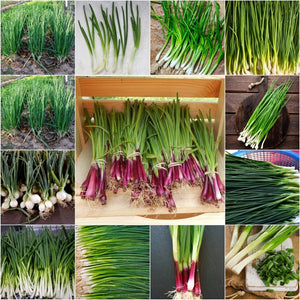
| 'Red (Bunching Red Beard)' | A. fistulosum; red stalk about 30 cm long on a plant to 70 cm | Colour in salads |
| 'Evergreen (Bunching Nebuka)' | A. fistulosum; clusters of 4 to 9 slender stalks, slow to bolt | A clump to cut from for months |
| 'Natsuyo' | A. fistulosum; non-bulbing, slender leaf, copes with heat | Summer and warm-climate sowings |
| 'White Lisbon' | A. cepa, a bulb onion; small bulbs may form from about 60 days | Sowing thickly and pulling young, before bulbs swell |
The bunching types do not form a true bulb, so they can stand in the bed for months. To grow onions for storing, see bulb onions.
Sowing direct
- Draw a shallow drill about 5 mm deep, up to 15 mm in light, sandy soil, with rows 15 to 30 cm apart.
- Sprinkle the seed thinly along it, cover with fine soil and firm gently.
- Water with a fine spray and keep the surface damp until the seedlings show, usually in 7 to 14 days.
- For pots, scatter the seed over the mix and cover it lightly.
Starting in trays
- Sow thinly in seed-raising mix in punnets or a tray, 5 mm deep.
- Grow the seedlings on for 4 to 6 weeks, until they are 10 to 15 cm tall.
- Harden them off (a week or so of longer spells outdoors each day, which toughens them for the open bed).
- Tease the roots apart, lay the seedlings in a shallow trench about 10 cm apart and cover the roots.
- Water in with seaweed solution at half strength, 15 mL per 9 L. Seedlings that lie flat stand up within a few days.
Care by growth stage
Steady moisture and a weed-free row decide the crop; feeding is light. Weeks count from sowing and stretch in winter.
| Stage | Water | Feed | Watch for |
|---|---|---|---|
| Emergence, weeks 0 to 3 | Keep the surface damp with a fine spray, never soggy | None until the first true leaf | Weeds among the seedlings; damping off (seedlings rotting and collapsing at soil level) in cold, wet trays |
| Seedlings, weeks 3 to 6 | Keep evenly moist; water in the morning, not the evening | Seaweed solution at half strength, 15 mL per 9 L, fortnightly | Crowding; thin as described in Thinning |
| Main growth, weeks 6 to 10 | Water often enough that the soil stays moist; the small roots cannot reach far | Fish and seaweed blend at 25 mL per 9 L, fortnightly | Silvery flecks from thrips; pale patches from downy mildew; orange rust bumps |
| Harvest, week 8 on | Keep watering evenly right through harvest | Fish and seaweed blend at 25 mL per 9 L after each cut on clumps kept for regrowth | Flower stalks; yellow young leaves on alkaline soil |
Once the seedlings are up, mulch between the rows with fine sugarcane or straw. Pile it or soil against the stems as they thicken to blanch them (keep out the light), which lengthens the white shank. If growth stalls in poor soil, a light dose of all-purpose controlled release granular (NPK around 14-5-10) scratched in can help.

Thinning
Crowded seedlings hold humid air around the leaves, which favours downy mildew and rust. Thin in two passes, and treat every pull as an early harvest.
- Thin rows grown for slim stalks to about 2 cm apart once the seedlings are big enough to grip.
- For thicker stems, thin again to 5 to 10 cm apart a few weeks later.
- Eat the thinnings in salads and stir-fries.
- Leave 'White Lisbon' sown thickly and pulled young, because crowding keeps the stalks fine.
- Split an old clump of a bunching type and replant single shoots to start a new one.
Companion planting
Spring onions are slim and quick, so they tuck in beside other low crops and move on before the space is needed.
Grows well with
- Carrot, whose fine foliage casts little shade on the onion row.
- Lettuce, low and quick, harvested over the same weeks.
- Beetroot and silverbeet, which share the moist, well-fed bed.
Keep apart
- Leeks, garlic, chives and bulb onions, which share thrips, rust and white rot.
- Climbing peas and beans, which shade the low row and which planners list as poor neighbours.
Harvesting Stalks
Start pulling once plants reach 15 to 20 cm, usually 8 to 14 weeks from sowing. Full size is 30 to 40 cm tall and about pencil thick.
- Pull whole plants or whole clumps, gripping low on the stem.
- In heavy soil, loosen the ground beside the row with a fork first.
- Cut clumps 3 to 5 cm above the soil instead, and they regrow a couple of times.
- Pull 'White Lisbon' before the base starts to swell into a bulb.

Keep spring onions in a plastic bag with a damp paper towel in the fridge, where they hold for about a week. Discard shrivelled or yellow leaves. Slice them raw into salads or scatter them over a stir-fry at the end. Keep scraps away from dogs and cats, because the onion family is toxic to them.
Common problems
Patchy germination. Onion seed loses vigour fast, and seed more than a couple of years old can be unreliable; cold, wet soil slows it further. Read more
Yellow youngest leaves. On alkaline soil, spring onions often run short of iron, and the newest leaves turn yellow first. Bring the pH down, as in Site, soil and setup.
Burnt, yellowing tips in summer. Hot, dry weather scorches the leaf tips; keep the soil moist and choose a heat-tolerant type such as 'Natsuyo'.
Plants lifting out of the soil. Onions push themselves towards the surface as they grow, which is normal. Draw soil or mulch back around the stems.
Flower stalks. Bunching onions left in the ground send up flower stalks in their second spring. Cut the clump back to about 5 cm and it regrows tender stalks.
Pests and diseases
Most trouble comes from one sap-sucker and three leaf and root diseases. Use only sprays labelled for spring onions, and keep to any withholding period on the label.
Onion thrips (Thrips tabaci). Insects about 1.5 mm long suck the leaf cells empty, leaving silvery-white flecks, mostly in warm weather. Spray horticultural oil or a soap solution several times, late in the afternoon, and pull the weeds that shelter them. Read more
Downy mildew (Peronospora destructor). Pale green to yellowish patches form partway down the outer leaves, with a violet-grey down in humid weather. It is worst when dew sits on the leaves (see Prevention first), and a copper fungicide may help. Read more
Onion rust (Puccinia allii). Bright orange or dark brown bumps form along the leaf veins, spread by wind and rain splash. It is not known to occur in Western Australia, and any rust on the onion family there must be reported.
White rot (Sclerotium cepivorum). Plants yellow and wilt, with white fluffy growth at the base and tiny black specks that survive in soil for up to 20 years. It is a major disease in south Queensland. Bin affected plants and keep that bed free of the onion family for at least ten years.
Prevention first
- Rotate beds, leaving two to three years between onion-family crops.
- Water in the morning, not the evening, so leaves dry before night.
- Pull weeds and self-sown onions, which harbour thrips and hold damp air.
- Sow thinly and go easy on nitrogen, because crowded, soft plants invite rust.
Tips
- Replant the white bases from a bought bunch in a pot or bed and they reshoot; see regrowing from kitchen scraps.
- Let a few bunching onions flower. The flowers draw bees, and the ripe seed gives you a fresh supply for the next sowing.
- In some parts of Australia these are sold as shallots. True shallots are a clustering bulb onion, grown from bulbs rather than seed.
Questions
Are spring onions and shallots the same thing?
In some parts of Australia, spring onions are sold as shallots. True shallots are a different plant: a bulb onion that forms a cluster of bulbs and is grown from bulbs, not seed. The spring onions in a seed packet are bunching onions or bulb onion varieties pulled young.
When should I plant spring onion seeds in Australia?
Most gardens can sow for much of the year. Tropical gardens sow April to August, and subtropical gardens February to October. Arid gardens sow February to April and August to October. Temperate gardens sow July to May, Mediterranean gardens February to December, and cool gardens August to April.
How long do spring onions take to grow from seed?
Usually 8 to 14 weeks from sowing. Growth is quicker in warm weather and slower in winter. You can start pulling slim stalks once plants reach 15 to 20 cm tall.
Will spring onions grow back after cutting?
Yes, bunching types regrow. Cut the leaves 3 to 5 cm above the soil and the plant sends up new stalks a couple of times. Bulb onion varieties such as 'White Lisbon' are better pulled whole.
Can I grow spring onions in a pot?
Yes. A pot at least 20 cm across and 15 to 20 cm deep will do, and a styrofoam broccoli box is better. Use quality potting mix, keep it moist and feed a liquid seaweed or fish and seaweed blend fortnightly.
Why are my spring onions flowering?
Bunching onions left in the ground flower in their second spring. Cut the clump back to about 5 cm and it regrows tender stalks. You can also leave a few to flower for bees and fresh seed.
Grow it



More vegetable guides
All vegetables
Amaranth
How to grow leaf amaranth, or Chinese spinach, in Australia: sowing months for six climate zones, warm soil, thinning, picking, pests and cooking the leaves.
| Position | Full sun |
|---|---|
| Depth | 3 to 6 mm |
| Spacing | 15 cm apart |
| First pick | 4 to 8 weeks |

Artichoke
How to grow globe artichokes from seed in Australia: sowing, spacing, feeding, when to cut the buds, cutting back, cardoon, and sowing months for every zone.
| Position | Full sun |
|---|---|
| Depth | 10 mm |
| Spacing | 1 to 1.5 m apart |
| First pick | About 42 to 57 weeks |

Bean
How to grow beans in Australia: sowing months by climate zone, bush and climbing types, low-nitrogen feeding, watering, picking pods, plus bean fly and rust.
| Position | Full sun, at least six hours |
|---|---|
| Depth | 25 to 30 mm |
| Spacing | Bush 10 to 15, climbing 15 to 20 cm |
| First pick | 7 to 14 weeks |

Beetroot
How to grow beetroot in Australia: sowing months for all six climate zones, thinning the seed clusters, steady watering, harvest size and the pests that matter.
| Position | Full sun or part shade |
|---|---|
| Depth | 10 to 20 mm |
| Spacing | 10 cm apart after thinning |
| First pick | 7 to 12 weeks |