
How to Grow Malabar Spinach in Australia
Malabar spinach is a frost-tender climbing vine grown for thick, glossy leaves through summer heat. Once the soil holds at least 18°C, soak the seed overnight. Sow it 10 mm deep and 20 to 30 cm apart at the foot of a trellis. Keep the soil moist, feed fortnightly, and pick shoot tips from about 8 weeks until frost.
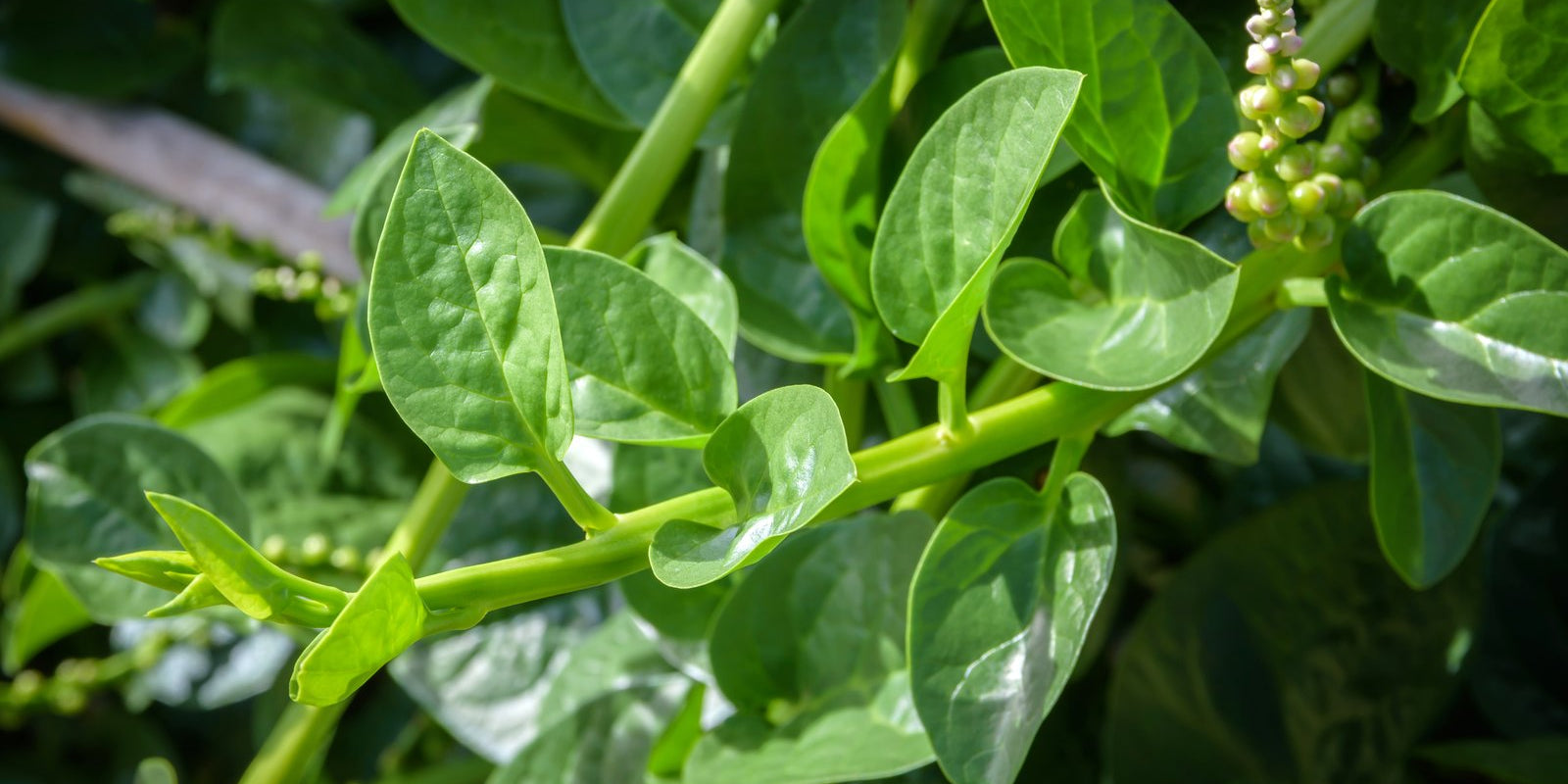
| Sun | Full sun to light shade |
|---|---|
| Water | Keep moist; daily in hot, dry spells |
| Soil | Rich, well drained, pH 5.5 to 7.0 |
| Feed | Liquid feed fortnightly; pellets at planting |
| Spacing | 20 to 30 cm |
| Depth | 10 mm |
| Germination | 10 to 21 days, soil 18 to 24°C |
| Harvest | From about 8 weeks |
| Container | Yes, 33 cm pot, about 18 L |
| Frost | Frost tender; frost kills the vine |
| Support | Trellis or fence at least 1.5 m high |
| Use | Raw young leaves, stir-fries, soups and stews |
Malabar spinach (Basella alba), also called Ceylon spinach, is a fast, twining vine in the family Basellaceae. It is grown for its thick, glossy leaves and tender shoot tips. It is not true spinach, and it keeps cropping through summer heat, long after spinach has run to seed. In the tropics it grows all year. The usual mistake is sowing it too early, into soil that is still cold.
Three mistakes that matter
- Sowing into cold soil. Seed is slow to come up in soil below about 18°C, and young plants stall while nights stay cool. Wait for warm spring soil before sowing outside; Starting in pots gives cooler districts a head start.
- Leaving it to sprawl. Without support the vine runs along the ground, roots where its stems touch the soil, and the leaves end up muddy and hard to pick. Put up a trellis or fence at least 1.5 m high before sowing.
- Letting the soil dry out. Water stress brings on early flowering, and the leaves turn bitter once flowering starts. Water deeply and often through summer, and keep a straw mulch over the root zone.
When to plant
Sow once the soil holds at least 18°C, the lower end of the 18°C to 24°C range in which the seed germinates best. Frost kills the vine outright, so frosty districts plant out only after the last frost. One spring sowing, kept picked, can crop for four to six months.
| Zone | Example cities | Sow | Harvest | Notes |
|---|---|---|---|---|
| Tropical | Darwin, Katherine NT; Cairns, Townsville QLD; Broome WA | Jan-Dec | Jan-Dec | Grows all year and often lives for years; dry-season vines need daily water. |
| Subtropical | Brisbane, Bundaberg QLD; Coffs Harbour, Lismore NSW | Aug-Mar | Oct-Jun | Sow once spring soil warms; growth slows in winter, and frost in inland valleys kills it. |
| Arid and semi-arid | Alice Springs NT; Broken Hill, Dubbo NSW; Mildura VIC; Kalgoorlie WA | Sep-Feb | Nov-Apr | Sow after the last frost; mulch deeply, water daily in heat, and avoid salty bore water. |
| Temperate | Sydney, Newcastle, Wollongong NSW; Melbourne, Geelong VIC | Sep-Jan | Nov-May | Sydney sows from September; Melbourne, the cold end, waits for warm soil around Melbourne Cup weekend. |
| Mediterranean | Perth, Bunbury WA; Adelaide and the SA coast | Sep-Feb | Nov-May | The summer heat arrives dry, so mulch deeply and water daily; vines usually die back in winter. |
| Cool and alpine | Hobart, Launceston TAS; Canberra ACT; Ballarat VIC; Orange NSW | Oct-Dec | Dec-Mar | A summer annual only: sow in pots indoors, plant out after the last frost; autumn frost ends it. |
At the early edge of a window, raise seedlings in pots and plant them out once the soil warms. Late sowings give a shorter harvest, because shortening autumn days push the vine into flower.
Site, soil and setup
A vine that can reach 4 m needs a permanent spot, a sturdy frame and soil rich enough to keep it in leaf.
| Get the bed right | What to do |
|---|---|
| Sun | Full sun; light shade in hot inland gardens gives larger, more succulent leaves |
| Soil | Rich, moist and well drained; it does not cope with waterlogged or salty soil |
| pH | 5.5 to 7.0; below that, garden lime or dolomite lime at 100 to 200 g per square metre, 4 weeks ahead |
| Base feed | Dig in a 5 cm layer of compost or well-rotted manure, then rake in pelletised chicken manure at 100 g per square metre |
| Support | A trellis, fence or mesh panel at least 1.5 m high, in place before sowing |
| Rotation | Avoid beds where root-knot nematodes galled the roots of last summer's crops |
Container growing
A pot at least 33 cm wide, holding about 18 L, carries one vine, with an obelisk in the pot or a trellis behind it. Fill it with premium potting mix, never garden soil. Both lines the store sells suit a pot, and the reddish-purple stems of the Red make it as ornamental as it is useful.
- Water: check daily in summer and water before the mix dries, since dry roots bring on flowering.
- Feed: fish and seaweed blend at 25 mL per 9 L, fortnightly from the first true leaves.
- Position: full sun; in frosty districts, move the pot to a sheltered spot in autumn and keep it there until spring.
Sowing Seeds
Sow direct at the foot of the trellis in warm soil, or raise seedlings in pots where spring warms slowly.
Preparing the seed
The hard seed coat slows water getting in, so untreated seed can take three weeks to come up. Soak the seed in water overnight before sowing, or rub each seed lightly on sandpaper to nick the coat (scarification). Either speeds germination. Both methods are set out in soaking and scarification.
Sowing direct
- Sow 10 mm deep, two or three seeds to a station, with stations 20 to 30 cm apart along the trellis.
- Keep the surface damp; seedlings usually appear in 10 to 21 days.
- Thin to the strongest seedling at each station once it has its first true leaves.
- Mulch with straw once the seedlings are up.
Starting in pots
Pots give a head start in the temperate, Mediterranean and cool zones, where spring soil warms slowly.
- Sow two seeds per small pot of seed-raising mix, at the same depth, and keep the stronger seedling.
- Keep the pots warm; a seedling heat mat helps in a cold spring.
- Plant out when seedlings are 5 to 10 cm tall, after the last frost.
- Harden off (accustom seedlings to sun and wind over about a week) before planting out.
- Water in with seaweed solution at half strength, 15 mL per 9 L.
| Line | Stems and leaves | Growth | Grow it for |
|---|---|---|---|
| Green | Green stems; thick, dark green leaves | Vigorous climbing vine | Leaves and tips for the kitchen |
| Red | Reddish-purple stems; glossy dark green leaves | Faster than the green, to about 4 m | Kitchen leaves, and a screen on a fence or arch |
The red-stemmed form is often sold as Basella rubra, an older name for the same species, and it grows exactly as the green does.
Care by growth stage
Heat, water and nitrogen decide this crop. It grows fastest from 20°C to 35°C, stalls when nights stay cool, and answers a regular liquid feed with new leaf. Weeks count from sowing.
| Stage | Water | Feed | Watch for |
|---|---|---|---|
| Germination, weeks 0 to 3 | Keep the surface damp, never soggy | None | Seed sitting in soil that is too cold (see When to plant); seedlings toppling at the base |
| Seedling, weeks 3 to 6 | Water whenever the surface starts to dry | Seaweed solution at half strength, 15 mL per 9 L, fortnightly; or an all-purpose soluble (NPK 23-4-18 to 27-5-9) at the label rate, fortnightly | Stems reaching the trellis: guide them onto the lowest wire |
| Climbing growth, weeks 6 to 10 | Deep soaks two or three times a week; daily in hot, dry spells | Fish and seaweed blend at 25 mL per 9 L, fortnightly, plus pelletised chicken manure at 100 g per square metre; or an all-purpose soluble (NPK 23-4-18 to 27-5-9), fortnightly | Aphids on soft shoot tips |
| Picking, week 8 onwards | Keep moisture steady right through picking; never let the bed dry out | Fish and seaweed blend at 25 mL per 9 L, fortnightly; or a controlled release granular (NPK around 14-5-10) scratched in at the label rate | Flower spikes in the leaf joints |
| Autumn slowdown | Water less as growth slows | None once nights turn cool | The first frost forecast: take cuttings or move pots under cover |

Pinching and Harvesting
Picking is the pruning here: every tip taken makes the vine branch, so a well-picked plant grows bushy and stays in leaf. Flowers are the signal to step in.
- Pinch out the growing tip once the vine is about 50 cm long, so side branches start.
- Pick off flower spikes as they form, to keep leaves coming and stop self-sown seedlings.
- Cut back runners that grow past the top of the frame or along the ground.
- In the tropics, feed long-lived vines regularly; vines that go unfed tend to die back after a couple of years.
Companion planting
Good neighbours share its summer heat without sharing its weak point, a root system that root-knot nematodes find easy to invade.
Grows well with
- Corn and amaranth, warm-season crops that do not feed root-knot nematodes, so they also suit the bed before it.
- Lettuce, sown on the shaded side of the trellis, where the vine screens it from the hottest sun.
Keep apart
- Tomatoes, eggplant and beans, which host the same root-knot nematodes, so numbers build up when they follow one another.
- Other climbers on the same frame, such as cucumbers, which compete for light and space and tangle at picking time.
Harvesting Leaves
Start picking from about 8 weeks after sowing, once the leaves are big enough to use.
- Snip shoot tips 15 to 25 cm long, with their young leaves, every week.
- Take large single leaves from the main stems between tip harvests.
- Pick in the cool of the morning, and get the leaves into the fridge quickly.

Picked shoots wilt within a day in summer warmth. Wrap them in a damp cloth or a bag in the crisper, and use them within a week. Eat young leaves raw in salads, or toss tips in a hot pan with garlic for a minute. Leaves added to soups and stews thicken them as they cook.
Common problems
Flowers and bitter leaves. Dry soil and shortening autumn days bring on flower spikes; see Three mistakes and Pinching and Harvesting.
Slow growth in spring. The vine barely grows while nights stay cool, so early plants can sit still for weeks before summer heat sets them going.
Collapse at the first frost. Frost kills the vine, so in cold districts it is grown as a summer annual; Tips sets out how to carry one over.
Purple stains and stray seedlings. Ripe berries hold a purple juice that stains paving and clothes, and dropped berries can come up as seedlings. Picking off flowers prevents both.
Pale, stretched seedlings. Seedlings raised on a dim windowsill stretch for light and flop when planted out. Read more
Pests and diseases
A thick leaf skin keeps Malabar spinach freer of leaf pests and diseases than most greens, so the main trouble is below ground.
Root-knot nematode (Meloidogyne species). Microscopic soil worms knot the roots into galls, and the vine stunts, yellows and wilts. The crop is very susceptible, and damage is worst in warm, sandy soils. Dig in compost or manure, and keep host crops apart as set out in Companion planting. Read more
Aphids (superfamily Aphidoidea). Small sap-sucking insects cluster on soft shoot tips. Hose them off or spray insecticidal soap, and let ladybirds and lacewings finish the job. Read more
Bacterial leaf spot. Spots appear on the leaves and can spread through a crowded vine. Pick off and bin spotted leaves, and thin tangled growth so the leaves dry quickly.
Damping off (Rhizoctonia species). Young seedlings rot at the stem base and topple, most often in cold, wet soil. Sow into warm soil, use fresh seed-raising mix in pots, and water lightly until seedlings grow away. Read more
Prevention first
- Lift a spent plant at the end of summer and check its roots for galls before choosing next year's bed.
- Keep compost and mulch topped up, since organic matter feeds the soil life that preys on nematodes.
- Check the shoot tips weekly for aphids at picking time.
- Water at the base in the morning, so the leaves dry quickly.
Tips
- Shoot tips about 20 cm long root readily in a glass of water. A rooted tip potted up in autumn and kept somewhere bright and frost free can start next summer's vine. Read more
- To save seed, let a few late spikes ripen to purplish-black berries, about a month after flowering, then dry them whole for sowing next spring.
- Pair it with true spinach for greens all year: spinach through the cool months, and Malabar spinach through the heat. Warrigal Greens and Egyptian Spinach, two other summer greens unrelated to it, have their own guides.
Questions
Is Malabar spinach the same as spinach?
No. Malabar spinach, Basella alba, is a climbing vine in the family Basellaceae and is unrelated to true spinach. It is used the same way in the kitchen, and it grows through hot summers, when true spinach runs to seed.
When do you plant Malabar spinach in Australia?
Sow in spring and early summer, once the soil holds at least 18°C and frost has passed. The tropics can sow in any month. Cool districts such as Canberra and Hobart sow in pots indoors from October and plant out after the last frost.
Why is Malabar spinach slimy?
The thick leaves hold mucilage, much like okra, which turns silky when cooked. Cook the leaves only briefly, or eat young leaves raw in salads. The same quality thickens soups, stews and curries.
Does Malabar spinach come back every year?
In the tropics it is a short-lived perennial that can crop for years. Frost kills it, so in cooler zones it is grown as a summer annual. Root a few shoot tips in water in autumn and keep them frost free to start next year's vine.
What is the difference between red and green Malabar spinach?
The red form has reddish-purple stems and grows faster than the green, reaching about 4 m. It is often sold as Basella rubra. Both are grown and eaten the same way, and the red doubles as an ornamental climber.
Can you grow Malabar spinach in a pot?
Yes. Use a pot at least 33 cm wide, holding about 18 L, with premium potting mix and an obelisk or trellis to climb. Water before the mix dries and feed fish and seaweed blend fortnightly.
Grow it
Tap Add beside a size to put it in your cart. You stay on this page.
- Spinach - Malabar (Ceylon) Green seedsFrom $2.99
- Spinach - Malabar (Ceylon) Red seedsFrom $2.99


More vegetables to sow in October
All vegetables
Amaranth
How to grow leaf amaranth, or Chinese spinach, in Australia: sowing months for six climate zones, warm soil, thinning, picking, pests and cooking the leaves.
| Position | Full sun |
|---|---|
| Depth | 3 to 6 mm |
| Spacing | 15 cm apart |
| First pick | 4 to 8 weeks |

Artichoke
How to grow globe artichokes from seed in Australia: sowing, spacing, feeding, when to cut the buds, cutting back, cardoon, and sowing months for every zone.
| Position | Full sun |
|---|---|
| Depth | 10 mm |
| Spacing | 1 to 1.5 m apart |
| First pick | About 42 to 57 weeks |

Bean
How to grow beans in Australia: sowing months by climate zone, bush and climbing types, low-nitrogen feeding, watering, picking pods, plus bean fly and rust.
| Position | Full sun, at least six hours |
|---|---|
| Depth | 25 to 30 mm |
| Spacing | Bush 10 to 15, climbing 15 to 20 cm |
| First pick | 7 to 14 weeks |

Beetroot
How to grow beetroot in Australia: sowing months for all six climate zones, thinning the seed clusters, steady watering, harvest size and the pests that matter.
| Position | Full sun or part shade |
|---|---|
| Depth | 10 to 20 mm |
| Spacing | 10 cm apart after thinning |
| First pick | 7 to 12 weeks |