
How to Grow Onions in Australia
Onions form a bulb once the days reach a set length, so match the type to your month. Sow short-day types in autumn and in the north, and intermediate and long-day types later in southern gardens. Sow 5 mm deep in free-draining, compost-rich soil, thin to 10 cm and weed often. Lift when half the tops fall, 24 to 34 weeks from sowing, then cure.

| Sun | Full sun, six hours or more |
|---|---|
| Water | Steady; ease off as the tops fall |
| Soil | Free-draining, compost-rich, pH 6.0 to 6.5 |
| Feed | Moderate; nitrogen early, potash as bulbs swell |
| Spacing | 10 cm apart |
| Depth | About 5 mm |
| Germination | 7 to 14 days, soil 8°C to 30°C |
| Harvest | 24 to 34 weeks |
| Container | Small types; 30 cm deep, 20 L or more |
| Frost | Frost hardy; grows slowly through winter |
| Use | Bulbs raw or cooked; thinnings as spring onions |
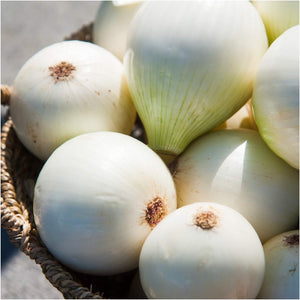
Onion (Allium cepa) belongs to the onion family, Amaryllidaceae, and is grown for its brown, white or red bulb, round, long or flat. It is a biennial (a plant that flowers in its second year) grown as an annual. Commercial crops grow from the Lockyer Valley in Queensland to the Riverina in New South Wales. The catch is day length: each variety starts its bulb only when days reach a set length.
Three mistakes that matter
- Sowing a type that does not suit the month. A variety sown out of step with its day length can bolt (run to flower), grow a thick neck or make no real bulb. Match the type to your sowing month: see Sowing Seeds.
- Letting weeds crowd the rows. Young onions have thin, upright leaves and compete poorly, and weeds that get ahead in the first months stunt them for good. Weed by hand every week while the plants are small: see Care by growth stage.
- Feeding nitrogen late, or digging in fresh manure. Both give soft bulbs with thick necks that let rot in and keep poorly. Feed early, stop nitrogen as the bulbs start to swell, and use only well-rotted manure: see Site, soil and setup.
When to plant
Sow so each plant grows plenty of leaf through the cool months before its bulbing day length arrives, because bigger plants make bigger bulbs. Seed germinates in soil from about 8°C to 30°C, so soil warmth seldom limits sowing.
| Zone | Example cities | Sow | Harvest | Notes |
|---|---|---|---|---|
| Tropical | Darwin, Katherine NT; Cairns, Townsville QLD; Broome WA | Apr-May | Sep-Nov | Short-day types only, sown as the dry season starts; bulb onions often struggle, and spring onions are surer. |
| Subtropical | Brisbane, Bundaberg QLD; Coffs Harbour, Lismore NSW | Feb-Jun | Aug-Dec | Short-day types; start February and March sowings in trays, planting out as autumn cools. |
| Arid and semi-arid | Alice Springs NT; Broken Hill, Dubbo NSW; Mildura VIC; Kalgoorlie WA | Mar-Aug | Oct-Feb | Around Alice Springs, sowing can start in February. Short-day types in autumn, intermediate types from June. |
| Temperate | Sydney, Newcastle, Wollongong NSW; Melbourne, Geelong VIC | Apr-Sep | Oct-Mar | Short-day types Apr to May, intermediate Jun to Jul, long-day Aug to Sep. Melbourne starts in late April. |
| Mediterranean | Perth, Bunbury WA; Adelaide and the SA coast | Apr-Sep | Oct-Mar | Adelaide starts in April and Perth in May, short-day types first; lift and cure before the summer heat peaks. |
| Cool and alpine | Hobart, Launceston TAS; Canberra ACT; Ballarat VIC; Orange NSW; Stanthorpe QLD | Apr-Sep | Nov-Mar | Short-day types Apr to Jun, keepers Jun to Sep; seedlings thinner than a pencil at midwinter seldom bolt. |
Sow short-day types early in a window and long-day types late in it. Sowing too early risks bolting, and sowing too late gives small bulbs (see Common problems).
Site, soil and setup
Onions sit on the surface with shallow roots, so they want an open, sunny bed that drains well and is free of weeds.
| Get the bed right | What to do |
|---|---|
| Sun | Full sun, at least six hours a day, out of strong wind |
| Soil | Fork 15 to 20 cm deep; dig in a 5 cm layer of compost, or 5 to 10 cm of well-rotted cow manure 4 to 6 weeks ahead; never fresh manure |
| pH | 6.0 to 6.5, around 6.5 ideal; below 6.0, dolomite lime or garden lime at 100 to 200 g per square metre, 4 weeks before sowing |
| Drainage | A raised bed on heavy clay; onions suffer after as little as two days of waterlogging |
| Base feed | Blood and bone at 100 to 150 g per square metre raked in at sowing, or a controlled release all-purpose granular (NPK around 14-5-10) mixed in |
| Rotation | A bed free of onions, garlic, leeks and shallots for at least four years |
A bed that has just grown leafy greens or brassicas suits onions well, because those crops use up much of the nitrogen. Never sow where onions or garlic have shown white rot (see Pests and diseases).

Container growing
A pot or trough at least 30 cm deep and 30 cm across, holding 20 L or more, grows a small crop. Fill it with vegetable potting mix and grow small types. For flat bulbs 2 to 5 cm across, sow 'Cipollini Brown'; 'Gladalan White' can be pulled young as a spring onion. Space plants about 5 cm apart for small bulbs.
- Water whenever the top of the mix starts to dry, which can mean daily in warm, windy weather.
- Feed seaweed solution at half strength, 15 mL per 9 L, fortnightly from the first true leaf. Switch to fish and seaweed blend at 25 mL per 9 L fortnightly, and stop once bulbs swell. Or mix a controlled release granular for containers into the mix at sowing.
- Stand the pot in full sun, six hours or more a day.
Sowing Seeds
Raise onions in trays for transplanting or sow them straight into the row; trays keep the fiddly early weeding out of the bed.
| Type | Bulbs when days reach | Sow | Keeping | Store varieties |
|---|---|---|---|---|
| Short day | About 10 to 12 hours | Autumn in every zone; the main type for tropical and subtropical gardens | Short; eat first | 'Gladalan Brown', 'Gladalan White' |
| Intermediate day | About 12 to 14 hours | Late autumn to midwinter in temperate, arid, Mediterranean and cool gardens | A few months | 'Early White Spanish', 'Yellow Spanish Early', 'Amposta Purple' |
| Long day | About 14 to 16 hours | Late autumn to early spring in southern gardens only | Six months or more, cured well | 'Early Pukekohe Long Keeper', 'Extra Early Creamgold' |
Some packets name no type, such as 'Rio Red Rocks', 'Early White Grano', 'Long Tropea Red' and the 'Odourless' onions. Follow the sowing notes that come with them. Some seed is treated with a fungicide (thiram) and may be dyed. Never eat it or feed it to animals, wear gloves, wash your hands afterwards, and keep it from children. Use fresh seed, because onion seed loses viability within a year or two.
Starting in trays
- Sow 5 mm deep in seed-raising mix, or drop 6 or 7 seeds into a 1 cm hole in each cell to grow a clump.
- Keep the mix moist in morning sun and afternoon shade; seedlings show in 7 to 14 days.
- Plant out 6 to 8 weeks after sowing, when seedlings are 10 to 15 cm tall and no thicker than a pencil.
- Harden them off first (a week or two of longer spells outdoors each day, which toughens them for the open bed).
Sowing straight into the bed skips transplanting, but the seedlings look like blades of grass and are easily lost among weeds.
Sowing direct
- Draw a furrow about 5 mm deep, with rows 30 cm apart.
- Mix the fine seed with dry sand so it runs out evenly (see sowing tiny seeds), cover it with fine soil and water gently.
- Keep the surface damp until the seedlings show.
- Thin early to 2 cm apart, then later to 10 cm, and eat the thinnings as spring onions.

Planting out
- Trim the tops and roots slightly, which makes the seedlings easier to handle and settle.
- Lay them along the side of a trench about 5 cm deep, roots at the bottom, and backfill. They stand up again within a week or so.
- Space plants 10 cm apart in rows 30 cm apart, or multi-sown clumps 25 cm apart.
- Thin each clump as it grows until three or four bulbs remain.
- Keep the base at soil level, because bulbs swell on the surface and planting too deep invites neck rot.
- Water in with seaweed solution at half strength, 15 mL per 9 L.
Care by growth stage
Clean rows and steady water in the leafy months, then potash and even moisture as the bulbs swell, decide both size and keeping. Weeks count from sowing and stretch in cold districts.
| Stage | Water | Feed | Watch for |
|---|---|---|---|
| Seedling, weeks 0 to 8 | Keep the surface damp, never soaking, with a gentle spray | Seaweed solution at half strength, 15 mL per 9 L, fortnightly from the first true leaf; conventional option, nothing more where a controlled release granular went in at sowing | Damping off (seedlings rotting and collapsing at soil level) in cold, wet mix; cutworms felling seedlings; seedling maggot (Delia platura), small larvae that tunnel into stems below ground in cool, moist soil, so seedlings wilt and die |
| Leaf growth, weeks 8 to 16 | Deep, regular soaks whenever the top few centimetres dry | Fish and seaweed blend at 25 mL per 9 L fortnightly; conventional option, the controlled release granular from sowing still covers this stage | Weeds; thrips silvering the leaves in dry spells; downy mildew in cool, damp weather; onion rust (Puccinia allii), orange or dark brown bumps along the leaf veins, which must be reported in Western Australia |
| Bulbing, weeks 16 to 26 | Even moisture; a dry spell followed by a soaking splits bulbs | No more nitrogen once the bulb is about twice the width of the stem; sulphate of potash at 30 to 50 g per square metre once, watered in; conventional option, a high potassium soluble (0-0-41) at the label rate, fortnightly | Flower stalks; thrips at their most damaging |
| Ripening, the last 2 to 4 weeks | Ease off as tops start to yellow, and stop 1 to 2 weeks before lifting so the necks dry | None | Tops falling over; yellowing plants that pull free with white fluff at the base |
Mulch lightly between the rows once plants are established, keeping it clear of the bulbs so they do not rot. In frosty districts a little straw over the rows protects young plants in hard cold. Rake it back in spring so the soil can warm. Hand-weed rather than hoe close to the plants.

Companion planting
Onions have narrow leaves, so good neighbours stay low and do not share their diseases.
Grows well with
- Lettuce, quick and low, which is cut before the bulbs need the room.
- Carrot, whose fine leaves cast little shade on the onion row.
- Spinach, low and leafy, which shares the cool season without shading the row.
Keep apart
- Garlic, leeks and shallots, which share white rot, thrips, downy mildew and rust.
- Sweet corn and climbing beans, tall crops that can shade the short onion leaves.
- Pumpkin and other sprawling vines, which smother the rows.
Harvesting Bulbs
Lift the bulbs once about half the tops have yellowed and fallen over, usually 24 to 34 weeks from sowing.
- Bend over any tops still standing once most have fallen.
- Choose a dry day, loosen the soil with a fork and ease the bulbs up rather than pulling on the leaves.
- Handle them gently, because a bruised bulb is the first to rot.
- Eat short-day types, red types and 'Long Tropea Red' early, and keep brown long-day types for storing.

Curing
| Step | What to do | How long |
|---|---|---|
| Dry | Spread the bulbs in a single layer on racks or slatted trays in a dry, airy spot out of hot sun, or hang them in bunches | 2 to 3 weeks, until the necks are dry and the skins papery |
| Trim | Cut the tops to 2 to 3 cm above the bulb and trim the roots, or plait soft-necked types together | Once the necks are fully dry |
| Store | A cool, dry, airy place, in mesh bags or slatted crates, off concrete and never in plastic bags | Brown keepers 6 to 8 months; white and red types less |
Without curing, even a long keeper is likely to rot early. Roast brown onions whole, slice red ones raw into salads, and cook cipollini whole.
Common problems
Flower stalks. Bolting usually follows a sowing too early, so plants thicker than a pencil meet winter cold, or drought and heat stress. Bolted bulbs will not store, so use them first.
Tiny bulbs or none. A short-day type sown too late bulbs before it has grown, making pickling-sized onions. A long-day type in the north may never meet its day length. See When to plant for the timing.
Thick necks. Late nitrogen and fresh manure are the usual cause (see Three mistakes), and an early sowing can do the same.
Split or double bulbs. Irregular watering while the bulbs swell splits them and shortens their storage life.
Pests and diseases
Most onion troubles in Australian gardens are sap-sucking thrips and a few soil and leaf diseases that rotation and hygiene help keep down. Use only sprays labelled for the pest on onions, and keep to any withholding period before harvest.
Onion thrips (Thrips tabaci). Slender insects about 1.5 mm long rasp the leaves, leaving silvery streaks, and large numbers can kill seedlings. Plants suffer most as bulbs begin to form. Hose them off or spray insecticidal soap, and encourage ladybirds and lacewings. Read more
Downy mildew (Peronospora destructor). Pale green-yellow patches carry a purplish-grey growth, spreading in cool, humid spells around 10°C to 15°C. Pull volunteer onions that carry it over, and use a copper fungicide if it keeps returning. Read more
White rot (Sclerotium cepivorum). Plants yellow, wilt and pull free, with white fluff and black specks like poppy seeds on the base. The specks survive in soil for 20 years or more. Bin sick plants with the soil around their roots, never compost them, and grow no alliums there again. It travels in soil, so clean boots and tools after working that bed. Western Australia keeps it out with strict movement controls.
Neck rot (Botrytis allii). The neck softens and rots once the bulbs are in storage. It carries on seed, volunteer plants and debris, and thick necks and bruised bulbs let it in, so cure every bulb thoroughly.
Black mould (Aspergillus niger). Sooty black spore masses form under the outer scales of stored bulbs. Heat and humidity at harvest favour it, so dry the bulbs quickly and store them cool.
Cutworm (Agrotis species). Soil caterpillars chew seedlings at ground level at night and hide 1 to 10 cm down by day, most in cool, wet weather. Patrol with a torch after dark and pick them off. Read more
Prevention first
- Raise your own seedlings rather than buying them, so white rot does not arrive with them.
- Keep onion, garlic and leek scraps out of the compost, and clear old onion debris after harvest.
- Avoid crowding and water the soil, not the leaves, so the foliage dries quickly.
- Pick off dead leaves as they appear, since they harbour disease.
Tips
- In southern gardens, sow three types for a longer harvest. Sow a short-day type around Anzac Day, an intermediate type in June and a long-day type in August.
- As bulbs near maturity, brush the soil off the top third of each one. The sun and air on the shoulders help it ripen and cure.
- Eat the thick-necked and oddly shaped bulbs first. Thin-necked bulbs with a flat base usually keep longest.
Questions
When should I plant onion seeds in Australia?
Mostly in autumn and winter, matching the type to the month. Tropical gardens sow short-day types in April and May, subtropical gardens February to June and arid gardens March to August. Temperate, Mediterranean and cool gardens sow April to September.
What is the difference between short-day and long-day onions?
Each type starts its bulb once days reach a set length. Short-day onions bulb at about 10 to 12 hours of daylight, intermediate types at 12 to 14 and long-day types at 14 to 16. Northern gardens grow short-day types; long-day types suit southern gardens and usually keep longest.
Why did my onions not form bulbs?
Usually the type did not suit the sowing month. A short-day onion sown too late bulbs early and stays tiny, while a long-day onion in the north may never meet its day length. Weeds, crowding and late nitrogen also shrink bulbs, so weed weekly and stop nitrogen once bulbs start to swell.
Why are my onions going to seed?
Bolting usually means the seed went in too early, so plants thicker than a pencil met a cold spell. Drought or heat stress can do the same. The bulb stops improving and will not store, so use bolted onions first and sow a little later next time.
How do I store home-grown onions so they last?
Cure them first. Spread the bulbs in a dry, airy spot out of hot sun for 2 to 3 weeks. They are ready when the necks are dry and the skins papery. Trim the tops to 2 to 3 cm and keep them cool and dry in mesh bags. Well-cured brown onions can keep 6 to 8 months.
Can I grow onions in a pot?
Yes, small ones. Use a pot at least 30 cm deep and 30 cm across, holding 20 L or more, filled with vegetable potting mix. Space plants about 5 cm apart and choose small types such as 'Cipollini Brown'. Water whenever the mix starts to dry and feed seaweed solution at half strength fortnightly.
Grow it




More vegetable guides
All vegetables
Amaranth
How to grow leaf amaranth, or Chinese spinach, in Australia: sowing months for six climate zones, warm soil, thinning, picking, pests and cooking the leaves.
| Position | Full sun |
|---|---|
| Depth | 3 to 6 mm |
| Spacing | 15 cm apart |
| First pick | 4 to 8 weeks |

Artichoke
How to grow globe artichokes from seed in Australia: sowing, spacing, feeding, when to cut the buds, cutting back, cardoon, and sowing months for every zone.
| Position | Full sun |
|---|---|
| Depth | 10 mm |
| Spacing | 1 to 1.5 m apart |
| First pick | About 42 to 57 weeks |

Bean
How to grow beans in Australia: sowing months by climate zone, bush and climbing types, low-nitrogen feeding, watering, picking pods, plus bean fly and rust.
| Position | Full sun, at least six hours |
|---|---|
| Depth | 25 to 30 mm |
| Spacing | Bush 10 to 15, climbing 15 to 20 cm |
| First pick | 7 to 14 weeks |

Beetroot
How to grow beetroot in Australia: sowing months for all six climate zones, thinning the seed clusters, steady watering, harvest size and the pests that matter.
| Position | Full sun or part shade |
|---|---|
| Depth | 10 to 20 mm |
| Spacing | 10 cm apart after thinning |
| First pick | 7 to 12 weeks |