
How to Grow Collards in Australia
Collards are loose-leaved brassicas picked leaf by leaf for months. Sow seed 5 to 10 mm deep, mostly from late summer into autumn, in soil of 8°C to 30°C. Space plants 45 to 80 cm apart in full sun and keep the soil evenly moist. Check under the leaves for caterpillars twice a week, and pick the lower leaves from 8 to 11 weeks.

| Sun | Full sun, 6 to 8 hours |
|---|---|
| Water | Evenly moist; about 25 to 50 mm weekly |
| Soil | Fertile, free-draining, deep; pH 6.5 to 7.5 |
| Feed | Light; fish and seaweed blend, fortnightly |
| Spacing | 45 to 80 cm, by variety |
| Depth | 5 to 10 mm |
| Germination | 3 to 7 days at 8°C to 30°C |
| Harvest | First leaves 8 to 11 weeks |
| Container | Yes, 'Vates'; pot at least 20 L |
| Frost | Frost hardy; frost sweetens the leaves |
| Use | Leaves steamed, braised, stir-fried or as wraps |
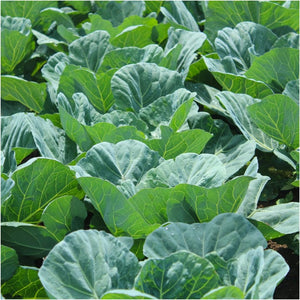
Collards (Brassica oleracea, Acephala group) are a leafy vegetable in the cabbage family, Brassicaceae, grown for broad leaves picked one at a time for months. They are the same species as kale and cabbage but form no head. They also handle heat better than either, so they suit northern gardens as well as southern ones. The usual mistake is letting caterpillars get a start on the young leaves.
Three mistakes that matter
- Letting caterpillars get ahead. Cabbage white butterfly and diamondback moth caterpillars feed under the leaves and can leave young plants full of holes. Check the undersides twice a week from planting and act on the first eggs or caterpillars, as set out in Pests and diseases.
- Planting too close. Collards grow into broad plants, and crowded ones give smaller leaves and hold the damp, still air that downy mildew needs. Give each plant the room shown in Thinning.
- Stripping the plant. Cutting off the top, or taking most of the leaves at once, stops the plant cropping again. Pick the lower, outer leaves and leave the top rosette growing, as described in Harvesting Leaves.
When to plant
Collard seed germinates in soil from 8°C to 30°C, usually in 3 to 7 days, so soil temperature seldom holds a sowing back. The better guide is the pests and the weather: caterpillars are most active from spring to autumn, and frost sweetens the leaves. One sowing crops for months, so most gardens need only one or two sowings a year.
| Zone | Example cities | Sow | Harvest | Notes |
|---|---|---|---|---|
| Tropical | Darwin NT; Cairns, Townsville QLD; Broome WA | Apr-Jul | Jun-Nov | Sow early in the dry season. 'Georgia Southern' copes best with the heat as the build-up approaches. |
| Subtropical | Brisbane, Gold Coast, Bundaberg QLD; Coffs Harbour, Lismore NSW | Mar-May and Aug | May-Dec | Autumn sowings crop through the mild winter. Diamondback moth peaks in autumn and spring; avoid summer sowings. |
| Arid and semi-arid | Alice Springs NT; Broken Hill, Dubbo NSW; Mildura VIC; Kalgoorlie WA | Mar-Jun | May-Oct | Sow once the summer heat breaks and mulch well. Plants ride out winter frosts and finish as spring heats up. |
| Temperate | Sydney, Newcastle, Wollongong NSW; Melbourne, Geelong VIC | Jan-Mar and Aug-Dec | Mar-Sep and Oct-Mar | Late summer sowings crop through winter. Spring and summer sowings meet the most caterpillars, so check leaves often. |
| Mediterranean | Perth, Bunbury WA; Adelaide and the SA coast | Feb-Apr and Aug-Oct | Apr-Sep and Oct-Jan | Shade and water late summer seedlings; winter rain carries autumn plants. Spring sowings finish before the dry heat. |
| Cool and alpine | Hobart, Launceston TAS; Canberra ACT; Ballarat VIC; Orange NSW | Aug-Feb | Oct-Jul | Start August sowings in trays under cover. Plants handle frost well, and it sweetens the leaves. |
In southern gardens, seedlings raised in trays in March are ready to plant out around Anzac Day. A late winter sowing can take over when autumn-sown plants flower in spring; see Common problems.
Site, soil and setup
| Get the bed right | What to do |
|---|---|
| Position | Full sun, 6 to 8 hours a day. In the tropics and subtropics, light afternoon shade helps in the hottest months |
| Soil | Moist, fertile, free-draining loam, dug deeply: collard roots can reach 60 cm |
| pH | 6.5 to 7.5. Below 6.5, garden lime or dolomite lime at 100 to 200 g per square metre, 4 weeks before planting. Where clubroot has appeared, lime to 7.0 to 7.5 |
| Drainage | No standing water. Warm, wet, acid soil favours clubroot, so use a raised bed on heavy clay |
| Organic matter | A 5 cm layer of compost dug in before planting |
| Base feed | Pelletised chicken manure at 100 g per square metre at planting |
Plant collards where beans, onions or tomatoes grew, never after kale, cabbage, broccoli or mustard. Clubroot spores can survive in soil for up to 20 years.
Container growing
'Vates' is the collard for a pot, since it stays about 30 to 40 cm tall. Grow one plant in a pot of at least 20 L and 30 cm across. Give it drainage holes and fill it with premium potting mix. 'Georgia Southern' grows too large for most pots and does better in a bed.
- Water: pots dry out faster than beds, so check them daily in warm weather and water before the mix dries out.
- Feed: from three weeks after planting, fish and seaweed blend at 25 mL per 9 L, fortnightly.
- Position: full sun in the cool months; move the pot into afternoon shade during hot spells.
Sowing Seeds
Raise collards in trays and plant them out at 4 to 6 weeks, or sow them where they are to grow and thin them.
Choosing a variety
| Variety | Size and habit | What it changes |
|---|---|---|
| 'Vates' | Compact, 30 to 40 cm tall and 50 to 90 cm across, with blue-green, lightly curled leaves | Early, with first picks from about 55 days. Thrives in colder climates, and light frost sweetens it. The better choice for pots, small beds and cool districts |
| 'Georgia Southern' | Large plants, up to 80 cm; an heirloom from before 1880 | Resists both heat and cold, so it suits tropical and subtropical gardens. Needs the widest spacing in Thinning |
Starting in trays
- Sow two seeds per cell of seed-raising mix, 5 to 10 mm deep.
- Keep the mix damp; seedlings usually emerge in 3 to 7 days.
- Snip the weaker seedling in each cell at mix level.
- Plant out at 4 to 6 weeks, when seedlings are 5 to 10 cm tall.
- Harden them off first (a week of gradually longer spells outdoors); see hardening off seedlings.
Sowing direct
- Rake the bed to a fine surface and water it the day before.
- Sow two or three seeds per station, 5 to 10 mm deep, with stations at the spacing in Thinning.
- Keep the surface damp until the seedlings are up.
- Thin to the strongest seedling at each station.
Care by growth stage
Steady water decides how tender the leaves are, and a light, regular feed keeps new leaves coming. Weeks count from sowing.
| Stage | Water | Feed | Watch for |
|---|---|---|---|
| Germination, weeks 1 to 2 | A light daily watering to keep the surface damp | Nothing | Seedlings collapsing in wet mix (damping off) |
| Seedling, weeks 2 to 6 | Water every day or two so the top few centimetres stay moist | Seaweed solution at half strength, 15 mL per 9 L, fortnightly | Seedlings cut through at ground level overnight (cutworm); the first white butterflies |
| Establishing, weeks 6 to 10 | Water deeply when the soil is dry 5 cm down, about 25 to 50 mm a week; mulch | Seaweed solution at 30 mL per 9 L at planting out, then fortnightly | Eggs and caterpillars under the leaves; grey aphid colonies |
| Picking, from weeks 8 to 11 | Keep the soil evenly moist right through picking | Fish and seaweed blend at 25 mL per 9 L, fortnightly, and pelletised chicken manure at 100 g per square metre once, mid-season | Yellow patches with grey growth beneath in cool, damp weather; yellowing, wilting plants |
| Spring after winter | Keep watering while you still pick | Nothing more | Flower stalks rising from the centre |
Water at the base in the morning, so the leaves dry quickly and downy mildew has less chance. If growth stalls in poor soil, a light dose of all-purpose controlled release granular (NPK around 14-5-10) scratched into the soil can help.
Thinning
Final spacing depends on the variety, since 'Georgia Southern' grows much larger than 'Vates'.
| Variety | Thin to | When |
|---|---|---|
| 'Vates' | 45 to 60 cm apart | Once seedlings have two or three true leaves |
| 'Georgia Southern' | 60 to 80 cm apart | Once seedlings have two or three true leaves |
- Snip unwanted seedlings at soil level rather than pulling them.
- Remove yellowing lower leaves at the stalk so air moves around the base.
- Bin leaves with downy mildew spots rather than composting them.
- Snap off flower stalks at the base as soon as they appear.
- Pull finished plants with their roots, so no stumps carry disease on.
Companion planting
Good neighbours for collards are plants from other families, which neither share its caterpillars nor carry clubroot.
Grows well with
- Dill, whose strong scent may help to confuse egg-laying cabbage white butterflies.
- Onion, which is not a brassica, so it shares none of the brassica pests or clubroot.
- Dwarf beans, which stay low and make a good crop to rotate with collards.
Keep apart
- Mustard, a host of cabbage aphid and clubroot.
- Tomato and climbing beans, whose tall growth shades and crowds low collard plants.

Harvesting Leaves
Start picking 8 to 11 weeks from sowing, once each plant has plenty of leaves. Take leaves before they reach full size, while they are still tender.
- Pick from the bottom up, taking the lowest, outer leaves first.
- Snap or cut each leaf at the base of its stalk.
- Leave the top rosette and the growing tip untouched, so the plant keeps cropping.
- Pick young leaves for stir-fries and mature leaves for steaming or braising.

Collards hold well on the plant, so pick only what the kitchen needs. Store picked leaves in a perforated plastic bag in the fridge, or chop, blanch and freeze them for longer keeping. Strip out the tough midrib of big leaves, then slice and steam them, stir-fry them or use whole leaves as wraps.
Common problems
Flower stalks in spring. Collards are biennial, so plants that have come through a cold season usually flower in spring. Their leaves then turn small and bitter, so sow again rather than wait.
Tough, coarse leaves. Leaves left to reach full size lose their tenderness, so pick them younger and keep the plant producing new ones.
Seedlings collapsing. Damping off rots the stem at soil level in wet mix, and brassica seedlings may stand on a thin, twisted stem called wire stem. Read more
Seedlings cut off at ground level. Cutworms feed at night and hide in the soil by day, so scratch the surface around the stump to find the curled caterpillar. Read more
Pests and diseases
Caterpillars do most of the damage to collards, and the best defence is looking under the leaves often. Use only sprays whose label names leafy brassicas, and keep to any withholding period.
Cabbage white butterfly (Pieris rapae). The white butterflies with dark wing spots lay eggs on the leaves, and velvety green caterpillars chew large holes and leave green droppings. First recorded in Melbourne in 1929, it is probably the most common butterfly in home gardens. Pick the caterpillars off, or spray a Bacillus thuringiensis (Bt) product. Read more
Diamondback moth (Plutella xylostella). Pale green caterpillars up to 10 mm long feed under the leaves, leaving papery windows that tear into holes, and wriggle hard when touched. In Queensland they resist several insecticide groups, so rely on Bt, hand picking and the small parasitic wasps that attack them. Around Stanthorpe, mid to late summer crops suffer more than early summer ones. Read more
Cabbage aphid (Brevicoryne brassicae). Grey-green aphids up to 3 mm long form dense colonies, coated in whitish powder, under the leaves and in the centre. Hose them off with a strong jet or spray insecticidal soap. Read more
Downy mildew (Hyaloperonospora parasitica). Yellow patches form on the upper leaf with greyish white growth beneath, most often on crowded seedlings in cool, moist weather. Space plants well, water in the morning and remove affected leaves. Read more
Clubroot (Plasmodiophora brassicae). Plants yellow, wilt and stall, and the roots are swollen and knobbly when dug. Pull affected plants with their roots and bin them, then lime and drain the bed and grow no brassicas there.
Prevention first
- Cover young plants with fine insect mesh so butterflies and moths cannot lay eggs.
- Check both sides of the leaves twice a week and crush any eggs.
- Pull wild radish, mustard weeds and shepherd's purse near the bed, which harbour brassica pests and diseases.
- Space plants as in Thinning, so air moves freely between them.
Tips
- In frosty districts, time an autumn sowing so plants reach picking size around the first frosts. Count back 8 to 11 weeks from your usual first frost.
- Sow a few more seeds than you need and keep the spare seedlings in their tray for a fortnight, to fill any gaps cutworms leave.
- Collards cross with kale, cabbage, broccoli and cauliflower, which are the same species. For seed that comes true, let no other brassica of that species flower nearby.
Questions
Are collards the same as kale?
They are close relatives. Both are Brassica oleracea, the same species as cabbage, and both form no head. Collards are grown for broad, smooth leaves picked one at a time. They handle heat better than kale, which makes them a useful substitute in tropical gardens.
When do you plant collards in Australia?
Most zones sow from late summer into autumn, from about February to May, so plants crop through the cool months. Temperate and cool gardens can sow again from August. In the tropics, sow from April to July in the dry season. The soil needs to be between 8°C and 30°C.
How do you pick collards so they keep growing?
Pick from the bottom up. Snap or cut the lowest, outer leaves at the base of the stalk and leave the top rosette and growing tip alone. The plant keeps making new leaves at the top, so a single plant can be picked for months.
Why are my collards flowering?
Collards are biennial. Plants that have come through a cold season usually send up flower stalks in spring, and the leaves then turn small and bitter. Snapping the stalks off buys a little time, but a fresh sowing is the better answer.
Can collards grow in hot climates like Darwin or Brisbane?
Yes. Collards tolerate heat better than kale or cabbage, and 'Georgia Southern' resists both heat and cold. Sow in the cooler, drier months: April to July in the tropics, and March to May or August in the subtropics.
Can you grow collards in a pot?
Yes. Choose 'Vates', which stays about 30 to 40 cm tall. Grow one plant in a pot of at least 20 L and 30 cm across, filled with premium potting mix. Check the pot daily in warm weather and feed with fish and seaweed blend fortnightly.
Grow it

More vegetable guides
All vegetables
Amaranth
How to grow leaf amaranth, or Chinese spinach, in Australia: sowing months for six climate zones, warm soil, thinning, picking, pests and cooking the leaves.
| Position | Full sun |
|---|---|
| Depth | 3 to 6 mm |
| Spacing | 15 cm apart |
| First pick | 4 to 8 weeks |

Artichoke
How to grow globe artichokes from seed in Australia: sowing, spacing, feeding, when to cut the buds, cutting back, cardoon, and sowing months for every zone.
| Position | Full sun |
|---|---|
| Depth | 10 mm |
| Spacing | 1 to 1.5 m apart |
| First pick | About 42 to 57 weeks |

Bean
How to grow beans in Australia: sowing months by climate zone, bush and climbing types, low-nitrogen feeding, watering, picking pods, plus bean fly and rust.
| Position | Full sun, at least six hours |
|---|---|
| Depth | 25 to 30 mm |
| Spacing | Bush 10 to 15, climbing 15 to 20 cm |
| First pick | 7 to 14 weeks |

Beetroot
How to grow beetroot in Australia: sowing months for all six climate zones, thinning the seed clusters, steady watering, harvest size and the pests that matter.
| Position | Full sun or part shade |
|---|---|
| Depth | 10 to 20 mm |
| Spacing | 10 cm apart after thinning |
| First pick | 7 to 12 weeks |