
How to Grow Kang Kong in Australia
Kang kong is a heat-loving, semi-aquatic green. Sow seed 5 to 10 mm deep once the soil reaches 20°C, or root stems from a shop bunch in water. Grow it in a closed container or boggy soil that never dries, feed it fortnightly, and start cutting shoots 4 to 8 weeks from sowing. Keep it out of ponds and waterways, where it spreads.

| Sun | Full sun or part shade |
|---|---|
| Water | Constantly wet soil or standing water |
| Soil | Rich, boggy soil; pH 5.0 to 7.0 |
| Feed | Medium; fortnightly liquid feeds while growing |
| Spacing | 10 to 15 cm |
| Depth | 5 to 10 mm |
| Germination | 5 to 7 days in soil above 20°C |
| Harvest | From 4 weeks after sowing |
| Container | Yes; closed 9 L bucket or larger |
| Frost | Killed by frost; slows below 10°C |
| Use | Shoots and leaves stir-fried, steamed or raw |
Kang kong (Ipomoea aquatica), also called water spinach, belongs to the morning glory family, Convolvulaceae. It is grown for its hollow, crunchy stems and tender leaves. Despite the name it is no spinach: its close relatives are sweet potato and morning glory. English spinach and silverbeet have guides of their own. It earns its place by thriving in the summer heat that scorches other leafy greens. The mistake most gardeners make is planting it where it can escape.
Three mistakes that matter
- Planting it where it can spread. The hollow stems float and root wherever a node touches water or wet soil, so kang kong can choke a pond and escape into waterways. Grow it in a closed container, never in a dam, creek or pond.
- Sowing into cold soil. Seed needs soil of at least 20°C, and kang kong struggles once average temperatures fall below 10°C. Seed sown into cool spring soil lies dormant or comes up patchily. Wait for warm soil, or start seed indoors in a warm spot.
- Watering it like other greens. Kang kong needs far more water than most vegetables, and a bed that dries between waterings gives slow, tough shoots. Keep the soil boggy, or grow it standing in water.
When to plant
Soil temperature decides the start: seed needs at least 20°C and comes up fastest at 25°C to 30°C. Plants grow best while days run between 20°C and 30°C, and frost kills them. One sowing usually feeds a household through the warm months, because cut stems keep regrowing.
| Zone | Example cities | Sow | Harvest | Notes |
|---|---|---|---|---|
| Tropical | Darwin, Katherine NT; Cairns, Townsville QLD; Broome WA | Apr-Aug | Jun-Apr | Sow direct in the dry season. In the wet, strike cuttings or raise seedlings under cover, away from downpours. |
| Subtropical | Brisbane, Gold Coast, Bundaberg QLD; Coffs Harbour, Lismore NSW | Sep-Feb | Nov-May | Sow once spring soil reaches 20°C. Plants slow in winter, though frost-free coastal pots may keep cropping. |
| Arid and semi-arid | Alice Springs NT; Broken Hill, Dubbo NSW; Mildura VIC; Kalgoorlie WA | Oct-Jan | Dec-Apr | Sow after the last frost. High evaporation makes a closed container of water the surest method. |
| Temperate | Sydney, Newcastle, Wollongong NSW; Melbourne, Geelong VIC | Oct-Dec | Dec-Apr | Sydney can start in October. Melbourne soil warms later, so sow from November in a sunny, sheltered spot. |
| Mediterranean | Perth, Bunbury WA; Adelaide and the SA coast | Oct-Dec | Dec-Apr | Summer heat arrives dry, so keep the soil boggy or the container topped up every day. |
| Cool and alpine | Hobart, Launceston TAS; Canberra ACT; Ballarat VIC; Orange NSW | Nov-Dec | Jan-Mar | Grow it as a summer annual in a pot in the warmest spot, or under cover. Frost ends it. |
In Melbourne and the cool zone, Melbourne Cup weekend is a sound marker for sowing outdoors. At the cool end of any window, start seed in pots in a warm spot and plant out once the soil has warmed.
Site, soil and setup
| Get the site right | What to do |
|---|---|
| Position | Full sun or part shade |
| Soil | Rich, moisture-holding soil high in organic matter. Heavy clay suits it, and a boggy spot that stays wet is ideal |
| pH | 5.0 to 7.0. Below 5.0, dig in garden lime or dolomite lime at 100 to 200 g per square metre, 4 weeks before planting |
| Organic matter | Well-rotted cow or horse manure in a 5 cm layer dug in 4 to 6 weeks before planting, then a 5 cm layer of compost |
| Base feed | Blood and bone at 100 to 150 g per square metre, raked in at planting |
| Containment | Keep any in-ground bed well away from ponds, drains and creeks |
Kang kong is treated as an environmental weed in some places. The City of Gold Coast has found it in the Coombabah wetlands and asks residents to grow it only in containers. Before planting in the ground, check the rules with your local council and your state biosecurity agency. In a rotation, treat it as a leaf crop: plant it after a fruiting crop such as cucumber, and follow it with a root crop.
Container growing
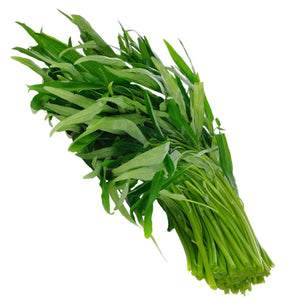
A container is the best home for kang kong, because it keeps the plant wet and keeps it from wandering. Use a closed container with no drainage holes. A 9 L bucket holds five plants, and a water pot 35 to 45 cm across gives a larger picking. Fill it with potting mix or compost to 5 cm below the rim, plant, then add water until it sits just above the mix. The store's 'Bamboo Leaf', with green leaves and green stems, grows well in pots and in hydroponic systems.
- Water: top up the container whenever the level drops below the surface of the mix.
- Feed: nutrients cannot drain away, so feed lightly: fish and seaweed blend at 25 mL per 9 L, fortnightly. Where fish live in the pot, use half that strength.
- Position: part shade for the first few days while roots form, then full sun or part shade.
- Mosquitoes: still water breeds them, so keep a few small fish in the pot, or stand it under a tap that overflows it often.

Sowing Seeds
Sow kang kong seeds direct into warm, wet soil, or raise seedlings in pots and move them to a bed or a water container.
Sowing direct
- Sow 5 to 10 mm deep in soil that holds at least 20°C.
- Space seeds 10 to 15 cm apart in rows 30 to 50 cm apart, or sow a block at 15 cm each way.
- Keep the soil moist but not flooded; seedlings usually emerge in 5 to 7 days.
- Plants grown close together support each other and give longer, less branched stems.
Starting in pots
Raising seedlings suits cooler districts, where the soil outside warms late. Seed germinates poorly underwater, so start it in moist mix and flood the pot or bed only once plants are growing.
- Sow into deep punnets or cells of seed-raising mix, 5 to 10 mm deep, and keep the mix very moist.
- Keep the punnets warm, at 25°C to 30°C if you can.
- Plant out when seedlings stand 10 to 15 cm tall with four true leaves.
- Harden seedlings off first (gradually getting them used to outdoor sun and wind over about a week); see hardening off seedlings.

Care by growth stage
Kang kong is a hungry, fast grower, so steady feeding matters as much as constant water. Weeks count from sowing.
| Stage | Water | Feed | Watch for |
|---|---|---|---|
| Seedlings, weeks 1 to 3 | Keep the mix very moist but not underwater | Nothing until the first true leaves, then seaweed solution at half strength, 15 mL per 9 L, fortnightly. No synthetic feed yet | Mix drying out on warm days |
| Establishing, weeks 3 to 5 | Keep the soil wet at all times; in a pot, keep water just above the mix | Seaweed solution at 30 mL per 9 L at planting. Or a controlled release granular (NPK 12-3-8 to 14-5-10) mixed in at planting | Leaf beetles chewing holes in young leaves |
| Fast leafy growth, weeks 5 to 8 | Keep the bed boggy; water heavily in hot, dry spells | Fish emulsion at half strength, fortnightly. Or an all-purpose soluble (NPK 23-4-18 to 27-5-9), fortnightly | Aphids and whitefly under young leaves |
| Cutting, from about week 8 | Keep the soil wet right through picking | Fish and seaweed blend at 25 mL per 9 L, fortnightly, plus pelletised chicken manure at 100 g per square metre mid-season. Or the all-purpose soluble, fortnightly | Clusters of caterpillars on the leaves |
| Cooling weather, autumn | Water less as growth slows, but never let the soil dry | Stop feeding once growth stalls | Slower regrowth after each cut |
Heavy watering washes nutrients out of the root zone. That is why slow-release feeds, such as blood and bone and pelletised chicken manure, suit in-ground crops.

Pinching and Harvesting
Regular cutting brings on a flush of tender side shoots. It also stops the trailing stems, which can reach 2 to 3 m, from wandering. Each cut is also a harvest, so cut often.
- Cut stems back hard, to a few nodes above the soil or water.
- Pinch out shoot tips on young plants to make them branch.
- Cut back any stem that reaches past its bed or pot, before its nodes root into open ground.
- Pick off flowers as they open, so plants cannot set seed.
- Put trimmings in the green waste bin, and never tip them, or water from the pot, into a drain, pond or creek.
Companion planting
Most kang kong grows in its own container, so its neighbours matter most where it shares a wet bed.
Grows well with
- Amaranth, another heat-loving summer green from outside the morning glory family, so it carries none of kang kong's leaf beetles.
- Taro, which suits the same warm, wet ground, so a boggy corner can hold both.
Keep apart
- Sweet potato and morning glory weeds, which share kang kong's tortoise beetles and leaf beetles.
- Low crops such as lettuce and bok choy, which the trailing stems soon smother.
Harvesting Leaves
Start picking 4 to 8 weeks from sowing, or 3 to 4 weeks after planting out. Cut while stems are thick, tender and crisp.
- Take the shoot tips and young leaves, the most tender parts of the plant.
- In warm weather, expect another cut every week or two.
- In the cool zone, expect two or three cuts before the first frost.

Kang kong wilts fast and is best eaten on the day it is cut. Wrap bunches in a plastic bag and keep them in the fridge for a day or two at most. Stir-fry the stems with garlic and chilli, steam them, add them to soups, or toss the youngest leaves raw through salads.
Common problems
No seedlings. Seed in soil below 20°C lies dormant or comes up patchily, as described in Three mistakes; resow once the soil warms.
Pale leaves. Pale leaves usually mean a hungry plant; give the liquid feed for its stage in Care by growth stage.
Tough, stringy stems. Stems left too long on the plant turn fibrous, so cut more often and eat the young growth.
Autumn die-back. Outside the tropics, plants slow and yellow as nights cool; this is normal, and Tips gives a way to carry a plant through winter.
Pests and diseases
Few pests trouble a fast-growing crop that is cut often. Use only sprays whose label covers leafy vegetables, and keep to the withholding period.
Aphids (family Aphididae). Groups of small green to almost black insects cluster under young leaves and on shoot tips. Prune off heavily infested shoots, or spray insecticidal soap. Read more
Silverleaf whitefly (Bemisia tabaci). Tiny white-winged insects rise from the leaves when a plant is shaken, and their young sit under the leaves. Spray horticultural oil or insecticidal soap onto leaf undersides. Read more
Leaf beetles (family Chrysomelidae). Small red beetles and golden tortoise beetles chew holes between the veins, doing most harm to young plants. Pick them off, and keep plants growing fast so they outgrow the damage.
Cluster caterpillar (Spodoptera litura). Egg masses covered in fawn hairs hatch into groups of caterpillars that strip the leaf surface. Remove the leaf part holding eggs or young caterpillars, or spray a Bacillus thuringiensis (Bt) product while caterpillars are small, as larger ones resist it. Read more
Root-knot nematode (Meloidogyne species). Plants are stunted, yellow and wilt easily, and their roots carry knots or galls. Pull affected plants and grow the next crop in a container of fresh potting mix. Read more
Prevention first
- Check under leaves and on shoot tips twice a week in warm weather.
- Pull morning glory family weeds from around the garden.
- Keep plants growing fast with steady water and regular feeds.
- Clear old vines before starting a new crop in the same spot.
Tips
- Stems bought as a bunch from an Asian grocer or farmers market root in a jar of water within a few days. See rooting cuttings in water.
- Outside the tropics, keep one pot in a warm, sheltered spot over winter, and start a fresh container from its spring shoots.
- Set the container near the kitchen door, where a quick cut for dinner is easy to remember.
Questions
Can I grow kang kong from a bunch bought at the shops?
Yes. Keep a few stems from a bunch bought at an Asian grocer or farmers market and stand them in a jar of water. Roots usually form within a few days. Plant the rooted stems in a closed container of wet potting mix.
Does kang kong have to grow in water?
No. It grows in any rich soil that stays constantly wet, and heavy clay suits it. Standing water simply makes that easy. A closed container with the water level just above the potting mix is the simplest way to grow it in a small garden.
Is kang kong a weed in Australia?
It can be. The floating stems root at every node and spread along waterways, and the City of Gold Coast treats it as an aquatic weed. Grow it in a closed container, never in a pond, dam or creek. Check with your local council and state biosecurity agency before planting it in the ground.
Why did my kang kong die over winter?
Kang kong is a tropical plant. It struggles once average temperatures fall below 10°C, and frost kills it. Outside the tropics it dies back as the weather cools. A pot kept in a warm, protected spot often reshoots in spring.
How do I stop mosquitoes breeding in a kang kong pot?
Mosquitoes breed only in still water. Keep a few small fish in a larger pot to eat the larvae, and feed at half strength so the fish stay healthy. Alternatively, stand the pot under a tap where it overflows often.
When is kang kong ready to pick?
Usually 4 to 8 weeks from sowing, once stems are thick, tender and crisp. Cut stems back to a few nodes above the soil or water. New shoots regrow quickly, so in warm weather you can cut again every week or two.
Grow it
More vegetable guides
All vegetables
Amaranth
How to grow leaf amaranth, or Chinese spinach, in Australia: sowing months for six climate zones, warm soil, thinning, picking, pests and cooking the leaves.
| Position | Full sun |
|---|---|
| Depth | 3 to 6 mm |
| Spacing | 15 cm apart |
| First pick | 4 to 8 weeks |

Artichoke
How to grow globe artichokes from seed in Australia: sowing, spacing, feeding, when to cut the buds, cutting back, cardoon, and sowing months for every zone.
| Position | Full sun |
|---|---|
| Depth | 10 mm |
| Spacing | 1 to 1.5 m apart |
| First pick | About 42 to 57 weeks |

Bean
How to grow beans in Australia: sowing months by climate zone, bush and climbing types, low-nitrogen feeding, watering, picking pods, plus bean fly and rust.
| Position | Full sun, at least six hours |
|---|---|
| Depth | 25 to 30 mm |
| Spacing | Bush 10 to 15, climbing 15 to 20 cm |
| First pick | 7 to 14 weeks |

Beetroot
How to grow beetroot in Australia: sowing months for all six climate zones, thinning the seed clusters, steady watering, harvest size and the pests that matter.
| Position | Full sun or part shade |
|---|---|
| Depth | 10 to 20 mm |
| Spacing | 10 cm apart after thinning |
| First pick | 7 to 12 weeks |