
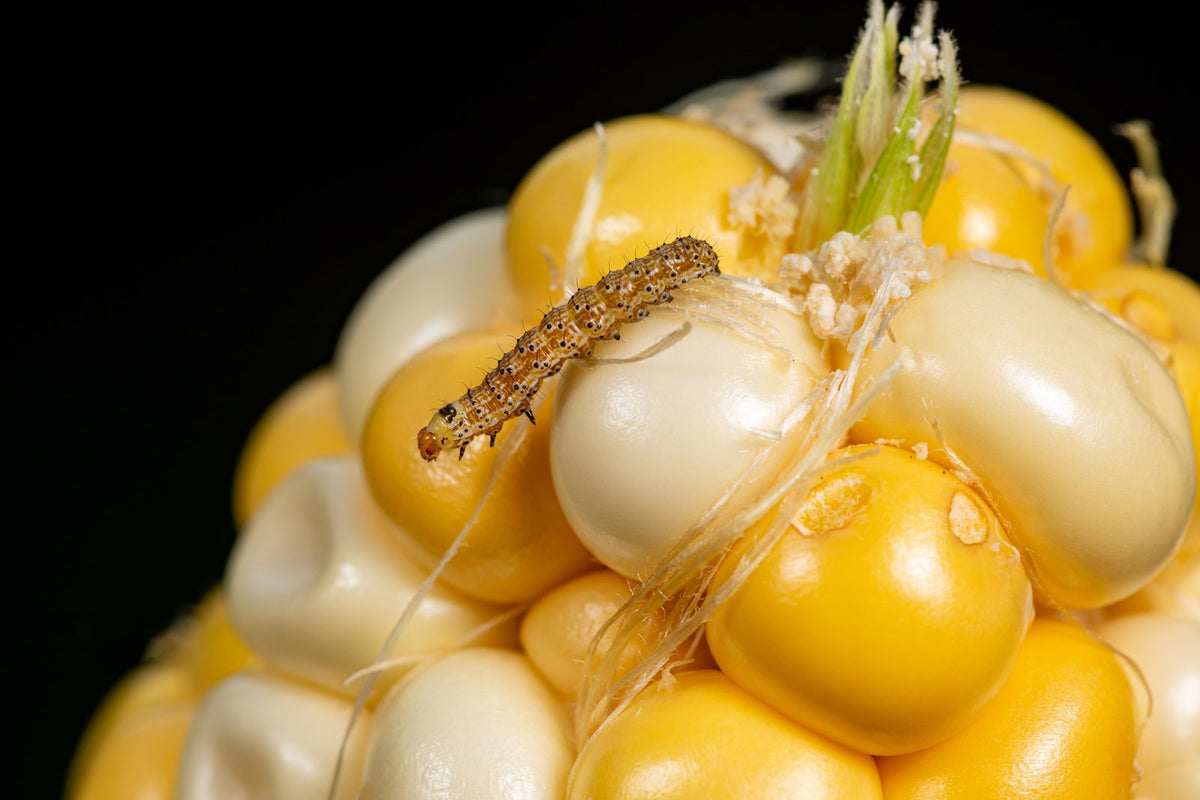
The short version: Armyworms are night-feeding caterpillars that move in groups and can strip sweet corn, lawns and leafy crops fast, leaving skeletonised leaves, ragged margins and brown lawn patches. The dependable approach is to scout at dusk, hand-pick where you can, and spray the caterpillar-specific Bacillus thuringiensis on young larvae, while leaning on the many predators and parasites that keep them down. For most home gardeners the pest that matters most is fall armyworm in sweet corn.
Armyworms get their name from the way they march, moving through a crop or across a lawn in numbers and feeding after dark. One evening the corn looks fine, and a couple of nights later the whorls are ragged and full of dark droppings.
Several different moths sit behind the name, but the management is similar, and catching them while the caterpillars are small makes all the difference.
How to spot armyworms
Armyworms are the caterpillars of several night-flying moths that feed in groups. They are smooth and near hairless, growing to about 40 millimetres, and most native armyworms show three pale stripes running back from a collar behind the head, which is a useful identifier. Fall armyworm, the exotic species now established across the north, carries a pale inverted Y on the head and four dark spots forming a square near the tail.
They mostly feed at night and shelter by day at the base of plants, in lawn thatch or in the soil, leaving dark frass behind. The damage shows as skeletonised or scalloped leaves, ragged margins, seedlings eaten whole, fast-spreading brown patches in lawns, and bored sweet corn cobs. Tell them apart from cutworms, which are solitary and fell seedlings at ground level, and from green cabbage caterpillars, which do not march.
Why they build up
The moths lay eggs in masses, some tucked into folds of dried grass and stubble, others as furry felted patches on foliage, walls and fences near lights. The eggs hatch within days to a couple of weeks depending on warmth, the larvae feed for a few weeks, then pupate in the soil, and there can be several generations across a warm season.
Outbreaks tend to follow warm, wet weather, with the main pressure from spring to autumn. Fall armyworm reached mainland Australia in early 2020 and is now established in the north, spreading south each warm season, so for home gardeners its main significance is as a pest of sweet corn.
How to control armyworms organically
- Scout at dusk and after dark. Check corn whorls and the base of plants, or lay a damp board or hessian to draw larvae up, then hand-pick them into soapy water.
- Spray Bt on young larvae. Bacillus thuringiensis (Bt, sold as Dipel) is selective for caterpillars and safe for bees, birds, pets and beneficial insects. It has to be eaten, so spray thoroughly late in the day, target the small larvae, and reapply after rain. It is weak on large caterpillars.
- Protect the crop physically. Exclusion netting over vegetables keeps the egg-laying moths off, and keeping plants vigorous helps them cope.
- Clean up after an outbreak. Clear crop and lawn debris where eggs are laid, and keep an eye on new flushes of growth.
The natural enemies do a great deal of the work. Parasitic wasps and flies, predatory beetles, shield bugs, lacewings, and birds, frogs and backyard chooks all take armyworms. Avoid broad-spectrum sprays, which set these helpers back and trigger flare-ups. This matters especially for fall armyworm, which carries resistance to several chemical groups, so home chemical control is unreliable and Bt, hand control and beneficials are the better path.
How to keep armyworms down
- For sweet corn, check the whorl regularly for egg masses and young larvae and act early, before they bore in where sprays cannot reach.
- Keep lawns and beds free of the debris and long grass where eggs are laid.
- Encourage a diverse garden so the predators and parasites are already present when an outbreak starts.
- Watch after warm, wet spells and summer storms, when numbers tend to surge.
Armyworms across Australia's climate zones
- Tropical (far north Queensland and the Northern Territory Top End, including Cairns and Darwin): a year-round risk, with fall armyworm established and other species active most months.
- Subtropical (Brisbane and northern New South Wales): long pressure from spring to autumn, worst after summer storms.
- Arid and semi-arid (inland New South Wales, South Australia and Western Australia, and the Northern Territory around Alice Springs): sporadic, with native armyworm surging after rain.
- Temperate (New South Wales, Victoria and the ACT, including Sydney, Melbourne and Canberra): the main season runs spring to autumn, so watch sweet corn and lawns after warm, wet spells.
- Mediterranean (Perth and southern Western Australia, and Adelaide in South Australia): dry summers, with native larvae marching into lawns and cereals from late winter into spring, and fall armyworm present in Western Australia.
- Cool and alpine (Tasmania, the highlands): a shorter window from mid to late summer and generally lower pressure.
Frequently asked questions
How do I tell armyworm from cutworm or cabbage caterpillars?
Armyworms feed in groups and march across leaves and lawn. Cutworms are solitary and fell seedlings at ground level, curling into a C. Cabbage caterpillars are green and chew brassica leaves without marching.
Is Dipel (Bt) safe to use?
Yes. It targets caterpillars only and is safe for bees, birds, pets and people, with no withholding period on food crops. It has to be eaten to work.
Should I worry about fall armyworm?
Mainly if you grow sweet corn. It is established in the north and moves south each warm season, so scout the whorl and treat young larvae early.
What about my lawn?
Lawn armyworm causes fast-spreading brown patches, and the grass usually recovers. They feed at night and hide by day, so treat the larvae rather than just the symptoms.
When are armyworms worst?
In warm, wet weather from spring to autumn, and after rain. Lawn damage often peaks in late summer to autumn.
Will they kill my corn?
A heavy infestation can wipe out seedlings and ruin cobs, but early scouting and Bt on the young larvae usually saves the crop.
Get out at dusk, treat the caterpillars while they are small, and keep the predators on side, and armyworms are far more likely to stay a scare than a wipe-out.
Related growing guides
Ready to plant? Browse our vegetable seeds, including sweet corn for the warm season.