
How to Grow Carrots in Australia
Carrots want deep, loose, stone-free soil in full sun and a seed row that never dries out. Sow direct 5 to 10 mm deep once the soil sits between about 8°C and 30°C. Cover the row with a board until the seedlings show, then thin to 5 cm. Most types are ready in 10 to 13 weeks, when the shoulders reach 2 to 3.5 cm across.

| Sun | Full sun; crops on three or four hours |
|---|---|
| Water | Even moisture; never dry then flooded |
| Soil | Deep, loose, stone-free, pH 6.0 to 6.5 |
| Feed | Light; low nitrogen, potash as roots swell |
| Spacing | 5 to 10 cm apart |
| Depth | 5 to 10 mm |
| Germination | 10 to 21 days, quickest at 20 to 30°C |
| Harvest | 9 to 18 weeks |
| Container | Yes, 30 cm pot, about 13 L, short types |
| Frost | Tops mark in frost; roots hold in cold soil |
| Use | Raw, roasted, grated, juiced or pickled |
Carrot (Daucus carota subsp. sativus) is a biennial root vegetable in the carrot family, Apiaceae, grown as an annual for its sweet, crisp taproot. It suits almost every Australian garden, and one packet gives months of picking. The usual failure is a row that never comes up, and the cause is nearly always a dry seedbed.
Three mistakes that matter
- Sowing into fresh manure or rough soil. A root that meets a stone, a clod or a lump of manure forks, twists and grows hairy. Dig at least 25 cm deep, rake out stones and skip the manure: see Site, soil and setup.
- Letting the row dry out. Carrot seed sits near the surface for two to three weeks, and one dry afternoon can end the germination. Soak the bed first, cover the row with a board or damp hessian, and check daily: see Sowing Seeds.
- Skipping the thinning. Crowded seedlings stay spindly and twist around each other, so none forms a proper root. Thin to 5 cm at the first true leaves and eat the second thinning: see Thinning.
When to plant
Carrot seed germinates in soil from about 8°C to 30°C, quickest between 20°C and 30°C, and it stalls above 35°C. The plants grow best through days of 15°C to 21°C, so aim to finish the crop in mild weather. Sow a short row every two to four weeks, and the picking runs for months.
| Zone | Example cities | Sow | Harvest | Notes |
|---|---|---|---|---|
| Tropical | Darwin NT; Cairns, Townsville QLD; Broome WA | Apr-Jun | Jul-Oct | Sow once the wet season ends and nights cool; heat gives short, thick roots, so pick a quick type. |
| Subtropical | Brisbane, Sunshine Coast QLD; Coffs Harbour, Lismore NSW | Feb-Oct | May-Feb | Autumn sowings give the sweetest roots; spring sowings meet summer heat before harvest, so keep them short types. |
| Arid and semi-arid | Alice Springs NT; Broken Hill, Dubbo NSW; Mildura VIC; Kalgoorlie WA | Feb-Apr and Aug-Oct | May-Aug and Nov-Feb | Early autumn and spring sowings do best; summer heat blocks germination and midwinter cold slows growth to a crawl. |
| Temperate | Sydney, Newcastle, Wollongong NSW; Melbourne, Geelong VIC | Aug-Apr | Nov-Aug | Coastal NSW starts in August; Melbourne waits for soil above 10°C. March and April sowings give sweet winter roots. |
| Mediterranean | Perth, Bunbury WA; Adelaide and the SA coast | Aug-Apr | Nov-Aug | Perth sands crop in any month; Adelaide plains list October to March. Summer sowings need shade and daily water. |
| Cool and alpine | Hobart, Launceston TAS; Canberra ACT; Ballarat VIC; Orange NSW | Sep-Mar | Dec-Jul | Sow once soil holds 10°C, usually after the last hard frosts; March rows must be up before frost returns. |
At the hot edge of the window, choose a quick short type and shade the row until the seedlings show. At the cold edge, wait for soil above 10°C. Growth below that is slow, and six to eight weeks of cold can send plants to flower.
Site, soil and setup
Carrots want full sun, though they still crop on three or four hours of direct sun a day. The taproot decides everything, so the soil must be loose, deep and free of stones. The sandy soils around Perth show why: Western Australia grows most of the country's export carrots on them.
| Get the bed right | What to do |
|---|---|
| Sun | Full sun; afternoon shade helps only in midsummer heat |
| Soil | Dig at least 25 cm deep, break every clod and rake out stones; work a 5 cm layer of fine, well-rotted compost through the top 15 cm |
| pH | 6.0 to 6.5; below 6.0, dolomite lime at 100 to 200 g per square metre, 4 weeks ahead |
| Drainage | On clay, a raised bed at least 25 cm deep, or a short Chantenay or round type that stops above the clay |
| Base feed | Blood and bone at 100 g per square metre raked into the top 10 cm at sowing, or a controlled release granular (NPK around 14-5-10) at sowing; no fresh manure |
| Rotation | A bed free of carrots, parsnips, parsley and celery for three to four years, and not straight after tomato, potato or pumpkin where nematodes are known |
Fresh manure and coarse, half-rotted compost make roots rough, spongy and branched, so anything organic goes in fine, aged and weeks ahead. Carrots are not heavy feeders and do well in the bed a manured crop has just left.

Container growing
A pot at least 30 cm wide and 30 cm deep, about 13 L, grows a worthwhile crop of short carrots. Fill it with a potting mix made for vegetables, never garden soil. Choose a light-coloured pot for warm-season sowings, and 'Paris Market', 'Little Finger' or 'Baby Amsterdam' for the seed.
- Water daily in warm weather until the seedlings are up, then whenever the top few centimetres are dry. A pot that dries out and floods again splits roots.
- Feed seaweed solution at half strength, 15 mL per 9 L, fortnightly from the first true leaves. As roots swell, switch to fish and seaweed blend at 25 mL per 9 L fortnightly. Or mix a controlled release granular (NPK around 14-5-10) into the mix at sowing and add nothing more.
- Full sun in the cool months; morning sun only once summer heat arrives.
Sowing Seeds
Sow direct, because a moved seedling forks, and keep the top centimetre damp until the grass-like seedlings show.
Sowing direct
- Soak the bed the day before, then draw a furrow 5 to 10 mm deep, with rows 25 to 30 cm apart. On clay, fill it with sieved compost or seed-raising mix.
- Mix the seed with four to ten parts of dry sand and dribble it along the row, roughly a seed a centimetre. Cover lightly and press the soil down with a board.
- Lay the board or damp hessian over the row and lift it daily to check the moisture. Remove it the day the first seedlings appear.
- Expect seedlings in 10 to 21 days, sooner in warm soil. The first leaves look like grass, so mark the row with a few radish seeds.
Seed keeps for a few years in a cool, dry drawer, but old seed germinates thinly.
| Type | Root | Suits | Varieties | Sowing to harvest |
|---|---|---|---|---|
| Nantes | Cylindrical, blunt, 15 to 20 cm | Most soils; the sweetest fresh eating | 'Scarlet Nantes', 'Nantes Darcy', 'Berlicum', 'Supabunch' | About 10 to 13 weeks |
| Chantenay | Short, broad-shouldered, 12 to 15 cm | Heavy clay and shallow beds | 'Chantenay Red Cored', 'Royal Chantenay' | About 10 to 13 weeks |
| Baby and round | Fingers of 8 to 10 cm, or balls 2.5 to 4 cm across | Pots, kids' gardens, quick crops | 'Paris Market', 'Little Finger', 'Baby Amsterdam' | About 9 to 10 weeks |
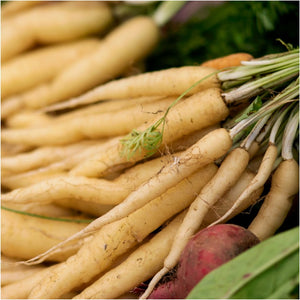
| Long and coloured | Tapered, 16 to 25 cm, in red, purple, yellow and white | Deep, loose beds | 'Atomic Red', 'Cosmic Purple', 'Solar Yellow', 'Lunar White' | About 10 to 13 weeks |
| Heat tolerant | Short to medium, 15 to 22 cm | Queensland and the north | 'All Seasons', 'Red Kuroda' | About 10 to 13 weeks |

Care by growth stage
Even water and restraint with nitrogen decide this crop. Weeks count from sowing and suit a Nantes type; baby carrots run ahead and long types behind.
| Stage | Water | Feed | Watch for |
|---|---|---|---|
| Germination, weeks 1 to 3 | Keep the surface damp with a fine spray, once or twice a day in hot weather, under the board or hessian | None | Soil washed off the seed by heavy watering; slugs and snails on the first shoots |
| Seedling and thinning, weeks 3 to 6 | 6 to 8 L per square metre every two or three days, so the root zone never dries | Seaweed solution at half strength, 15 mL per 9 L, fortnightly from the first true leaves; conventional option, nothing more where a controlled release granular went in at sowing | Weeds, which outgrow carrots easily; cutworms (Agrotis species) felling seedlings overnight; vegetable weevil (Listroderes difficilis) notching leaves |
| Root swelling, weeks 6 to 10 | A deep soak weekly, more in heat, so moisture never swings from dry to flooded | Sulphate of potash at 30 to 50 g per square metre once, or fish and seaweed blend at 25 mL per 9 L fortnightly; conventional option, a high potassium soluble (0-0-41) dissolved fortnightly | Aphids (Aphididae) on new leaves; shoulders pushing above the soil; leaf spots after wet weather |
| Maturing, weeks 10 to 16 | Even moisture to the end, up to 40 L per square metre every four days in midsummer heat, and a good watering two hours before lifting | None | Forked or split roots when you pull a test carrot; roots left too long turning woody |
Those water figures suit open beds in dry weather; rain and mulch cut them. Hold the nitrogen: high-nitrogen feeds such as fish emulsion grow big, bushy tops and do nothing for the roots.

Thinning
Thinning gives each root its 5 cm, and it is done twice: at the first true leaves, then at 12 to 15 cm tall. A crowded row grows thin, twisted roots whatever the soil.
- Thin after watering, when the soil is soft and the seedlings lift cleanly.
- Snip or pinch the extras at soil level rather than pulling, so the keepers stay put.
- Leave one plant every 5 cm for baby and round types. Widen long types to 10 cm as you pull the second thinning to eat.
- Firm the soil back around the keepers, water them in, and take the thinnings away.
Companion planting
Carrots are low, slow and lightly fed, so the best neighbours leave early or cast no shade.
Grows well with
- Lettuce, which is picked before the carrots need the space.
- Radish, the row marker, pulled before the carrots thicken.
- Spring onions and leeks, upright and shallow, which cast no shade.
- Dwarf beans and peas, which fix their own nitrogen and leave a lightly fed bed behind them.
Keep apart
- Parsnip, parsley and dill, which share carrot's leaf blight (Alternaria dauci) and other carrot-family troubles.
- Tomato, capsicum, potato and pumpkin as the crop before carrots on warm, sandy ground, because all build up root-knot nematode (Meloidogyne species).
- Brassicas, whose broad leaves shade a low row and whose beds are fed harder than carrots like.
Harvesting Roots
Pull the first roots when the shoulders reach 2 to 3.5 cm across, usually 9 to 18 weeks from sowing depending on the type.
- Water the bed a couple of hours before lifting, so the roots come out whole.
- Loosen alongside the row with a fork on heavy soil, pull the largest first and leave the rest to grow on.
- Twist or cut the tops off straight away, because they draw moisture from the root.
- Lift the row before roots turn woody, at about 16 to 18 weeks for most types.
- In cool districts, leave winter roots in the ground and pull as needed, but lift before spring growth restarts.

Store topped, unwashed roots in a sealed bag in the coldest part of the fridge, close to 0°C, where they keep for weeks. Keep them away from apples, pears and other ripening fruit, whose ethylene turns carrots bitter; bunched carrots with tops on last about ten days. Eat them raw, roasted, grated, juiced or pickled; purple and red types keep their colour when cooked.
Common problems
Split or cracked roots. Soil that dried right out and was then flooded, or a heavily fed bed, cracks roots lengthways; water evenly and mulch. Forked roots are the fault in Three mistakes.
Green shoulders. Light on a crown that has pushed above the soil turns it green; hill soil or mulch over shoulders as they show.
Bolting. Cold spells (see When to plant) then lengthening spring days make a young carrot bolt (run to flower), and the root goes woody. Sow after the coldest weeks and pull any plant that throws a stalk.
Woody or bitter roots. Long spells above 25°C give roots a strong, harsh flavour, and roots left too long turn starchy: see Harvesting Roots for the lifting time.
Pale, slow roots. Below 10°C growth stalls and roots come long, thin and pale, because colour develops best between 10°C and 20°C; winter rows simply need more weeks.
Pests and diseases
The carrot fly (Psila rosae) of overseas gardening books is not established in Australia; the pests that matter here are below. Read more
Root-knot nematode (Meloidogyne species). Microscopic soil worms enter near the root tip and raise lumps of 1 to 10 mm, so carrots fork, knot and grow hairy. They are common in warm, sandy soils and in Alice Springs backyards. Rotate, add compost, which feeds their predators, and sow for winter, when cool soil slows them. Read more
Green peach aphid (Myzus persicae) and carrot virus Y. This aphid is the most efficient carrier of carrot virus Y, which occurs in most Australian carrot districts. Infected plants show mottled, reddened or feathery leaves, and roots infected young come stubby and knobbly. Pull volunteer carrots and finished rows, the main source of the virus. Read more
Cutworm (Agrotis species). Fat, smooth caterpillars up to 50 mm long hide in the soil by day and cut seedlings off at ground level at night. Picked up, they curl into a C. Clear weeds three to four weeks before sowing and scratch the soil around a felled seedling. Read more
Vegetable weevil (Listroderes difficilis). A flightless grey-brown weevil about 8 mm long with a pale V on its back. Adults and legless larvae feed at night from autumn to spring, notching leaf edges or eating seedlings to the ground. Hunt by torch after dark and clear capeweed, its favourite weed host.
Alternaria leaf blight (Alternaria dauci). Dark brown to black angular spots with yellow halos on the older leaves after wet weather, merging until the tops blacken. Sow thinly so leaves dry quickly, remove spent tops and rotate.
Prevention first
- Rotate carrots and their relatives on a three to four year cycle, off ground that grew nematode-prone crops.
- Cover the row with fine insect mesh from sowing, edges buried, against moths, weevils and aphids alike.
- Weed early and often, since weeds host cutworm and weevil and outgrow a carrot seedling in days.
- Pull volunteer carrots and finished rows, and compost spent tops away from the next sowing.
Tips
- In the tropics, sow into the dry season. Across Queensland and the north, choose 'Red Kuroda', bred for subtropical and tropical heat, or 'All Seasons', the main Queensland variety.
- Anzac Day is a fair marker for the last autumn sowing in temperate and Mediterranean gardens; roots sown then fill through the cool months.
- Leave one or two of your best plants to flower in their second spring. The flat white heads feed hoverflies and parasitic wasps that hunt aphids, and the seed can be saved.
Questions
When should I plant carrots in Australia?
Sow once the soil sits between about 8°C and 30°C. Tropical gardens sow April to June in the dry season, subtropical gardens February to October. Arid gardens sow February to April and August to October. Temperate and Mediterranean gardens sow August to April, and cool gardens September to March. Sow a short row every two to four weeks.
Why did my carrot seeds not come up?
The row dried out. Carrot seed sits 5 to 10 mm deep for 10 to 21 days, and any dry spell in that time stops it. Soak the bed first and cover the row with a board or damp hessian. Lift it daily to check, and remove it when the first grass-like seedlings show. Old seed also germinates thinly.
Why are my carrots forked, twisted or hairy?
The root tip met something on the way down: a stone, a clod, a lump of fresh manure or heavy clay. Root-knot nematode, which leaves small knots, and the cavity spot fungus (Pythium sulcatum) fork them too. Dig deep, sieve out stones, use fine aged compost rather than manure, and rotate carrots for three to four years.
How long do carrots take to grow?
Most types take 10 to 13 weeks from sowing, and long types in cool weather up to 18 weeks. Baby and round carrots such as 'Paris Market' are ready from about 9 weeks. Pull the first roots when the shoulders reach 2 to 3.5 cm across, and lift the row before 16 to 18 weeks.
Can I grow carrots in pots?
Yes. Use a pot at least 30 cm wide and deep, about 13 L, filled with vegetable potting mix. Choose short types such as 'Paris Market', 'Little Finger' or 'Baby Amsterdam' and thin to 5 cm apart. Water daily in warm weather and feed seaweed solution at half strength fortnightly.
Why do my carrots split?
Uneven water. Soil that dried right out and was then flooded makes roots crack lengthways, and heavy rain after a dry spell does the same. A heavily fed bed makes it worse. Water evenly, mulch between rows, and lift roots on time rather than leaving them past 16 to 18 weeks.
Grow it




More vegetable guides
All vegetables
Amaranth
How to grow leaf amaranth, or Chinese spinach, in Australia: sowing months for six climate zones, warm soil, thinning, picking, pests and cooking the leaves.
| Position | Full sun |
|---|---|
| Depth | 3 to 6 mm |
| Spacing | 15 cm apart |
| First pick | 4 to 8 weeks |

Artichoke
How to grow globe artichokes from seed in Australia: sowing, spacing, feeding, when to cut the buds, cutting back, cardoon, and sowing months for every zone.
| Position | Full sun |
|---|---|
| Depth | 10 mm |
| Spacing | 1 to 1.5 m apart |
| First pick | About 42 to 57 weeks |

Bean
How to grow beans in Australia: sowing months by climate zone, bush and climbing types, low-nitrogen feeding, watering, picking pods, plus bean fly and rust.
| Position | Full sun, at least six hours |
|---|---|
| Depth | 25 to 30 mm |
| Spacing | Bush 10 to 15, climbing 15 to 20 cm |
| First pick | 7 to 14 weeks |

Beetroot
How to grow beetroot in Australia: sowing months for all six climate zones, thinning the seed clusters, steady watering, harvest size and the pests that matter.
| Position | Full sun or part shade |
|---|---|
| Depth | 10 to 20 mm |
| Spacing | 10 cm apart after thinning |
| First pick | 7 to 12 weeks |