
How to Grow Pumpkins in Australia
Pumpkins are a frost-tender vine for full sun, rich soil and plenty of room. Sow 20 to 25 mm deep once soil holds 16°C. Tropical gardens sow April to July, subtropical August to February, arid and semi-arid September to January. Temperate and Mediterranean gardens sow September to December, cool and alpine October to December. Water steadily through flowering, and pick after 15 to 20 weeks, when the stalk turns corky.

| Sun | Full sun, sheltered from wind |
|---|---|
| Water | 25 to 40 mm a week in warm weather |
| Soil | Deep, fertile, well drained, pH 6.0 to 6.5 |
| Feed | Heavy; potash from the first flowers |
| Spacing | 50 cm to 1.5 m |
| Depth | 20 to 25 mm |
| Germination | 4 to 14 days in soil above 16°C |
| Harvest | 15 to 20 weeks |
| Container | Not suited to pots |
| Frost | Frost tender; needs 4 to 5 frost-free months |
| Use | Roasting, soups and baking; seeds toasted |
Pumpkin (Cucurbita maxima, C. moschata and C. pepo) is a frost-tender annual vine in the gourd family, Cucurbitaceae. It is grown for hard-skinned fruit that keeps for months, in any garden with four to five frost-free months and room to run. The usual disappointment is young fruit that yellows and drops, which is a pollination problem far more often than a disease.
Three mistakes that matter
- Sowing outside the warm window. Seed fails in cold soil, and a late sowing runs into autumn cold before the fruit matures. Sow inside the window for your zone, once the soil is warm enough: see When to plant.
- Letting vines go dry at flowering. Stressed plants shed flowers and young fruit, so the weeks of flowering, fruit set and fruit fill decide the crop. Water without a miss through those weeks, under straw mulch: see Care by growth stage.
- Picking early and cutting the stalk short. Immature fruit has less flavour and stores poorly, and a stalk cut close lets rot into the fruit. Wait for the signs in Harvesting Fruit before you cut.
When to plant
Seed needs soil above 16°C, where it can take up to 14 days to emerge. At 20°C it is up within a week, and at 25°C in about four days. One sowing a season is usual, because the harvest keeps.
| Zone | Example cities | Sow | Harvest | Notes |
|---|---|---|---|---|
| Tropical | Darwin NT; Cairns, Townsville QLD | Apr-Jul | Aug-Nov | Sow as the wet season ends, so vines grow through the dry; humid, wet weather brings mildew. |
| Subtropical | Brisbane, Gold Coast QLD; Coffs Harbour NSW | Aug-Feb | Dec-Jul | Sow from August once soil holds 16°C; frost-free coastal gardens can sow again in January or February for winter fruit. |
| Arid and semi-arid | Alice Springs NT; Mildura VIC; Broken Hill NSW | Sep-Jan | Jan-May | Sow after the last frost once soil holds 16°C; shelter vines from hot, dry winds and mulch well. |
| Temperate | Sydney, Newcastle NSW; Melbourne, Geelong VIC | Sep-Dec | Jan-May | Sow from September in Sydney, October in Melbourne; keep December for quicker types such as butternut. |
| Mediterranean | Perth, Bunbury WA; Adelaide and the SA coast | Sep-Dec | Jan-May | Perth can start in August; Adelaide plains wait for late September. Mulch well, as summer heat arrives dry. |
| Cool and alpine | Canberra ACT; Hobart TAS; Ballarat VIC; Stanthorpe QLD | Oct-Dec | Feb-Apr | Start seed in pots from September; plant out after the last frost, around Melbourne Cup weekend, and choose quicker types. |
At the cold edge of the window, start seed in pots on a seedling heat mat and plant out after the last frost. At the late edge, choose a quicker type, because long-season pumpkins sown late can fail to mature before the cold.
Site, soil and setup
Pumpkin roots can reach a metre deep, so deep, free-draining soil with plenty of compost suits them. Plant at the edge of the vegie patch, where vines can run away from smaller crops.
| Get the bed right | What to do |
|---|---|
| Sun | Full sun, with shelter from hot, dry winds |
| Soil | Fertile and well drained: dig in 5 to 10 cm of well-rotted cow or horse manure 4 to 6 weeks ahead, or a 5 cm layer of compost |
| pH | 6.0 to 6.5; on acid soil, dolomite lime at 100 to 200 g per square metre, 4 to 6 weeks ahead |
| Drainage | A mound of compost-enriched soil 15 to 20 cm high; a raised bed on heavy clay |
| Base feed | Pelletised chicken manure at 100 g per square metre plus blood and bone at 100 to 150 g per square metre, at planting |
| Mulch | Straw once the soil is warm, and later under each fruit |
| Rotation | Not where pumpkin, zucchini, cucumber or melon grew in the past two years |
Fresh manure burns young plants and encourages rhizoctonia rot, so use only aged manure. Cucurbits grown in the same soil year after year build up disease and nematodes in the soil.
Sowing Seeds
Sow direct into a mound where the season allows, and start in pots only where the warm months are short.
Sowing direct
- Sow two or three seeds per mound, 20 to 25 mm deep.
- Keep the mound moist; seedlings show in 5 to 10 days in warm soil.
- Thin each mound to the strongest seedling.
| Type | Species | Varieties | Spacing | Sowing to harvest |
|---|---|---|---|---|
| Large grey | C. maxima | 'Queensland Blue', 'Jarrahdale' | 0.8 to 1.2 m apart on irrigated beds 1.8 m wide; 1 to 1.5 m apart in rows 2 to 3 m apart on drier, open ground | 18 to 20 weeks |
| Jap or Kent | C. moschata | 'Jap', also sold as 'Kent' | 0.8 to 1.2 m apart on irrigated beds 1.8 m wide | 20 to 25 weeks |
| Butternut | C. moschata | 'Butternut' | 50 to 60 cm apart on irrigated beds 1.8 m wide | 15 to 18 weeks |
| Small-fruited and bush | C. maxima and C. pepo | 'Golden Nugget' (a bush type), 'Small Sugar', 'Jack Be Little' | 60 cm to 1 m apart | 10 to 17 weeks |
Times shift with climate: warm gardens are often quicker and cool gardens slower.
Starting in pots
- Sow two seeds to a pot at least 5 cm wide and deep. Biodegradable pots planted whole spare the roots.
- Grow seedlings on for about four weeks, until they carry two or three true leaves.
- Harden off (accustom seedlings to sun and wind over about a week), then plant out after the last frost.

Pollination
Each vine carries separate male and female flowers, and bees move the pollen between them. The first flowers are all male, on long thin stalks. Females follow, each sitting on a small swelling that becomes the fruit.

A female flower that misses out yellows and drops, often at golf-ball size. Hot, dry wind kills pollen, and cold, wet or cloudy weather keeps bees at home. Where fruit keeps failing, pollinate by hand early in the morning, soon after the flowers open.
- Pick a freshly opened male flower and strip its petals to expose the pollen-covered centre.
- Rub it gently onto the sticky centre of each open female flower.
- Use one male flower for several females, or carry the pollen on a small paintbrush.
Care by growth stage
Water at flowering and restraint with nitrogen decide this crop. Too much nitrogen early grows leaf at the expense of fruit, and female flowers can fail to set. Weeks count from sowing and suit the large types; quick types run ahead.
| Stage | Water | Feed | Watch for |
|---|---|---|---|
| Seedling, weeks 1 to 5 | Keep the mound moist until seedlings show, then soak deeply whenever a finger pushed into the soil comes out dry | Seaweed solution at half strength, 15 mL per 9 L, fortnightly from the first true leaves | Pumpkin beetle and 28-spotted ladybird, which can strip a seedling; slugs and snails; cutworms |
| Running vines, weeks 6 to 9 | 25 to 40 mm a week in warm weather, soaking the soil at the base | Fish emulsion at half strength, fortnightly; stop if vines are all leaf | The first male flowers; aphids under leaves and on shoot tips; two-spotted mite (Tetranychus urticae) bronzing leaves in hot, dry weather |
| Flowering and fruit set, weeks 9 to 12 | The same, without a miss | Sulphate of potash at 30 to 50 g per square metre once, then liquid potash per label fortnightly | Female flowers and bee visits; small fruit that yellows and drops |
| Fruit fill, week 12 to ripening | Steady deep soaks, at least weekly in dry weather | Pelletised chicken manure at 100 g per square metre once, with fish and seaweed blend at 25 mL per 9 L fortnightly | Fruit fly stings, powdery mildew, fruit resting on wet soil; in the north, cucumber moth (Diaphania indica) larvae chewing leaves and fruit under a silk canopy |
| Ripening, the last 1 to 2 weeks | Ease off as the stalks start to cork | None | Sunburn on fruit exposed by dying leaves; rats and possums |
That 25 to 40 mm is 25 to 40 L per square metre. Where summers are humid, water in the morning and keep the leaves dry. In the dry heat of a South Australian summer, wet leaves dry fast and matter less.
If you prefer a conventional feed, mix a controlled release granular (NPK around 14-5-10) into the mound at planting. Water on an all-purpose soluble (NPK around 23-4-18) fortnightly while vines run, then a fruiting and flowering soluble (NPK around 15-4-26) from the first flowers.

Companion planting
Pumpkin is the ground layer of the old three sisters planting of corn, beans and squash.
Grows well with
- Sweet corn, which stands above the vines while pumpkin leaves shade out weeds below.
- Climbing beans, which use the corn as a pole and add nitrogen to the soil.
- Nasturtium, which can reduce pest pressure beside pumpkin and squash, according to university studies.
- Alyssum, borage and cosmos, whose flowers draw bees and beneficial insects to the patch.
Keep apart
- Potato, which hosts the same 28-spotted ladybird.
- Zucchini, cucumber and melons, which share both mildews, the mosaic viruses and cucumber fly.
Harvesting Fruit
Pick when the vine dies back and the stalk turns dry, brown and corky, usually 15 to 20 weeks from sowing.
| Type | Ripe when |
|---|---|
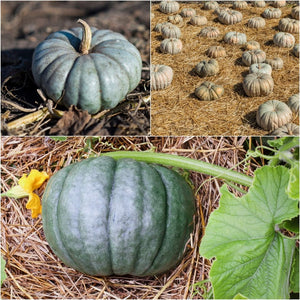
| 'Jarrahdale' and other grey types | The skin turns from glossy dark green to dull grey |
| Butternut | The fruit is fully coloured, with no green left on the skin |
| Jap or Kent | The green stripes lose their gloss and turn dull |
- Tap the fruit: a ripe pumpkin sounds hollow.
- Press a thumbnail into the skin: ripe skin resists it.
- Cut with secateurs, leaving 5 to 10 cm of stalk.
- Lift fruit from underneath, never by the stalk, which can tear out and let rot in.
- Bring fruit in before a hard frost; a light frost that kills the vine rarely harms it.
- Set aside marked or stalkless fruit to eat first, since only sound fruit keeps.

Curing
Curing hardens the skin and dries the stalk, and it is what makes a pumpkin keep.
| Where | Conditions | How long |
|---|---|---|
| Outdoors | Dry, sunny weather, with fruit on its side and raised on a rack or mesh for airflow; in fierce inland heat, under leaves or shadecloth so it does not sunburn | About a week, up to two |
| Indoors | Cold or wet weather: a warm, well-ventilated room at about 27°C | Until the skin is hard and dry |
Store cured fruit on its side somewhere dry and airy at 12 to 15°C, such as a shed or back verandah. Below 10°C whole fruit suffers chilling injury, so keep it out of the fridge. Expect 2 to 6 months, and longer from good keepers: 'Jarrahdale' outlasts Jap and the small-fruited types. Check the pile often and remove any fruit that softens.
Roast it, turn it into soup, and toast the rinsed seeds with oil and salt as a snack.
Common problems
Young fruit yellows and drops. Usually the flower was not pollinated; see Pollination. Vines that dried out at flowering also shed fruit: see Care by growth stage.
All leaf and male flowers. Heavy nitrogen, high temperatures, dry air and long days all favour male flowers over females. Stop the fish emulsion and wait for milder weather.
Blossom end rot. A dark, sunken, leathery patch at the flower end of the fruit. Calcium reaches a swelling fruit only with steady water, so soil moisture that swings is the cause. Water evenly and mulch. More on blossom end rot
Fruit rotting underneath. Damp soil beneath a developing fruit starts the rot; slide straw or cardboard under each one.
Gnawed fruit. Rats and possums chew ripening pumpkins, and a broken skin will not store. Possums are protected, so rely on exclusion.
Pests and diseases
Seedlings are the vulnerable stage; a vine that is running outgrows most leaf damage.
Pumpkin beetle (Aulacophora hilaris). Yellow-orange, 6 to 7 mm long, with four large black spots; the plain pumpkin beetle (A. abdominalis) has none. Beetles feed in groups and chew leaves back to the veins, and a few can kill a seedling. Cover young plants with insect mesh until they are established.
28-spotted ladybird (Epilachna vigintioctopunctata). Dull orange with 28 black spots and a fine downy coat, unlike the glossy ladybirds that eat aphids. Adults chew the tops of leaves and the spiny, creamy-yellow larvae the undersides, leaving a skeleton of veins. Squash adults, larvae and the yellow egg clusters under leaves.
Cucumber fly (Zeugodacus cucumis) and Queensland fruit fly (Bactrocera tryoni). Cucumber fly is a major pest of cucurbits in Queensland, and occurs in the Northern Territory and north-east New South Wales. Pumpkin is one of its main hosts, and Queensland fruit fly has field records on C. pepo pumpkins. Maggots tunnel in stung fruit and rot follows. Bag young fruit once it has set, and freeze or boil stung fruit rather than composting it. Cucumber fly ignores the male lures in Queensland fruit fly traps. More on Queensland fruit fly
Melon aphid (Aphis gossypii). Pale green to yellow aphids cluster under leaves and on shoot tips, curling them and leaving sticky honeydew. Their worst damage is spreading papaya ringspot, zucchini yellow mosaic and watermelon mosaic viruses, which distort fruit, grey types most of all. Use insecticidal soap at the label rate on heavy colonies. Read more
Powdery mildew (Podosphaera xanthii). White powdery spots on the shaded, older leaves first. Spores travel on the wind and need humid air, not wet leaves. It matters most on young vines; late in autumn the crop is already made. Remove the worst leaves and spray 1 part full-cream milk to 10 parts water. More on powdery mildew
Downy mildew (Pseudoperonospora cubensis). Angular yellow patches boxed in by the leaf veins, in warm, moist weather early in the season. It needs 6 to 12 hours of wet leaf, so it follows rain and evening sprinklers. Read more
Prevention first
- Clear weeds and spent cucurbit vines before sowing, since both carry mildew, aphids and virus over.
- Give vines full sun and their full spacing, so air moves through the leaves.
- Check seedlings twice a week for beetles, and turn leaves for ladybird eggs and aphids.
- Pick up fallen and stung fruit promptly; mildewed vines can go into a hot compost heap.
Tips
- Let vines root where they touch the ground. The extra roots feed and anchor the plant, so avoid shifting established runners.
- Nip out the tip once the main vine is 3 to 4 m long. Late in the season, remove flowers and small fruit that cannot ripen before the cold.
- Small-fruited types such as 'Golden Nugget' can climb a tripod or low trellis. Large fruit is too heavy.
- Varieties cross readily within a species and rarely, if at all, between species, and a cross shows only in the saved seed. C. pepo pumpkins also cross with zucchini. For seed that comes true, tape a female flower shut before it opens. Next morning hand-pollinate it with pollen of the same variety, then retape it.
- Pumpkin seedlings that volunteer from the compost heap are often the strongest vines in the garden. What they will fruit is a lottery.
Questions
When should I plant pumpkins in Australia?
Sow once frosts are over and the soil holds 16°C. Tropical gardens sow April to July, in the dry season. Subtropical gardens sow August to February and arid and semi-arid gardens September to January. Temperate and Mediterranean gardens sow September to December, and cool and alpine gardens October to December, after the last frost.
Why do my baby pumpkins turn yellow and fall off?
Usually the female flower was not pollinated. Hot, dry wind kills pollen, and cold, wet or cloudy weather keeps bees away. Pollinate by hand early in the morning. Strip the petals from a male flower and rub its centre onto each open female flower. A vine that dried out at flowering also drops young fruit.
How do I know when a pumpkin is ready to pick?
The vine dies back and the stalk turns dry, brown and corky. The fruit sounds hollow when tapped, and the skin resists a thumbnail. Grey types turn from glossy green to dull grey, and butternuts lose all green. Cut with secateurs, leaving 5 to 10 cm of stalk.
How long do pumpkins take to grow?
Most take 15 to 20 weeks from sowing. Small-fruited and bush types such as 'Golden Nugget' can be ready in 10 to 17 weeks. Butternut takes about 15 to 18 weeks, large grey types 18 to 20, and Jap or Kent 20 to 25. Expect the shorter times in warm climates and the longer in cool ones.
How do I cure and store pumpkins?
Sit cut fruit outside in dry, sunny weather for one to two weeks, on its side and off the ground. In cold or wet weather, cure in a warm, airy room instead. Store on its side somewhere dry and airy at 12 to 15°C. Keep whole fruit out of the fridge.
How much room does a pumpkin vine need?
Large grey and Jap types go 0.8 to 1.2 m apart on an irrigated bed 1.8 m wide. On drier, open ground, give grey types 1 to 1.5 m. Butternut manages at 50 to 60 cm. Small-fruited and bush types go 60 cm to 1 m apart, and 'Golden Nugget' can climb a tripod.
Grow it



More vegetable guides
All vegetables
Amaranth
How to grow leaf amaranth, or Chinese spinach, in Australia: sowing months for six climate zones, warm soil, thinning, picking, pests and cooking the leaves.
| Position | Full sun |
|---|---|
| Depth | 3 to 6 mm |
| Spacing | 15 cm apart |
| First pick | 4 to 8 weeks |

Artichoke
How to grow globe artichokes from seed in Australia: sowing, spacing, feeding, when to cut the buds, cutting back, cardoon, and sowing months for every zone.
| Position | Full sun |
|---|---|
| Depth | 10 mm |
| Spacing | 1 to 1.5 m apart |
| First pick | About 42 to 57 weeks |

Bean
How to grow beans in Australia: sowing months by climate zone, bush and climbing types, low-nitrogen feeding, watering, picking pods, plus bean fly and rust.
| Position | Full sun, at least six hours |
|---|---|
| Depth | 25 to 30 mm |
| Spacing | Bush 10 to 15, climbing 15 to 20 cm |
| First pick | 7 to 14 weeks |

Beetroot
How to grow beetroot in Australia: sowing months for all six climate zones, thinning the seed clusters, steady watering, harvest size and the pests that matter.
| Position | Full sun or part shade |
|---|---|
| Depth | 10 to 20 mm |
| Spacing | 10 cm apart after thinning |
| First pick | 7 to 12 weeks |