
Who you are trying to attract
Scientists have described about a million species of insects, and only a small share of them damage garden plants. Most are neutral, and many are working in your favour: they pollinate crops, feed on pests, or break down organic matter. Nearly all of the useful ones need two things from a garden, nectar and pollen for the adults and prey for the young, so a patch that supplies both keeps them close.
The helpers you are most likely to meet in an Australian garden are ladybirds, lacewings, hoverflies, parasitic wasps, predatory mites and spiders. Praying mantids belong on the list too, with one caveat: they take beneficial insects as readily as pests.

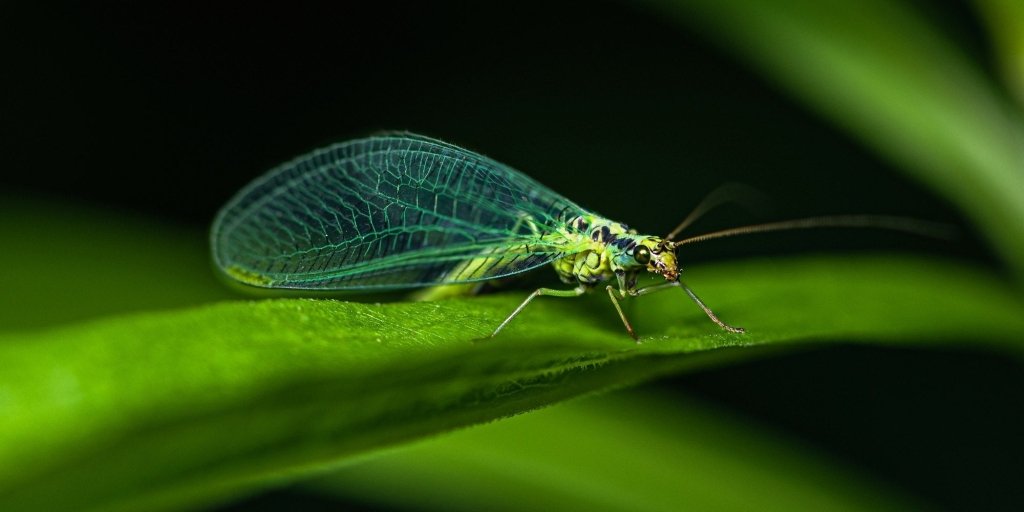
The young usually do most of the eating. Hoverfly adults live on nectar and pollen while their larvae work through aphids, and lacewing larvae are so single-minded about aphids that they are nicknamed aphid lions. That is why flowers matter as much as prey. Without flowers there are no adults on hand to lay eggs, and without eggs there are no larvae patrolling the crop.

Flowers that feed them
Small, open flowers do the work, because most beneficial insects are tiny and cannot reach into a deep bloom. The carrot family is the classic source. Dill, coriander, parsley, and carrots or parsnips left to flower all carry flat heads made of hundreds of minute flowers, which double as landing pads.
The onion family is not related to the carrot family, but it does a similar job. Chives, garlic chives and spring onions left to flower carry globe heads of small flowers that hoverflies and small wasps feed from, and a clump of chives at the end of a bed flowers early with no fuss.
Fennel appears on most beneficial insect lists, and in Australia it needs a caution. Wild and bronze fennel have naturalised widely, are treated as environmental weeds across much of the south and east, and are declared noxious weeds in Victoria, so they are not plants to let loose. We do not sell bronze fennel, and dill or coriander give you the same flat flower heads. If you grow Florence fennel for the bulb, harvest it before it sets seed, and note that we cannot send fennel seed to Tasmania or Victoria.
Keep something in flower all year
One flush of flowers in spring is not much use to insects that breed through the warm months, so aim for a succession. Sowing months shift a long way across the country, and the groupings below follow our own sowing calendar. They are broad, so gardeners who sit between two zones should lean on local frost dates rather than the label.
- Tropical. Darwin, Cairns, Townsville, Broome and the Top End. The dry season carries the flowers: sow coriander and dill Apr-Aug, alyssum May-Jun and calendula Jun-Jul, with sunflower and marigold Mar-Sep and cosmos Mar-Aug. Basil flowers most of the year here, so leave some to bloom.
- Subtropical. Brisbane, the Gold and Sunshine coasts, Bundaberg, Coffs Harbour and the NSW north coast. Sow calendula and cornflower Mar-Jul and alyssum, coriander and dill Mar-Aug, then sunflower, cosmos and marigold Aug-Mar through the warm months.
- Arid and semi-arid. Alice Springs, Broken Hill, Kalgoorlie, Longreach, Mildura, Port Augusta and most of the inland. Two windows work best. Sow alyssum, calendula, cornflower and coriander Mar-May and dill Mar-Apr, then all five again in Aug, with coriander and dill running on into Sep. Sunflower goes in Aug-Nov and marigold Aug-Oct. Water rather than cold is usually the limit.
- Temperate. Sydney, Melbourne, Geelong, Newcastle and most of coastal southern Australia. Sow calendula Feb-May, cornflower and coriander Feb-Jun, alyssum and dill Aug-Sep, borage Sep-Dec, and sunflower, cosmos and marigold Sep-Jan.
- Mediterranean. Perth, Adelaide, the south-west of Western Australia and the South Australian gulf country. Follow the temperate months and lean on the autumn sowings, because the mild wet winter and dry summer mean the winter and spring flowers carry most of the season. A summer patch here needs irrigation.
- Cool and alpine. Hobart, Canberra, Ballarat, Katoomba, Armidale, the tablelands and the alpine districts. Sow cornflower and coriander Feb-Apr and again Aug-Oct, calendula Feb-Apr and Aug-Sep, alyssum and dill Sep-Jan, and sunflower, cosmos and marigold Sep-Dec.
Perennial herbs fill the gaps between annual sowings. Thyme, oregano and catmint flower for weeks and return each year. Lemon mint, also sold as bergamot or bee balm, is usually an annual rather than a perennial, but it often self-seeds, so leave a few flower heads to drop seed or sow it again the following year.
Insectary plants among the crops
Short-lived annuals such as phacelia, coriander, buckwheat and sweet alyssum fill any gap, and perennials such as thyme, oregano and catmint hold their ground year after year. A few of each along the bed edges beats one block in a far corner.
Mint earns its keep but needs containing: grow it in a pot or a sunken bottomless container, because mint runs from the roots and will take a bed.
Cornflowers and borage make a good pair beside cucumbers, zucchini and pumpkins. Cornflowers feed small insects over a long season, and borage brings in the bees those crops need for a decent set.
Sunflowers are best kept to the edges, on the southern side of a bed or along a fence, so their shadow falls away from the crops. Bush beans and chillies grown in their shade usually crop less, except in hot inland gardens where afternoon shade helps. Compost the spent stalks rather than digging them into a seedbed, because sunflower residues can slow the germination of small seeds.
Plants that pull in particular insects
Sweet alyssum
Sweet alyssum, sold in Australia as sweet Alice, is a low carpeting annual that fills crevices and path edges and flowers for months in mauve or white. The tiny flowers are the right size for hoverflies, lacewings and the small parasitic wasps that go on to hunt aphids in the crop beside them. Alyssum brings in bees as well, which helps pumpkin, zucchini and cucumber set fruit.

Carrot, parsley and parsnip left to flower
Leave a few plants to flower at the end of the season and they become the best feeding station in the garden. The insects they support then work on aphids, mealybugs, mites, thrips and small caterpillars. Hoverflies and lacewings belong on the hunting side of that list rather than the prey side.
Yarrow
Yarrow carries flat cushiony heads in white, lemon or pink on feathery foliage, grows to about 75cm and flowers from summer into late autumn. Hoverflies favour it, and it is their larvae that eat aphids while the adults feed on nectar and pollen. One caution: yarrow has naturalised in parts of southern Australia and is regarded as a weed of alpine and subalpine country, so gardeners in cool and alpine districts should cut the heads off before they set seed. It also spreads by rhizomes, so never dump pieces of root in bushland.
Ladybirds and where they gather
Ladybirds gather where aphids are, and the flat heads of dill, coriander and yarrow hold them nearby between outbreaks. Both the adults and their spiky larvae eat aphids, and the larvae usually eat the most, so learn to recognise them before you brush one off a leaf. A good population can reduce how often you reach for a spray, although it does not replace keeping an eye on the crop.
Shelter, water and bug hotels
Food is only half of it. A shallow saucer of water with pebbles as landing spots gives insects a safe drink, and a quiet patch of undug soil gives ground-nesting native bees somewhere to live. Hollow stems, a pile of prunings or a bundle of bamboo tubes under cover shelter the smaller predators over winter, and a bug hotel does the same job in a tidier package. Put it out of driving rain and hot afternoon sun, with flowers within a few steps, because shelter without food holds nothing. Our guide to insect hotels covers what to build and where to put it.
Sprays and the balance
A garden full of predators takes a season or two to build, and one broad-spectrum spray can set it back. Start with the measures that leave the helpers alone: hose aphids off, squash what you can reach, net brassicas, cut out badly affected growth, and keep the flowers coming. If a pest gets away from you, choose an APVMA-registered product for that pest, use it exactly as the label says, and spray late in the day when bees have stopped working.
Seed for a beneficial insect patch
A border along one bed edge is enough to start. Our Beneficial Bug Mix seeds and Pollinator and Beneficial Insect Seed Mix combine annuals, perennials, herbs and flowers chosen for this job, and our guide to what goes into a beneficial bug mix has more detail. Both are seed mixes, and state import rules mean we cannot send seed mixes to Western Australia or Tasmania. Gardeners there can build the same patch from single lines such as alyssum, dill, coriander, cornflower, calendula and yarrow.
Related growing guides
- The patch that helps itself: gardening for bees and beneficial insects
- Aphids: How to Spot, Control and Prevent Them in an Australian Garden
- Organic pest control in Australia: working with the garden, not against it
Ready to plant? Browse our flower seeds.
1 comment
Julia McGrath
I was astonished in late summer to find the leaves on the zucchinis I was about to pull out (all mildewy and manky looking by then) seemed to have a lot of the yellow ladybirds on them Turning them over it was like a baby bug maternity ward! Hundreds of them – so I had to leave the plants in. Also discovered them on a solanum bush I’ve been trying to get rid of, again now I can’t pull the damn thing out