
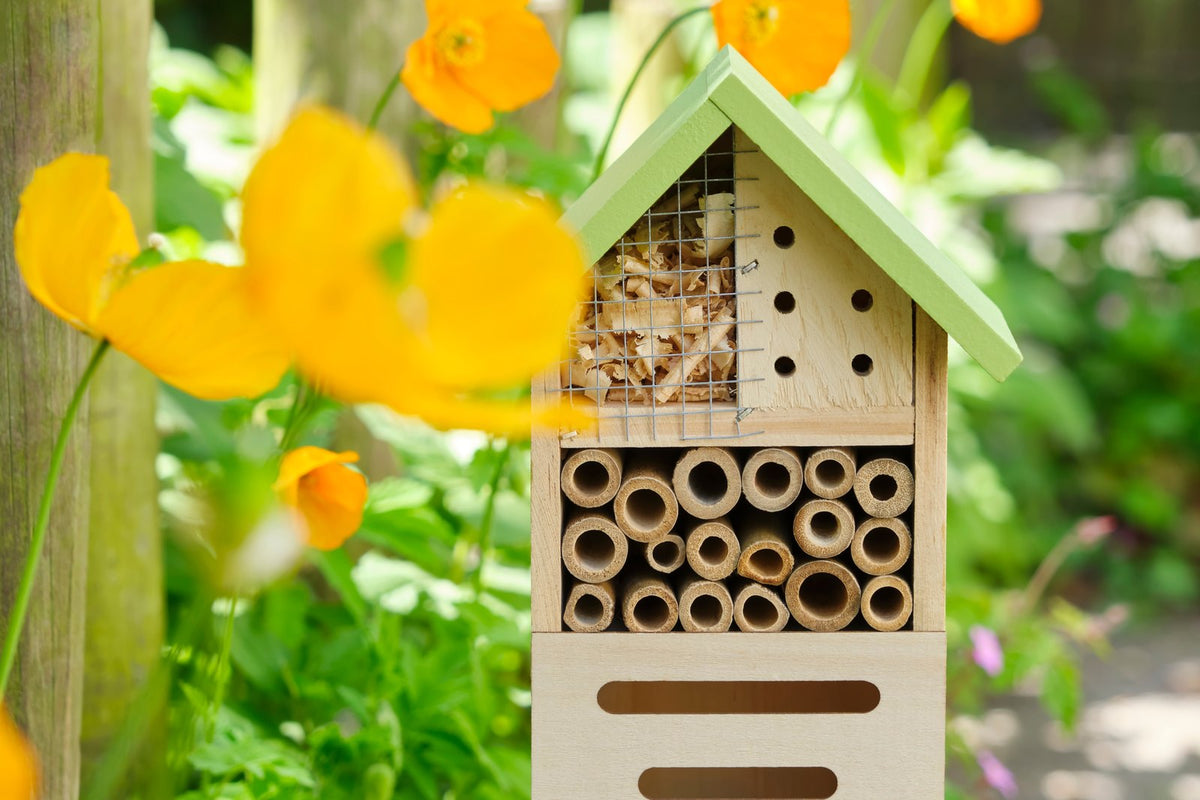
The short version: An insect hotel gives solitary native bees and beneficial predators like lacewings and ladybirds somewhere to shelter and nest. To actually help, it needs smooth-bored holes in a range of sizes, a dry sheltered spot with morning sun, and regular cleaning, because reused tubes build up mites and disease. Most importantly, it only works if the garden also offers flowers for food and is free of broad-spectrum sprays. A few small, well-kept hotels beat one big neglected one.
Insect hotels have become a popular garden feature, and a good one genuinely supports the native bees and predatory insects that pollinate crops and eat pests. A bad one, left to rot and never cleaned, can do more harm than good.
The difference is in the detail, and in remembering that the hotel is only half the job. Without flowers to feed them, the guests have no reason to stay.
Who an insect hotel is for
An insect hotel is a structure of natural materials that offers nesting and shelter to beneficial insects, above all the solitary native bees. Cavity-nesting bees such as resin bees, leafcutter bees and reed bees will use the tubes, along with lacewings, ladybirds and predatory wasps.
Two honest caveats save disappointment. The much-loved blue-banded bee does not use tubes at all, as it digs shallow burrows in clay soil, mudbrick or soft mortar, so you help it with a patch of bare, undisturbed clay rather than a hotel. And European honeybees do not use these either, because they are social and nest as large colonies, not in single tubes.
Why it is worth doing
Supporting these insects pays off in the garden. Native bees are excellent pollinators, and some, like the blue-banded bee, can buzz-pollinate crops such as tomatoes in a way honeybees cannot. The predators you shelter earn their keep too, as ladybird and lacewing larvae are voracious feeders on aphids and other soft pests, covered in our guide to the beneficial bug mix.
How to build one that works
- Use a range of hole sizes. Bundle hollow bamboo or reeds and drill hardwood blocks with holes from about three to ten millimetres, since different bees want different diameters. Native bees will not use holes wider than ten millimetres.
- Make the holes smooth and deep. Bore them cleanly, since a rough hole is less attractive, close them at the back so each is a dead end, and make them around 100 to 150 millimetres deep. Use untreated timber, never chemically treated wood, varnish or paint.
- Give it a roof. A waterproof overhang keeps the nest dry.
- Add a lacewing chamber. Tightly packed straw or rolled cardboard is commonly used to shelter lacewings.
- Leave bare clay nearby. A patch of undisturbed soil or a small clay bank serves the ground-nesting native bees that tubes do not suit.
Where to put it, and why you must clean it
Place the hotel somewhere sheltered from strong wind and heavy rain, with good morning sun, which in Australia means a north-to-east aspect. Raise it on a post to keep it out of the damp, fix it firmly so it does not swing, and site it near flowering plants and a water source, such as a shallow dish with pebbles so the bees do not drown.
The part most people skip is maintenance, and it matters. Tubes and liners must be replaceable and cleaned or replaced from time to time, because parasites, mites, mould and disease build up in reused tubes and spread. Use paper liners or renewable stems, clean the holes after the bees have emerged in spring, replace any mouldy or repeatedly parasitised sections, and retire the whole hotel after a few years. This is exactly why a giant, permanent, unmaintained hotel is a poor idea: it concentrates disease. Several small, scattered hotels that you actually keep clean are far better.
The part that really matters: food
An insect hotel only helps if there is food nearby, which means a year-round supply of nectar and pollen and some pest prey. Plant a diversity of flowers, so there is always something in bloom, and avoid broad-spectrum insecticides, since even gentle sprays harm the very insects you are trying to house. Our guide to a pollinator garden covers what to plant. Without that, a hotel is just an empty building.
Insect hotels across Australia's climate zones
The build is much the same everywhere, with small tweaks for local conditions.
- Cool and cold temperate (Tasmania, southern Victoria, the New South Wales and ACT tablelands and alpine areas): position it to catch the morning warmth.
- Temperate (coastal New South Wales, much of Victoria, including Sydney and Melbourne): a straightforward north-to-east aspect works well.
- Mediterranean (southern South Australia and Adelaide, south-west Western Australia and Perth): provide reliable water through the dry summer.
- Subtropical (south-east Queensland and northern New South Wales, including Brisbane): easy conditions, with shelter from heavy downpours.
- Tropical (far north Queensland and the Northern Territory Top End, including Cairns and Darwin) and arid and semi-arid (inland New South Wales, South Australia and Western Australia, including Alice Springs in the Northern Territory): add afternoon shade and always provide water in the heat.
Frequently asked questions
What lives in an insect hotel?
Solitary native bees such as resin, leafcutter and reed bees, along with lacewings, ladybirds and predatory wasps. Not honeybees, and not the ground-nesting blue-banded bee.
Do native bees sting?
Most are gentle and not aggressive. Australia's stingless bees cannot sting at all, others can but rarely do, and the males cannot sting.
Where should I put it?
Somewhere sheltered with morning sun, a north-to-east aspect, raised and firmly fixed, near flowers and water.
Why do I need to clean it?
Mites, parasites, mould and disease accumulate in reused tubes, so clean or replace the liners each year and retire the hotel after a few years.
Will a hotel fix my aphid problem?
Not by itself. It supports the predators, but you also need flowering plants and no broad-spectrum sprays. It is long-term habitat, not an instant fix.
Will honeybees use it?
No. European honeybees are social colony nesters, so they do not use bee hotels.
Build it well, keep it clean, and surround it with flowers, and an insect hotel becomes a real home for the bees and predators that quietly keep a garden productive.
Related growing guides
Ready to feed the good bugs? Browse our flower seeds for year-round nectar, and our herb seeds, many of which the bees love in flower.