
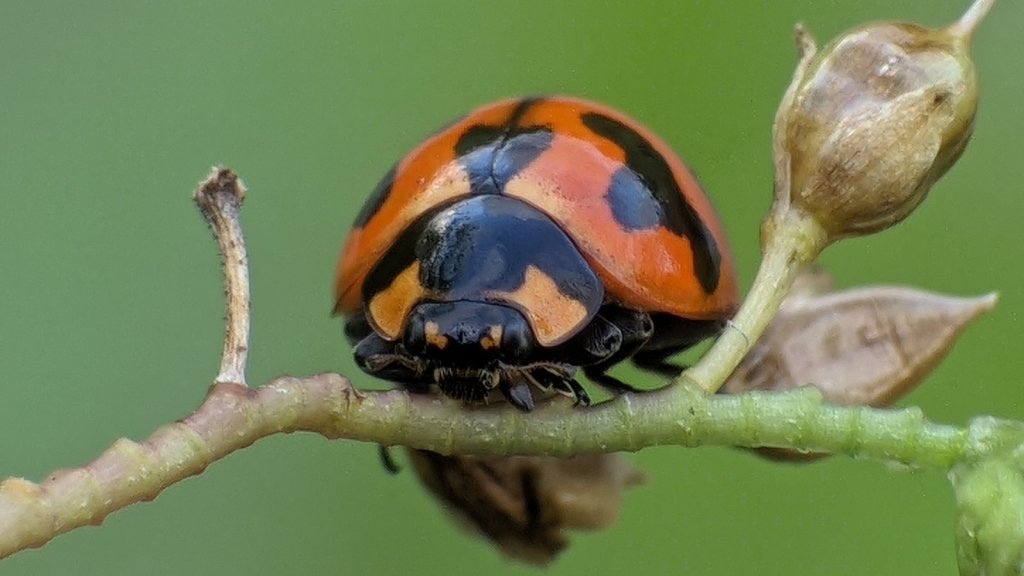
Most ladybirds in an Australian garden are working for you. A few are not, and those few strip the leaves off pumpkin, zucchini, potato and tomato. Gardeners kill the wrong ones regularly, usually the larvae, which look nothing like the adult. Telling them apart takes two seconds, and spots have nothing to do with it.
The short version: Look at the shine first. A predatory ladybird is smooth and glossy, like a bead of enamel. The two leaf eaters carry short downy hairs, so they look dull, and the leaf beneath them is grazed into pale lacy windows. If the beetle gleams, leave it alone, and its spiky larvae too. If it is dull, do not squash it yet: a few valuable predators are dull and hairy as well, the mealybug ladybird among them, so a dull beetle only counts as a leaf eater when the leaf under it is windowed or its pale spiny larvae are there.

The two second test
CSIRO entomology puts the Australian ladybird fauna at 57 genera and about 500 species, roughly half still undescribed, and says most species are predatory, particularly on insects that are pests of agriculture. The plant feeders sit in one tribe, the Epilachnini. The Australian Faunal Directory lists eight Epilachna species for Australia, and two of them are the ones that reach vegetable gardens.
Surface and sheen. On a plant feeding ladybird the upper surface is covered in short downy hairs, and that is what separates them from the common glossy predators such as the transverse and common spotted ladybirds. Under a lens the hairs are obvious. Without one, the beetle looks matt, with no bright highlight along the back where a glossy predator reflects a clear point of light. The test only works one way. A glossy beetle is never a leaf eater. A dull one might be, but some predators are dull too: the mealybug ladybird is covered in fine short white hairs and has no spots at all. So a dull beetle needs the second half of the test, the damage, before you act. Do not count spots: the same fact sheet series notes that spot number is variable and cannot be used to identify ladybird beetles.
The damage. Plant feeders scrape rather than chew clean holes. Larvae graze the under surface and leave the upper surface intact, so the leaf shows pale windows you can see light through. Adults feed on both sides and make holes. Badly grazed leaves dry, curl and die.
The helpers you will actually meet
The Queensland government lists eight beneficial ladybirds in its ladybird beetles guide, giving the adults as 1 mm to 7 mm long, round, convex, orange and black. Three of those, plus the mealybug ladybird, which has its own Queensland page, are the four a home gardener most often meets.
| Species | What you see | What it eats |
|---|---|---|
| Transverse ladybird, Coccinella transversalis | 4 mm to 6 mm, glossy orange and black, throughout Australia | Aphids, as adult and larva |
| Common spotted ladybird, Harmonia conformis | Larger, orange with many black spots on a high gloss back | Aphids, scale, soft bodied insects |
| Mealybug ladybird, Cryptolaemus montrouzieri | About 4 mm, orange head and thorax, black wing covers with no spots, dull and finely haired rather than glossy; larva in waxy filaments | Mealybug eggs and young, soft scales |
| Minute two spotted ladybird, Diomus notescens | Tiny and dark with two pale marks | Small soft bodied pests and mites |
The transverse ladybird figures come from the Australian Museum. The mealybug ladybird is a native whose larva mimics its prey so well that gardeners wipe it off with the mealybugs. The aphid guide covers what these predators face.
The two that eat your leaves
Australian checklists carry them as Epilachna vigintioctopunctata, the 28 spotted potato ladybird, and Epilachna vigintisexpunctata, the 26 spotted. Overseas material uses Henosepilachna, which the Australian Faunal Directory treats as a synonym.
Adults are the size of the larger garden ladybirds and wear black spots on a dull orange back with no shine, and there are usually many small spots rather than a few bold ones.
Both work the nightshades, meaning potato, tomato, eggplant and capsicum, and the cucurbits, meaning pumpkin, zucchini, cucumber and melon. They also breed on solanaceous weeds such as blackberry nightshade, where outbreaks often start. Eggs are oval and yellow, about 1 mm long, laid upright in batches of 10 to 20 under a leaf, so they look much like a predator's eggs. Larvae are pale yellow with long, dark tipped branched spines, reaching about 6 mm.

Where they actually occur
Here the advice changes by region. Occurrence records held by the Atlas of Living Australia, checked 18 September 2026, put both leaf eaters overwhelmingly in the east: close to nine in ten of the roughly 310 records of the 28 spotted ladybird, and of the roughly 294 records of the 26 spotted, come from New South Wales and Queensland.
- Tropical: far north Queensland, the Top End of the Northern Territory, the Kimberley in Western Australia. Both leaf eaters are recorded in Queensland and the Northern Territory, and the warmth allows a long breeding season, so check cucurbits and eggplant whenever they grow.
- Subtropical: south east Queensland and the northern New South Wales coast. The centre of the records for both, so a dull beetle on a pumpkin leaf earns a proper look.
- Arid and semi-arid: inland Western Australia and South Australia, central Northern Territory, western New South Wales and Queensland. Leaf eater records inland are sparse while the transverse ladybird is recorded across the interior, so a beetle in an irrigated patch is more likely a predator. If in doubt, photograph it for your state department of agriculture.
- Temperate: the New South Wales coast and tablelands, and most of Victoria. The two halves differ. New South Wales holds more leaf eater records than any other state, so on the New South Wales coast run the full check, sheen, damage and larva, before you decide. Victoria holds more common spotted ladybird records than any state and only two of the 28 spotted, so a spotted ladybird on a Melbourne zucchini is very likely a helper.
- Mediterranean: Perth and the south west of Western Australia, Adelaide and the South Australian agricultural districts. A handful of Western Australian records of the 28 spotted, none in either state for the 26 spotted, so treat a spotted ladybird as a helper.
- Cool and alpine: Tasmania, Canberra and the rest of the Australian Capital Territory, the alpine country of New South Wales and Victoria. Tasmania holds no leaf eater records and the Australian Capital Territory holds two, so the beetles on your broad beans are very likely predators.
These zones are broad groupings. If you garden on a boundary, lean on local cues such as your first and last frosts, and on what turns up on your leaves.
Eggs, larvae and the pupa stuck to a leaf
The larva is the stage gardeners destroy by mistake. The Queensland guide describes a predatory larva as tapered at the abdomen, often with prominent tubercles, up to 2 mm longer than the adult, grey or black with orange markings. Eggs are yellow, football shaped and stood on end in groups. The pupa is globular and glued to the leaf by its rear end, like a dried orange and black scab.
Eggs and pupae will not settle it. The leaf eaters also lay yellow eggs upright in batches under the leaf, and they also pupate stuck to the underside. The larva is the stage that tells you: grey or black with orange markings means a predator, pale yellow with long dark tipped branched spines means a leaf eater.

Appetite is worth knowing before you spray. IPM Guidelines for Grains states a common spotted ladybird can consume up to 2,400 aphids in her lifespan. A laboratory study of Coccinella transversalis, the species that lives here, measured green peach aphid consumption at about 333 aphids across the four larval stages before pupation. It ran in Indonesia, so read it as a measure of the species rather than of your garden.
Keeping the ones you have
Tolerate a low level of aphids. A garden with no aphids supports no aphid predators. Clear every colony on sight and the ladybirds have no reason to lay eggs on your plants. Leave a light infestation on a tough plant as the breeding ground.
Keep something in flower. Flowering vegetation encourages green lacewings to stay in the landscape, and adult hover flies feed on nectar and pollen, according to the same IPM Guidelines summary. Small flowers suit short tongued insects best. Sweet alyssum along a bed edge flowers for months, and the beneficial bug mix and pollinator garden guide go further.
Know what your sprays do. The grains industry publishes an impact of common insecticides on beneficial insects table. Synthetic pyrethroids rate high toxicity to predatory beetles with persistence beyond ten days, where high means a high proportion killed and re establishment taking several weeks. The organophosphate methidathion rates high for predatory beetles too. Dimethoate, even at the high rate, rates moderate for predatory beetles, which the table defines as activity significantly reduced but populations able to recover in a week or so.
Softer options are not free either. A 2024 study in the journal Insects sprayed natural products onto ladybird larvae and recorded corrected mortality of 38.3 per cent from a pyrethrin product, 33.3 per cent from soap and 28.2 per cent from sweet orange oil. Pyrethrins alone still killed larvae as a dried residue. That work used a European ladybird, so read it as a guide to behaviour. Our pyrethrum guide covers timing and bees: spot treat one plant, check the leaf for larvae and pupae first, and expect to set your predators back with the pest.
Is it worth buying ladybirds?
For one job, yes. Cryptolaemus montrouzieri is available from commercial biocontrol companies and released against mealybug, including into greenhouses, where the release is contained and aimed at a known pest. In an open backyard the case is weaker: ladybirds fly, and they leave when the food runs out. We found no Australian trial of releases in home gardens, so treat confident supplier claims carefully.
What to do when you find the leaf eaters
- Confirm it, and all of it: a dull surface with downy hairs under a lens, scraped windows on the same plant, and pale yellow spiny larvae underneath. A dull beetle with no windows and no pale larvae is not proven, so leave it.
- Pick them off. Adults, larvae and egg batches come off by hand into soapy water, usually enough at garden scale.
- Pull blackberry nightshade and other solanaceous weeds nearby, since they carry the population between crops.
- Check twice a week while cucurbits and nightshades are growing hard.
- Clean up spent potato, tomato and pumpkin plants at season end rather than leaving shelter behind.
Frequently asked questions
Do more spots mean it is a pest?
No. Spot numbers vary within a species and overlap between them, which is why the Pacific pest fact sheets say the count cannot be used for identification.
What is the orange and black thing that looks like a tiny alligator?
Very likely a predatory ladybird larva: tapered body, prominent bumps, grey or black with orange markings, slightly longer than the adult. The hungriest stage, so leave it alone.
Will a soap spray fix aphids without hurting ladybirds?
Not entirely. Soap killed about a third of ladybird larvae sprayed directly in the study above. Its advantage over a pyrethrin product is that the dried residue did not keep killing.
Next time you are in the patch, turn over three leaves on whatever is carrying aphids and look for a spiny grey larva with orange markings. Eggs standing on end and a pupa glued underneath tell you a ladybird is breeding there but not which kind, so it is the grey larva that settles it. Find larvae, eggs and pupae together on an aphid colony and the predators are established, so let them work.