
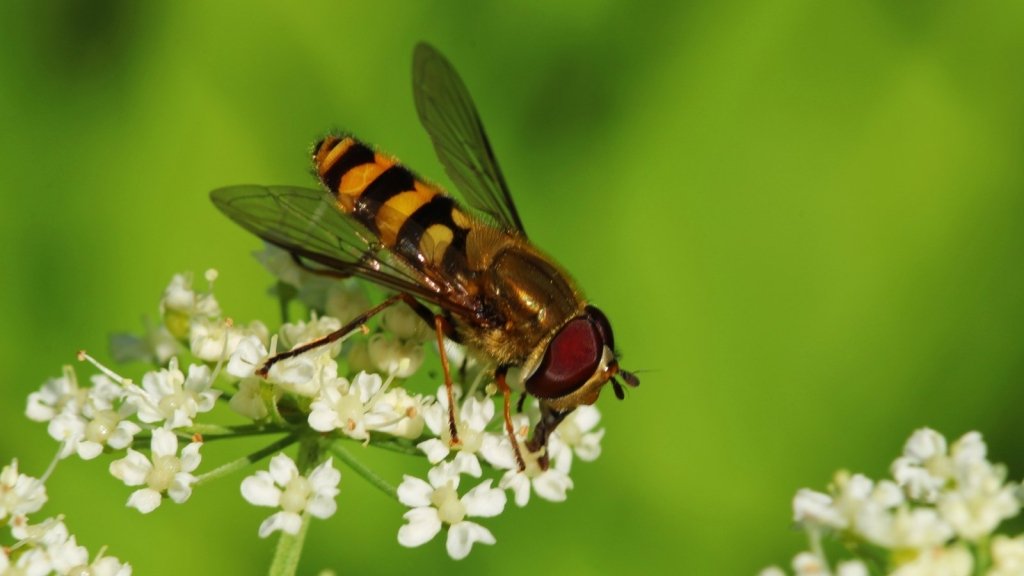
Two very different animals are at work in your vegetable patch, and they are the same insect at different ages. The adult hovers over flowers and pollinates while it feeds. The larva is a legless grub that eats its way through aphid colonies, and almost no home gardener recognises it.
The short version: Hoverflies are true flies with one pair of wings and no sting, and it is the maggot-like larvae, not the adults, that clear aphids. Adults feed at shallow, open flowers, so sow alyssum, coriander and dill in and beside the beds early enough to be flowering before the aphids arrive, then leave the colonies alone long enough for the larvae to work.
How to know you are looking at a hoverfly
Hoverflies belong to the family Syrphidae. The first three checks work on an insect settled on a flower; the last only applies if you catch one.
- Count the wings. The South Australian Department of Primary Industries and Regions puts it plainly: hoverflies are true flies and possess only one pair of clear wings, where bees and wasps have two pairs.
- Watch the flight. They hold one spot in mid air, flick sideways, then hold again.
- Look at the head. The Australian Museum describes a large head with large eyes, the classic fly face, and small or inconspicuous antennae, where a wasp waves long ones about.
- They cannot sting. A held hoverfly mimics the stinging action of a wasp by pushing its abdomen tip into your fingers, with no sting behind it.
Adults are 4 to 10 mm, flattened, marked black and yellow: borrowed warning colouring, sometimes with a wasp-like waist, buying a defenceless fly the second glance a bird gives a wasp.
The two you are most likely to see
Cesar Australia names Melangyna viridiceps and Simosyrphus grandicornis as the common Australian species. Museums Victoria lists M. viridiceps as the Common Hover Fly, body up to 1 cm; the Queensland Good Bug Bad Bug guide lists S. grandicornis as a major predator of aphids and whitefly. The Atlas of Living Australia holds records of M. viridiceps from every state, heaviest in the cooler south east, and none from the Northern Territory; S. grandicornis is recorded everywhere, territories included.

The larva is the whole point
It grows to about 10 mm, flattened, legless and maggot-like, broadest at the rear and narrowing to a pointed front end with no visible head, and runs from cream through green to brown, often with a pale stripe down the back. Cesar Australia notes that larvae are sometimes mistaken for pests.
Gardeners usually call it a caterpillar or a small slug. The Good Bug Bad Bug guide says hoverfly larvae are often misidentified as grass blue butterfly larvae, and gives the test: the caterpillar has proper legs, the hoverfly larva has none. A slug rasps holes in the leaf; a hoverfly larva leaves shrivelled aphid husks and no damage.
On how many aphids, use Australian numbers. Work at the University of Adelaide measured both species on rose aphid at 10, 15 and 20 degrees and reported a lifetime total of about 300 aphids, as third-instar equivalents, across the three larval stages, with consumption higher at the lower temperatures.
Eggs are laid singly near colonies of aphids, or even among them, and South Australian advice adds that adults spot a colony then lay beside it, so hatching larvae have food at once. So do not search the whole plant: turn over the worst aphid-covered shoot and look inside.
The adult eats something completely different
Adults take nectar and pollen, and this is the lever you control. The aphid-eating hoverflies have short mouthparts, so a long tubular flower hides its nectar from them, which is why every Australian guide points to the same shapes. South Australian guidance says adults are strongly attracted to yellow and white flowers with open centres that make pollen easy to reach, and AgPest records the same preference. So umbels and daisies, not foxgloves and salvias: alyssum, coriander, dill, parsley run to seed, calendula, cosmos, cornflower and buckwheat.
What to sow, where to put it, and when
An Australian review of habitat management for vegetable pests, led from Charles Sturt University, found alyssum, buckwheat, cornflower and dill raised the densities of generalist predators including hover flies, with aphid numbers falling as a result. It singles out alyssum, Lobularia maritima, across multiple crops, and notes coriander and dill in lettuce.
Placement matters. That review reports, from lettuce trials in Spain and the United Kingdom, that the drop in aphid numbers was greatest close to the flowering strip and faded with distance, with little left about 10 metres away. A clump of alyssum at the end of each bed, a few plants flowering between rows, and a strip along the fence within a few metres will do it. A flower bed at the far end of the block will not.
Timing is where people go wrong. Hoverflies arrive in response to aphids, so sowing flowers when you first see aphids leaves you weeks behind. Sow alyssum and coriander as soon as the soil warms, sow again three to four weeks later, and let a few coriander, dill and parsley plants bolt. Fennel is a declared noxious weed in Victoria and the restricted category prohibits trade in those plants and their seed, so Victorian readers should use dill, coriander, parsley or alyssum instead. Alyssum and buckwheat self-seed freely, so cut them back after flowering.
South Australian guidance also recommends varied habitat, including hedgerows, cover crops, brush piles and wildflower strips, for alternative food, shelter and protection from pesticides and extreme weather. AgPest adds that certain hoverfly species need access to water for breeding.

The spray problem, including the sprays assumed to be safe
The Pacific Pests, Pathogens and Weeds fact sheet on hoverflies, written by the University of Queensland and CABI under an ACIAR project, is blunt: pesticides easily kill hoverflies, and routine spray programs will destroy them completely. It singles out pyrethrum and synthetic pyrethroids as particularly harmful to biological control agents, and AgPest rates organophosphates as high to very high impact on hoverflies.
The softer options need the same caution. New Mexico State University Extension, reviewing insecticides used in organic production, states that with insecticidal soaps the soft-bodied larval stages of beneficial insects such as ladybird beetles and hoverflies are also likely to be affected. That is overseas guidance, but the point carries: the hoverfly larva is a soft-bodied insect sitting inside the aphid colony you are about to wet.
So before any spray, including soap, oil or pyrethrum, turn the shoot over and look for larvae. If they are there, squash the worst colony by hand instead. More on the pest in our guide to spotting and controlling aphids.
Can hoverflies alone stop an aphid outbreak?
Sometimes. Cesar Australia describes hoverfly larvae as a very reliable form of control during the warmer days of spring when low to moderate numbers of aphids are present. Low to moderate is the condition, and the lag is the reason: aphids first, then adults, then eggs, then larvae, because a colony has to exist and be found before one egg is laid. On a mature plant that lag does not matter; on a seedling, a heavy infestation can stunt it first. The same Pacific fact sheet gives a rule of thumb for that moment, written for island vegetable growers but easy to apply here: more than two hoverfly maggots in a colony means no action is needed.

When hoverflies are active around Australia
- Tropical (far north Queensland, the Top End of the Northern Territory, the Kimberley in Western Australia): the Atlas of Living Australia has Northern Territory records for S. grandicornis and none for M. viridiceps. With no frost to plan against, keep something in flower across the wet and the dry.
- Subtropical (south east Queensland, the northern New South Wales coast): both species are on record, S. grandicornis more numerous in Queensland. The Beatsheet, run by the state Department of Agriculture and Fisheries, is the closest thing to a local calendar for aphids and their predators.
- Arid and semi-arid (inland Western Australia and South Australia, western New South Wales, inland Queensland, central Northern Territory): both species are recorded in those two states. Water rather than warmth is the limit, so put the flowers on the vegetable irrigation.
- Temperate (coastal New South Wales including Sydney, most of Victoria, south east South Australia): a Sydney study found Melangyna active through autumn and winter, and Cesar Australia recorded hoverflies arriving in numbers in Melbourne in the first weeks of October 2016, so have flowers open before then.
- Mediterranean (Perth and the south west of Western Australia, Adelaide and nearby districts of South Australia): both species are recorded in Western Australia. The dry summer is the gap, so aim for a winter to spring flowering window and water the alyssum through it.
- Cool and alpine (Tasmania, the Australian Capital Territory including Canberra, the Victorian and New South Wales highlands): M. viridiceps dominates those records, and the Adelaide study found larvae ate more aphids in total at 10 and 15 degrees than at 20, so a cool spring is not wasted. Use your last frost as the cue to sow.
These zones are broad groupings. If you garden between two of them, lean on local cues such as your first and last frost dates and when aphids actually appear on your roses.
Frequently asked questions
Will hoverfly larvae damage my plants?
No. They eat insects only. Any chewed leaf or sticky residue next to them is the aphids' work, and the larva is there because of it.
Where do hoverflies go in winter?
In mild coastal areas they may not go anywhere: the Sydney study found Melangyna active through autumn and winter where winter-flowering plants exist. In colder districts adults are scarce until spring, which is why the flowers need to be open before the first aphids, not after.
Do the larvae eat anything besides aphids?
Aphids are the main food, but AgPest also lists caterpillars and mealybugs. Leaving a small aphid population somewhere unimportant gives adults a reason to keep laying, which is the logic behind a beneficial bug mix.
Where to start this week
Sow a shallow-flowered plant inside the beds, and next time you find an aphid colony, look inside it first. Alyssum seed is the easiest start because it flowers low, long and close to the crop, and coriander earns its place twice over if you let some bolt. For the wider picture, read our guide to a pollinator garden in Australia.