
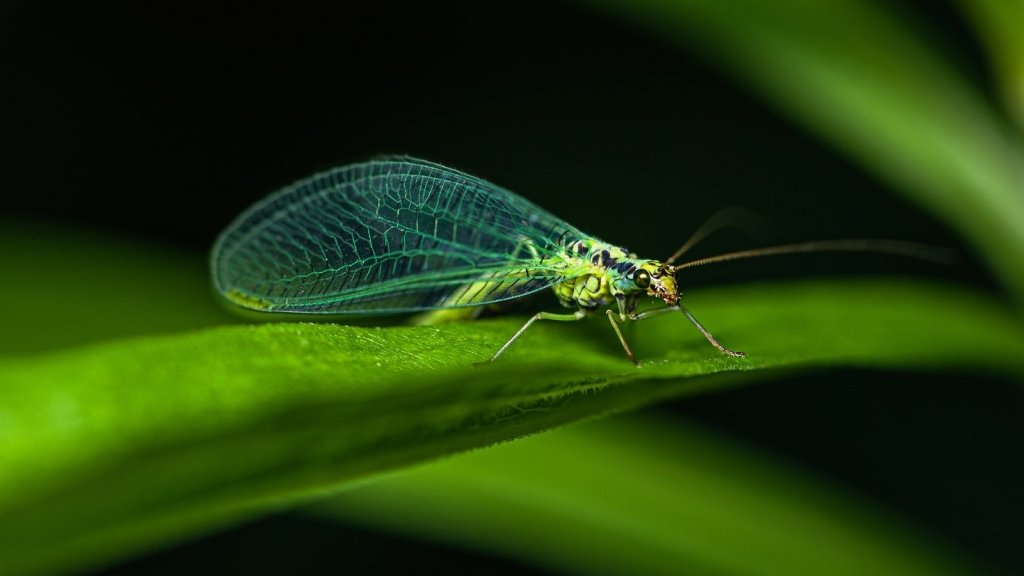
Lacewings are the quiet workhorse predator of an Australian vegetable patch, and most gardeners walk past them. The adult is the pretty part, pale, with veined wings held like a tent. The work is done by the larva, a flat, bristly thing with curved jaws that gardeners call the aphid lion.
The short version: Sow shallow, open flowers such as sweet alyssum and cornflower inside the vegetable beds, keep broad-spectrum insecticides off the patch, and leave leaf litter and standing stems through winter. A lacewing hotel is a pleasant craft project with thin evidence behind it.
Green and brown lacewings are two different families
The two groups here are green lacewings (family Chrysopidae) and brown lacewings (family Hemerobiidae), as Cesar Australia sets out in its guide to beneficials in crops. Green adults reach about 12 mm, brown adults about 8 mm, and both fly at night, according to the Queensland Government lacewings fact sheet.
A shared common name hides differences. Two green lacewings recorded in Australian crops are Mallada signatus and Plesiochrysa ramburi, compared by Queensland Department of Agriculture and Fisheries researchers in a Beatsheet article on green lacewings. The brown lacewing is Micromus tasmaniae, listed in the Australian Faunal Directory and the most heavily recorded of the green and brown lacewings in the Atlas of Living Australia, with more than 10,000 occurrence records. Most overseas writing is about Chrysoperla carnea. The Atlas of Living Australia holds no records under that name, and the only Chrysoperla the Australian Faunal Directory lists here is the native Chrysoperla congrua, recorded mainly in Queensland, Western Australia and the Northern Territory.
The eggs on stalks are the giveaway
Green lacewing eggs are white, laid in groups under leaves, each on a long, flexible stalk. Brown lacewing eggs are cream-coloured, laid singly, with no stalk, according to the Queensland Government lacewings fact sheet.
The stalk is not decoration. Studying the related Mallada desjardinsi in ant-tended aphid colonies in Japan, Hayashi and Nomura in Environmental Entomology (2014) found eggs with intact stalks were almost untouched by ants, while 50 to 80 per cent of eggs whose stalks had been cut at the base were destroyed. It gave no protection against another lacewing species, so the stalk answers one threat, not all of them.

The aphid lion, and what it eats
The larva looks nothing like the adult. It is tapered, mottled and quick, with sickle-shaped jaws it drives into soft-bodied insects or eggs before sucking out the contents, as the Queensland fact sheet describes. The jaws are hollow, a point made in the Pacific Pests fact sheet on brown lacewing. Green lacewing larvae of some species pile their victims onto their backs; brown lacewing larvae are longer and bare. Besides aphids they take moth eggs, small caterpillars, whitefly, thrips, mealybugs and mites, plus scale insects and psyllids for the brown lacewing.
Queensland researchers recorded Plesiochrysa ramburi larvae eating an average of 500 mealybugs across larval development, a stage taking 28 days at 25 degrees Celsius, with Mallada signatus no different. Zhou and colleagues (2024) found third instar Mallada signatus larvae ate more than 75 tomato potato psyllid nymphs in a day. The Pacific Pests sheet puts brown lacewing larvae at up to 25 aphids a day, with adults eating a similar number.

What the adults eat decides what you plant
The Queensland fact sheet is plain: both adults and larvae of brown lacewings are predatory, while for green lacewings it is the larvae that hunt, the adults taking nectar and pollen. So flowers are adult food for green lacewings, which the fact sheet says persist better where nectar is nearby. Brown lacewings want prey, shelter and an unsprayed bed.
An Australian trial gives a usable shortlist. In a Hort Innovation project led by Charles Sturt University with Cesar Australia and NSW Department of Primary Industries, flowering strips of sweet alyssum, buckwheat and cornflower were grown inside brassica crops across New South Wales, Victoria, South Australia and Queensland. Cesar Australia reports a positive correlation with higher beneficial numbers, and reduced pest numbers alongside, brown lacewings among them.
- Put it in the bed, not in a corner. The trial flowers grew within the crop, so a row down the middle of the brassicas beats a distant border.
- Choose shallow, open flowers. Sweet alyssum and cornflower are the two from that trial a home gardener sows easily; our note on what is in a beneficial bug mix covers the ready-made blends. Coriander and dill left to flower give the same small, open shape.
- Sow in succession, a short row every three to four weeks through spring, so something flowers before aphids build.
- Leave fennel out in Victoria. Foeniculum vulgare is a declared noxious weed in all ten Victorian catchment regions, restricted in nine and regionally controlled in Corangamite, on the Agriculture Victoria noxious weeds list. Use dill or coriander.
Is a lacewing hotel worth building?
The idea comes from European research on overwintering chambers for the Chrysoperla carnea group, which hibernates as an adult and will pack into a dry box. McEwen and colleagues, in the Journal of Applied Entomology (1999), found correctly placed chambers could be colonised by large numbers of adults, with considerable variation between areas. They then tested whether those overwintered lacewings could control pests. That attempt, in their words, was not successful.
Two things stop that transferring here. Chrysoperla carnea is not recorded in Australia, and the green lacewings in our gardens are different species. We also could not find a published Australian trial of a lacewing shelter.
So build one if you enjoy building things. A small weatherproof box with narrow slots, packed loosely with dry straw and fixed waist height out of rain and wind, gives an adult a dry crevice in a cold snap. Whether our species overwinter as adults the way Chrysoperla carnea does has not been shown, and shelter is all a box has been shown to give, so do not let it stand in for the flowers.
A nesting box for solitary bees is a different case, covered in our guide to insect hotels and native bees.
Cheaper shelter works on the same principle. The Queensland fact sheet notes cooler temperatures may trigger diapause, and an insect settling in for a cold spell wants somewhere dry and still. Leaf litter, seed heads and hollow stems left standing supply that at no cost, so tidy beds in late winter.
Buying lacewings: when it makes sense
Australian biological control suppliers sell green lacewing eggs and larvae. Enclosed, against an identified pest, at a sensible density they can work: in the psyllid study above, eight green lacewing larvae per caged tomato plant cut the population by 64 per cent.
Open ground is less reliable. In apple orchards, Schmidt-Jeffris and colleagues in Biological Control (2025) found a single hand release of lacewing eggs or larvae at a commercial rate cut aphids by about half in one trial, and did not repeat that result in the next two years of the same study, when aphid numbers at the start were far higher. Their conclusion was that releasing at the first sign of aphids is critical. Raupp and colleagues released lacewings on landscape plants and found no evidence of aphid reductions. Both are overseas, with different species, so read them as a caution. Buy lacewings for a glasshouse or poly tunnel, for a pest caught early, with repeat releases and nectar nearby, not as a one-off sprinkle.
The spray problem
Lacewing adults are very sensitive to some pesticides, according to the Queensland fact sheet, and the Pacific Pests fact sheet states lacewings are very susceptible to insecticides and their residues. Cesar Australia adds that indiscriminate use of broad-spectrum insecticides affects beneficial insects, and recommends selective chemicals. Identify the pest first, treat the affected plant not the bed, and follow the label.
Lacewings around Australia
- Tropical (far north Queensland, the Top End of the Northern Territory, the Kimberley in Western Australia): warm year round, so green lacewings need not shut down. Keep something in flower every month. Brown lacewing records from the Territory are scarce.
- Subtropical (south-east Queensland, the northern New South Wales coast): both families are recorded, and mild winters let a nectar plant flower most of the year, so keep alyssum through winter.
- Arid and semi-arid (inland Western Australia and South Australia, central Northern Territory, western New South Wales and Queensland): both are recorded inland, but a dried-off flower gives no nectar, so the row needs irrigation and afternoon shade.
- Temperate (Sydney and coastal New South Wales, Melbourne and central Victoria): Victoria holds the largest share of Australian Mallada signatus records, and the aphid flush comes with spring growth, so sow in late winter.
- Mediterranean (Perth and the south-west of Western Australia, Adelaide and the South Australian gulf districts): both lacewings are recorded in Western Australia in similar numbers. Dry summers are the constraint, so sow alyssum in autumn and early spring.
- Cool and alpine (Tasmania, Canberra and the Australian Capital Territory, the Victorian and New South Wales high country): expect both. Tasmania holds far more Micromus tasmaniae records than any other state, and Syrett and Penman (1981), working in New Zealand, measured a developmental threshold near 5.8 degrees Celsius, so the brown lacewing keeps going in cold weather and shelter matters for it. Tasmania is also where the green Plesiochrysa ramburi is most recorded, and its adults need the flowers, so keep the alyssum row as well.
These zones are broad groupings. If you garden between two, lean on local cues such as your first and last frost dates.
Frequently asked questions
How do I tell an aphid lion from a small caterpillar?
Look at the head. A lacewing larva carries curved jaws projecting well clear of the head, and it moves fast and erratically. A caterpillar has a rounded head capsule and prolegs down the body. The Queensland fact sheet notes they may be confused with carab beetle larvae.
Will lacewings clear an aphid outbreak on their own?
Sometimes, and not to a timetable. A predator population builds after the pest population, and lacewings are part of a slower balance with ladybirds, hoverflies and parasitoid wasps. If one plant is overwhelmed, hose the aphids off and leave the rest alone.
Is a lacewing hotel the same idea as a bee hotel?
No. A bee hotel supplies a nest site to insects that nest in tunnels. A lacewing hotel supplies a dry crevice, which is a weaker claim, and untested here.
Your next step
Pick one bed. Sow a short row of alyssum down the middle this spring, put the sprays away, and leave the litter under the shrubs next autumn. Then start turning leaves over: the eggs on stalks will show it is working before you see an adult.