
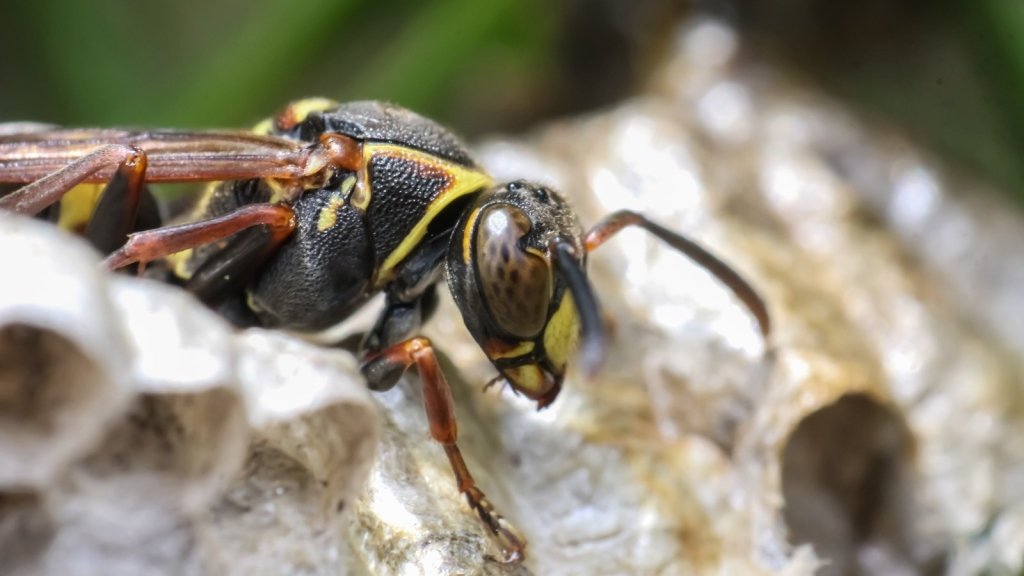
Most gardeners meet a wasp and look for something to spray it with. In an Australian vegetable patch that is usually the wrong call, because most wasps you see are removing the caterpillars, aphids and spiders you were worried about. A few deserve care, one deserves a phone call.
The short version: Leave the tiny dark wasps and the mud nest builders alone, because they are working through your caterpillars and aphids for free. Keep clear of a paper wasp nest, and have it removed professionally if it hangs over a doorway or washing line. The exception is the European wasp, Vespula germanica. In Western Australia it is a declared pest to report; elsewhere its nest is a job for a licensed pest controller or your council, not for you.

Three kinds of wasp, three different jobs
1. Parasitoid wasps, the ones you rarely see
These are the workhorses, and you will probably never see one. Cesar Australia describes aphid parasitoids as mostly 2 mm to 3 mm long, from the genera Aphidius, Aphelinus, Diaeretiella, Lysiphlebus and Trioxys. A female lays an egg inside a living aphid and the larva feeds from within.
Business Queensland pairs Aphidius colemani with green peach and turnip aphid, and Aphidius ervi with pea and blue green aphid. On brassicas, Cesar Australia names Diadegma semiclausum, Apanteles ippeus and Diadromus collaris as the leading parasitoids of diamondback moth, while Cotesia and Apanteles wasps take cabbage white caterpillars and armyworm. One small native wasp is the exception in a home garden: the citrus gall wasp makes woody lumps on citrus stems, and our guide covers it.
2. Solitary hunting wasps: mud daubers and potter wasps
These build the mud lumps people scrape off brickwork. The Australian Museum puts the mud-dauber wasp Sceliphron laetum at about 3 cm, stocking each nest cell with paralysed spiders and one egg, and potter wasps, subfamily Eumeninae and around 1.5 cm, at the same job with caterpillars. The museum notes potter wasps are not aggressive and rarely attack people, and that mud-dauber attacks are rare. Wait until the cells are open and empty before scraping one off.
3. Paper wasps, Polistes species
These you can watch working. The Australian Museum describes Polistes paper wasps building an inverted cone of cells from saliva and wood fragments under branches and eaves, and catching caterpillars to feed their larvae. The museum notes that native paper wasps are smaller than European wasps and lack their vivid yellow markings, so judge by the nest and the colour rather than by size. The same page notes they deliver painful stings but are less aggressive than European wasps, and normally attack only if the nest is disturbed.

The evidence trail you can read
Aphid mummies. A parasitised aphid stops moving, swells and hardens. Cesar Australia describes aphids that bloat and turn brown or gold, roughly one to two weeks from egg to adult, and the University of California IPM program adds the rounded hole the wasp leaves when it cuts its way out. Find mummies among your aphids and leave that colony alone for a fortnight.
Parasitised caterpillars. Look for small white silken cocoons, which Cesar Australia recorded on or close to the host's body in Victoria and southern New South Wales. That caterpillar is finished, so squashing it destroys only the wasps inside. Our guide to cabbage white and diamondback caterpillars covers the rest of the bed.
Either sign means the same thing: stop spraying and let it run.
What to plant so the parasitoids stay
This is where companion planting earns its keep, because adult wasps do not live on aphids. University of Maryland Extension notes that adult parasitoids feed on nectar, pollen and honeydew, and that the best sources are flowers with wide or shallow corollas, such as the carrot and cabbage families. A wasp 2 mm long cannot reach into a deep tubular flower.
Cesar Australia reports trial plots on vegetable farms in New South Wales, Victoria, South Australia and Queensland planted with sweet alyssum, buckwheat and cornflower, indicating a positive correlation between flowers grown within brassica crops and beneficial insect numbers.
- Sweet alyssum along a bed edge: tiny open flowers, long season, low enough not to shade a crop.
- Coriander, dill and parsley left to bolt, because the flat umbel suits a small wasp.
- A few carrots or parsnips left to flower in their second year.
- Cornflower, calendula and cosmos for open, shallow flowers later on.
Fennel is often suggested for this job, but Agriculture Victoria lists Foeniculum vulgare as a declared noxious weed in every Victorian catchment region, restricted in nine and regionally controlled in Corangamite, and we do not send fennel seed to Victoria, so Victorian gardeners should use coriander or dill. Our beneficial bug mix guide covers mixed flower strips, and an insect hotel adds shelter for larger solitary wasps.
Why the spray costs more than it saves
Cesar Australia groups synthetic pyrethroids, organophosphates and carbamates as hard or broad-spectrum pesticides, and states that spraying a pesticide can have the same impact on beneficials as on the pests it is designed to kill. Its aphid parasitoid page adds that these wasps have a limited effect where such sprays are applied, and University of Maryland Extension calls parasitoid wasps very sensitive to insecticides.
The cost arrives later. A review of insecticide toxicity to natural enemies in Australian grains, Overton and colleagues in Insects, 2021, notes that frequent chemical use can cascade through trophic levels and drive secondary pest outbreaks: in a backyard, aphids back within weeks with nothing to hold them down. If you do spray, read our note on pyrethrum spray first, and spot treat.
The European wasp is a different matter
The Australian Museum describes Vespula germanica as a stout wasp with a yellow and black banded abdomen, a pair of black spots on each yellow band, and a habit of flying with its legs tucked close to the body. Better Health Channel puts workers at about 15 mm, describes a grey papier-mache nest in the ground, retaining walls or tree hollows, and notes it stings repeatedly and releases a pheromone that calls others in.
- Against a paper wasp. A paper wasp nest is an open comb on a short stalk in plain view; a European wasp nest is a hidden cavity with a small entrance hole. ACT City Services points to bright yellow legs and markings against the duller native paper wasps.
- Against a honey bee. Bees are furry and brownish gold; wasps look hard and shiny. Healthdirect notes a bee leaves its sting and venom sac behind and dies, while a wasp leaves no sting in you.
- Behaviour. A wasp working your picnic meat is more likely to be a European wasp, because paper wasps are out hunting caterpillars.
In Western Australia the Department of Primary Industries and Regional Development treats European wasps as declared pests, reports every detected incursion eradicated since 1977, and asks for sightings to go to the Pest and Disease Information Service on (08) 9368 3080 or padis@dpird.wa.gov.au. In the ACT, nests on government land are treated after a report, private land is the owner's responsibility, and the advice is blunt: do not attempt to treat the nest, because you risk being stung. In the south east it is established: the Australian Museum records it first in Tasmania in 1959 and in Victoria, South Australia and New South Wales by 1978.
When a nest is a genuine problem
Act on a nest within daily reach: above a door, over a path, at the washing line, beside a play area, or where someone with a sting allergy lives. One high under a back eave that nobody passes is best left alone. When a nest does have to go, hand it over. Healthdirect advises professional removal, because doing it yourself increases your chance of being stung, and Better Health Channel strongly recommends a licensed pest control operator or your council. That is why there is no chemical recipe here. Healthdirect also advises a doctor after 5 or more stings in a child or 10 in an adult, and emergency services for difficulty breathing, throat swelling, dizziness or collapse.
Where you garden changes the picture
These zones are broad groupings. If you sit between two, lean on local cues such as your own first and last frosts.
- Tropical (Northern Territory Top End, far north Queensland, the Kimberley in Western Australia): the Australian Museum's European wasp records are from Tasmania and the southern mainland, so a striped wasp here is more likely to be a native paper wasp or potter wasp. Check the markings before you act, and in the Kimberley report any suspected European wasp to DPIRD.
- Subtropical (south east Queensland, northern coastal New South Wales): paper wasps stay active over a long season, so check eaves and pergolas before you prune.
- Arid and semi-arid (inland South Australia and Western Australia, western New South Wales and Queensland, central Northern Territory): wasps come to food and water, so keep cans and pet bowls covered.
- Temperate (most of New South Wales, much of Victoria, south east South Australia): colonies are established and nests grow from spring through to autumn, so act early rather than in February.
- Mediterranean (Perth and the Western Australian south west, Adelaide and the South Australian agricultural areas): in Western Australia the wasp is a declared pest under eradication, so report sightings; in South Australia it is established around Adelaide, so a nest is a job for your council or a licensed pest controller.
- Cool and alpine (Tasmania, Canberra and the ACT, the Victorian and New South Wales high country): this climate suits the European wasp. Canberra reports nests on government land through ACT City Services, by the online European wasp report form or Access Canberra on 13 22 81; a nest on private land is the owner's job for a licensed pest controller.
Frequently asked questions
How do I know the aphids are parasitised and not just dead?
A parasitised aphid is swollen and rigid, brown or gold, and stays stuck to the leaf. A dead aphid shrivels and drops. The giveaway is the neat round exit hole, which is the wasp's door rather than feeding damage.
Do paper wasps sting without provocation?
The Australian Museum records that they normally attack only when the nest is disturbed. Stings usually come from disturbing a nest nobody had noticed, so look before you mow, hedge or open a shade sail.
Will planting flowers bring more stinging wasps into my yard?
It brings more of the small nectar feeding parasitoids, which do not sting people. Paper wasp numbers follow nest sites and caterpillar supply, and European wasps come for protein and sugary drinks.
A sensible next step
Walk your brassica bed this week and turn a few leaves over. Gold mummies among the aphids, or white cocoons beside a limp caterpillar, mean you already have the wasps. Keep them fed and do not spray them out. Sow a metre of alyssum and look again in a fortnight.