
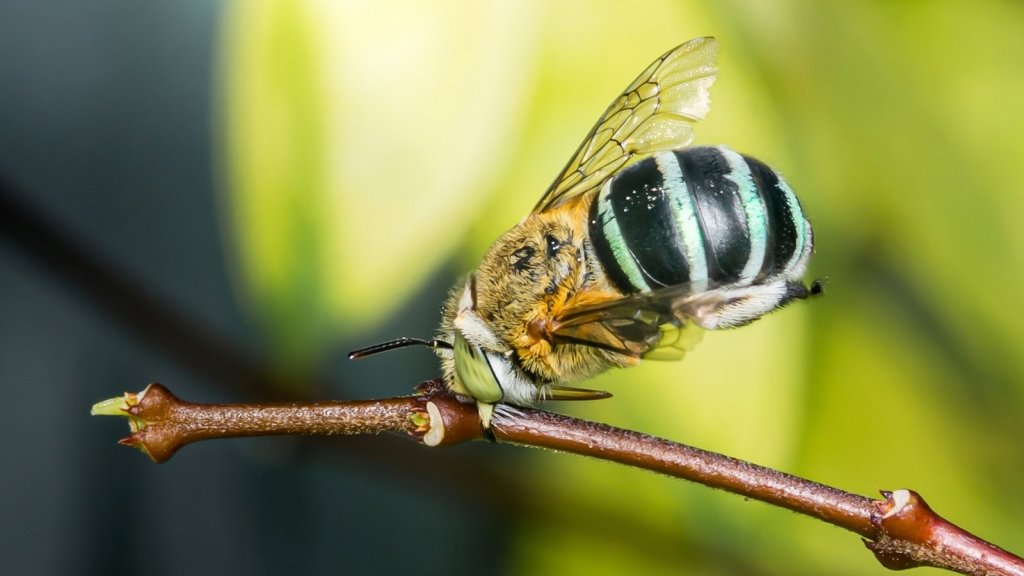
A tomato flower does not spill its pollen when an insect walks over it. The pollen sits locked in a tube that opens through one small pore, and it comes out when a bee grips the anthers and vibrates hard enough to shake it free. The honey bee cannot do that. Three groups of Australian native bees can.
The short version: Buzz pollination, or sonication, is a bee vibrating pollen out of a flower whose anthers open by a pore rather than splitting. Tomatoes are self fertile and set some fruit from wind alone, so this is about better fruit rather than any fruit, and you bring the bees in with blue and purple flowers, bare unmulched soil or a clay nesting block instead of a drilled timber bee hotel, and no insecticide on anything in flower.
What buzz pollination actually is
In most flowering plants the anther splits along its length and the pollen is there for the taking. In a smaller group it stays shut and releases pollen through a tiny pore at the tip. Botanists call these poricidal anthers, and the Annals of Botany review of buzz pollination describes them as tubular anthers opening only through small pores or short slits.
The shaking is the bee. She lands, folds her wings, grips the anther cone and contracts her flight muscles without flying, which that review records at roughly 80 Hz to 500 Hz. The Australian Museum adds the local detail: a blue banded bee curls around the anther and bangs her head against it as she vibrates.

Which crops have it, and which do not
Check first. The global review of buzz pollinated crops in the Journal of Economic Entomology lists tomato (Solanum lycopersicum), eggplant (Solanum melongena), tamarillo (Solanum betaceum), bush tomato (Solanum chippendalei), potato (for seed, not tubers), blueberry and cranberry (Vaccinium) and kiwifruit (Actinidia deliciosa).
Two common additions do not hold up. Capsicum is absent from that review, and the PhytoKeys monograph of chili peppers gives the genus anthers that open by longitudinal slits, so they sit in the ordinary group. Kiwi berry is Actinidia arguta, a relative of the listed kiwifruit, not the same plant, and a 2026 study of its flowers describes its anthers splitting lengthways rather than opening by a pore.
Zucchini and pumpkin are a different problem, constantly muddled with this one. Cucurbits have no pored anthers. They carry separate male and female flowers, so pollen must travel between two flowers and shaking the plant achieves nothing. The fix is in our guide to zucchini flowers with no fruit.
What a buzz pollinator adds to a tomato crop
Tomatoes do not fail without native bees. The same review states that although tomatoes are self compatible, pollination is still required for full fruit set, and that likely needs anther shaking from wind, mechanical movement or insect visits.
What a bee adds is completeness: more pollen on the stigma, more fertilised seeds, and more seeds means a larger, better shaped fruit. In the meta analysis inside that review, buzz pollinating bees raised fruit weight about 65 per cent over unpollinated controls, while mechanical vibration raised it about 30 per cent, which was not statistically significant. Many of those trials are greenhouse work with no wind, so the backyard gap is smaller. University of Adelaide greenhouse trials with the common blue banded bee, reported through the Australian Native Bee Research Centre, gave tomatoes 15 to 20 per cent heavier than the growers' vibration wand.
The three you can realistically attract
Blue banded bees (Amegilla species) are chunky, honey bee sized but rounder, with a furry gingery thorax and a black abdomen banded in iridescent blue or turquoise hair. They hover and dart rather than trudge. The Wheen Bee Foundation records them across the country except Tasmania, and confirms the females buzz pollinate.
Teddy bear bees (Amegilla bombiformis) are stocky and bumblebee shaped, in orange brown fur with dark bare bands across the abdomen and often a worn black patch on the thorax. The Australian Native Bee Research Centre puts them at 7 mm to 15 mm, in soil burrows, Australia wide except Tasmania, and the Hunter Region Landcare Network records them buzz pollinating.
Carpenter bees (Xylocopa species) are large and loud, and the green carpenter bee has been tested as a buzz pollinator of greenhouse tomatoes in Australia. The peacock carpenter bee, Xylocopa bombylans, is 1.6 cm to 1.8 cm of shifting metallic purple and green, in eastern Australia north of Sydney. The green carpenter bee, Xylocopa aerata, is recorded as extinct in Victoria and mainland South Australia. Both tunnel into soft dead wood: a dead Banksia trunk, an old grass tree flower spike or a standing dead limb.

How to bring them in
1. Flowers, blue ones in particular
The Australian Native Bee Research Centre calls lavender spikes particularly attractive to blue banded bees, and native rosemary (Westringia) attractive to blue banded and teddy bear bees. From seed, the blue and purple end of our flower seed range gives the same colours: lavender, salvia Blue Bedder, cornflower Blue Boy, borage, phacelia, anise hyssop and lavender blue scabiosa. Sow each in a block rather than single plants, and keep something in flower for a long season.
2. Nesting, where most bee hotel advice goes wrong
A standard bee hotel, drilled hardwood and cut bamboo, houses cavity nesting bees: the guide to bee hotel visitors lists resin and leafcutter bees (Megachile) and masked bees (Hylaeus) as the tenants of those tubes. Blue banded bees are not tube nesters. They dig. The Wheen Bee Foundation describes Amegilla as ground nesting, in burrows 5 cm to 10 cm deep in sandy clay or loam, sheltered from rain on sloping banks. In town they take mudbrick, old mortar, or earthen banks under houses, and a high concrete content discourages them.
So give them a clay or rammed earth block with starter holes in a sunny sheltered spot, or a bank of soft soil. The Biodiversity Council of Australia article on building your own bee hotel quotes bee ecologist Clancy Lester saying around 70 per cent of Australia's native bees nest in the ground, the blue banded bee among them, and advising clay blocks beside bare unmulched ground. For tube nesters, see our guide to insect hotels.
3. Undisturbed ground and no spray on flowers
Leave a warm patch of bare, unmulched, undug soil out of the mower's path, and do not tidy an eroded bank or old mortar while bees use it. On spraying, the Australian Native Bee Research Centre is blunt: insecticides kill native bees along with garden pests, so avoid them where you can, and otherwise choose a low toxicity product, spray when bees are inactive and keep it off the flowers. The pollination service BeeAware puts it in label form: do not spray any plants while bees are foraging. Organic sprays included, which is the point of our article on pyrethrum spray.

If no buzz pollinators turn up
Outdoors with a breeze, self fertile tomatoes generally set fruit, so if your trusses are filling, leave them. If they are not, vibrate the truss yourself: flick it with a finger, or hold a running battery toothbrush against the truss stem for a few seconds while the flowers are open, repeating as new flowers open on the truss. In a 2025 Horticulture Research study, vibration applied to greenhouse tomato flowers raised seed number per fruit by roughly 1.9 to 2.1 times over untreated controls in one cultivar, and by more in three others. It earns its keep where wind and insects are missing: a greenhouse, a polytunnel, an enclosed balcony, a plant under netting.
Where these bees are, by climate zone
These zones are broad groupings. If you sit between two, lean on local cues such as your first and last frost dates and what is flying in your garden.
- Tropical. Far north Queensland, the Top End of the Northern Territory, the Kimberley in Western Australia. Amegilla cingulata runs up the east coast to the tip of Queensland. Site a clay block out of the wet season downpours.
- Subtropical. South east Queensland and the northern New South Wales coast. The best chance of all three, since the peacock carpenter bee occurs north of Sydney.
- Arid and semi-arid. Inland Western Australia and South Australia, central Northern Territory, western Queensland, far western New South Wales. Amegilla are present and the sandy clay banks they nest in are often already there, so flowers are the limit.
- Temperate. Coastal and tableland New South Wales and most of Victoria. Blue banded and teddy bear bees are both here. The green carpenter bee survives in New South Wales but is recorded as extinct in Victoria.
- Mediterranean. Perth and the south west of Western Australia, Adelaide and the South Australian gulf districts. The common blue banded bee, Amegilla chlorocyanea, is here, and the Adelaide tomato work used South Australian bees.
- Cool and alpine. Canberra and the ACT, the New South Wales and Victorian high country, and Tasmania. Amegilla do not occur in Tasmania, so Tasmanian gardeners should use the vibration method above. In the high country the flying season is short, so long flowering plants matter most. Follow your state department guide for local timing.
Frequently asked questions
Do blue banded bees sting?
Females can sting, but these are solitary bees with no colony to defend, so they behave nothing like a honey bee at a hive. Watch a nesting bank rather than grab at it.
Will they damage my house if they nest in the mortar?
The Australian Native Bee Research Centre records them nesting in the soft mortar of old brick buildings and in mudbrick, and notes that mortar with a high concrete content usually discourages them. If you need to move them on, repoint with a harder mix after the season's bees have emerged rather than while the burrows are occupied.
Can I buy blue banded bees for my garden?
No. There is no hive to buy and no queen to install. They are solitary ground nesters, so the way to get them is habitat: the right flowers, bare soil, no spray.
Where to start
Sow a block of one blue or purple flower from our flower seed range beside the tomato bed, then clear a sunny patch of bare soil nearby and leave it alone. Our tomato seed range is the other half of the job, and our guide to a pollinator garden in Australia covers the rest.