
How to Grow Chinese Broccoli in Australia
Chinese broccoli is a cool-season brassica grown for tender stems, leaves and white-budded shoots. Sow 6 mm deep in fertile, free-draining soil in full sun, in most zones from late summer into autumn and again in early spring. Thin to 20 to 25 cm, net against caterpillars from sowing and keep the soil evenly moist. Cut the main shoot as buds form, usually 7 to 12 weeks from sowing.
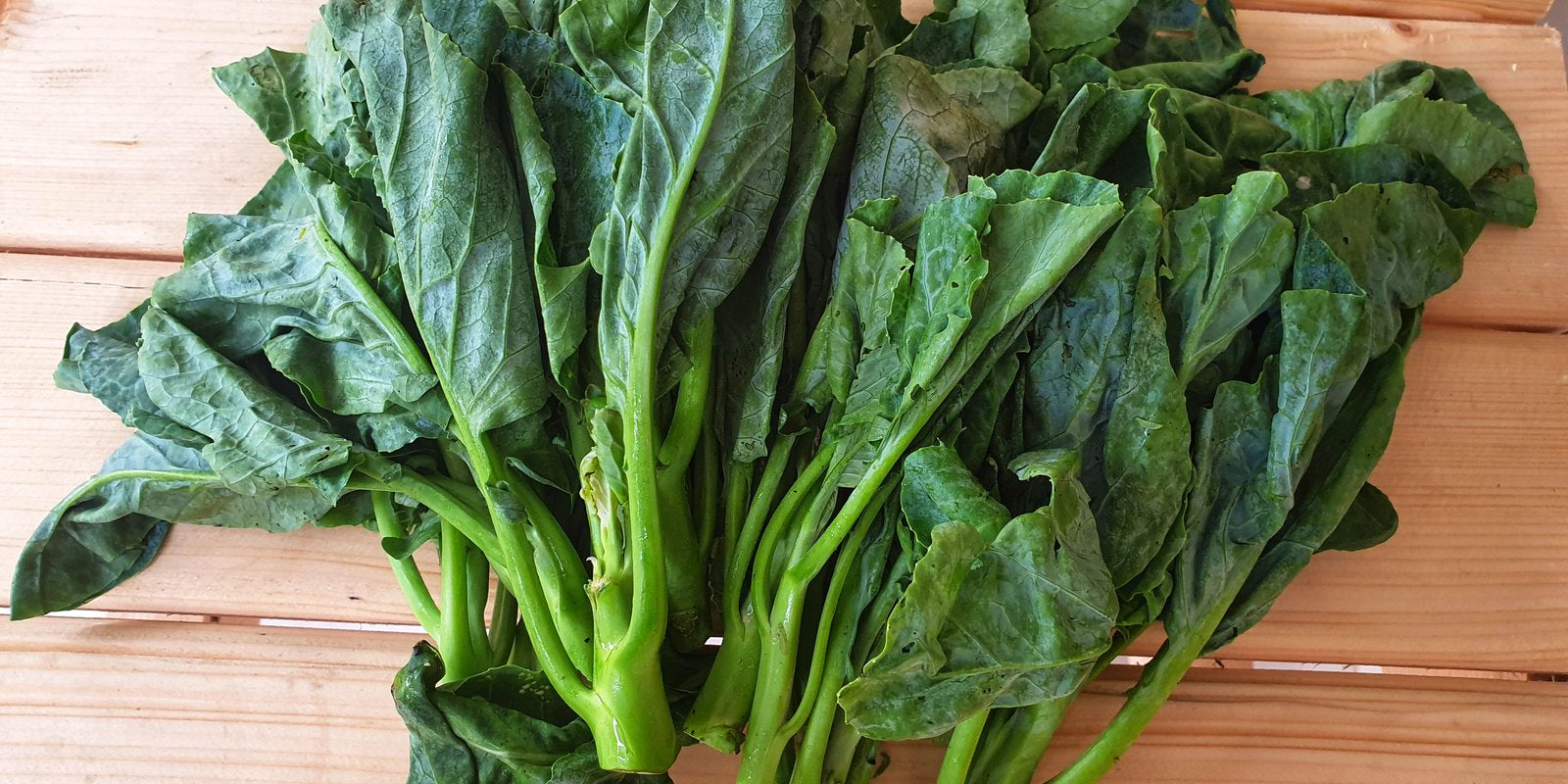
| Sun | Full sun; light shade when hot |
|---|---|
| Water | Keep evenly moist from sowing to harvest |
| Soil | Fertile, free draining, pH 6.0 to 7.0 |
| Feed | Medium; fish emulsion, half strength, fortnightly |
| Spacing | 20 to 25 cm |
| Depth | 6 mm |
| Germination | 5 to 15 days, soil 7 to 30°C |
| Harvest | Shoots 7 to 12 weeks |
| Container | Yes, 30 cm pot, about 15 L |
| Frost | Takes light frost, not hard freezes |
| Use | Stems, leaves and buds, stir-fried or steamed |
Chinese broccoli, or kai lan (Brassica oleracea Alboglabra Group), is a cabbage-family (Brassicaceae) crop grown for its thick stems, leaves and white-flowered shoots. Also called gai lan, it copes with warmer weather than broccoli, its close relative, so every Australian zone has a window for it. The usual mistake is waiting for a broccoli-sized head.
Three mistakes that matter
- Waiting for the flowers. Once the white flowers open, the stems turn woody and the plant puts its effort into seed. Cut each shoot while the buds are formed but still closed.
- Rushing seedlings in warm weather. Seedlings that race along in trays in warm weather often flower while still small, giving few leaves and thin stems. Sow inside your zone's window and plant out at three to four weeks, before roots crowd the cell.
- Leaving plants uncovered. Caterpillars of cabbage white butterfly (Pieris rapae) and diamondback moth (Plutella xylostella) chew the leaves and can tunnel into the shoots. Stretch fine insect mesh over hoops on sowing or planting day.
When to plant
Seed germinates in soil from about 7°C to 30°C, fastest at 25°C to 30°C, and plants grow best in air between 18°C and 28°C. Cold spells push young plants to flower early, so in most zones the strongest crops come from sowings in late summer and autumn. Sow a fresh row each time the last one reaches about half size, for a steady supply.
| Zone | Example cities | Sow | Harvest | Notes |
|---|---|---|---|---|
| Tropical | Darwin NT; Cairns, Townsville QLD; Broome WA | Apr-Aug | Jun-Nov | Sow through the dry season with afternoon shade; wet-season heat and humidity bring early flowering and leaf disease. |
| Subtropical | Brisbane, Sunshine Coast, Bundaberg QLD; Coffs Harbour NSW | Feb-Sep | Apr-Dec | Autumn and winter crops grow best; shade February and September sowings, which finish in warm weather. |
| Arid and semi-arid | Alice Springs NT; Broken Hill NSW; Mildura VIC; Kalgoorlie WA | Mar-Aug | May-Nov | Frosty nights slow midwinter sowings; mulch heavily, water deeply and finish crops before the summer heat. |
| Temperate | Sydney, Newcastle NSW; Melbourne, Geelong VIC | Feb-Apr and Aug-Oct | Apr-Jul and Oct-Jan | Late summer sowings crop best; sow autumn rows before Anzac Day and spring rows once frosts ease. |
| Mediterranean | Perth, Bunbury WA; Adelaide SA | Feb-May and Aug-Sep | Apr-Aug and Oct-Dec | Shade February sowings from late heat; spring crops need to finish before the dry summer heat arrives. |
| Cool and alpine | Hobart TAS; Canberra ACT; Ballarat VIC; Orange NSW | Sep-Mar | Nov-Jun | Spring rows can bolt after a cold snap, so midsummer sowings crop most reliably; finish before hard frosts. |
At the hot end of a window, stretch shadecloth over the row and water more often. In the temperate and Mediterranean zones, autumn rows sown before Anzac Day usually crop before winter slows them. Plants take light frost but not a hard freeze.
Site, soil and setup
Give Chinese broccoli a sunny bed of fertile, free-draining soil with plenty of organic matter. Choose ground where no brassica has grown for at least four years, to lower the risk of clubroot (Plasmodiophora brassicae).
| Set up | What to do |
|---|---|
| Sun | Full sun, at least six hours a day; light afternoon shade in districts with very hot summers |
| Soil | Dig in a 5 cm layer of compost, or 5 to 10 cm of well-rotted cow or horse manure, 4 to 6 weeks before sowing |
| pH | 6.0 to 7.0, never below 5.0; below 6.0, garden lime or dolomite lime at 100 to 200 g per square metre, 4 weeks ahead; 7.0 to 7.5 where clubroot has appeared |
| Base feed | Pelletised chicken manure at 100 g per square metre, or blood and bone at 100 to 150 g per square metre, raked in at sowing |
| Drainage | Mound the rows or raise the bed on heavy soil, because warm, acid soil with standing water favours clubroot |
| Shelter | Out of strong wind, as young plants grow best in even conditions, never too wet, dry or shaded |
A home pH kit shows whether lime is needed at all, and the soil pH article explains how to adjust it.
Container growing
The Kailaan line in the store makes a compact plant, so a large pot on a sunny balcony or courtyard suits it. A pot at least 30 cm across and 25 cm deep holds about 15 L, enough for one plant kept for side shoots. Fill it with premium potting mix and check that it has drainage holes.
- Water: check daily in warm weather and water whenever the top 2 cm of mix feels dry, as pots dry out much faster than beds.
- Feed: fish and seaweed blend at 25 mL per 9 L, fortnightly from the first true leaves. Or mix a controlled release fertiliser for containers into the mix at planting.
- Position: full sun through the cool months; move the pot into afternoon shade once the weather heats up.
Sowing Seeds
Sow Chinese broccoli where it is to grow, or raise it in cells and plant it out young.
Sowing direct
- Sow about 6 mm deep in rows 25 cm apart.
- Firm the soil lightly and water with a fine rose.
- Keep the surface damp; seedlings usually appear in 5 to 15 days.
- Thin in stages, as set out in Thinning.
Starting under cover
- Sow two or three seeds per cell of seed-raising mix, 6 mm deep.
- Snip out all but the strongest seedling once true leaves show.
- Plant out 3 to 4 weeks after sowing, at three or four true leaves.
- Harden off first (stand the tray outdoors a little longer each day for about a week).
Water transplants in with seaweed solution at half strength, 15 mL per 9 L, then mulch around each plant.
Care by growth stage
Thick, tender stems come from steady growth without a check, so even moisture and a moderate supply of nitrogen matter more than heavy feeding. Weeks count from sowing.
| Stage | Water | Feed | Watch for |
|---|---|---|---|
| Seedling, weeks 0 to 3 | Light and often; never let the surface dry | Nothing until the first true leaves, then seaweed solution at half strength, 15 mL per 9 L, fortnightly; or a controlled release all-purpose granular (NPK around 14-5-10) mixed into the bed at sowing at the label rate | Exclusion netting on from sowing day; damping off (seedlings rotting at soil level) in trays; snails after rain; in warm weather, cabbage centre grub (Hellula hydralis), a cream caterpillar with red-brown stripes that webs leaves and bores into the growing point |
| Leafy growth, weeks 3 to 6 | A deep soak whenever the top few centimetres dry; mulch | Fish emulsion at half strength, fortnightly, or one side-dressing of blood meal at 50 to 100 g per square metre about four weeks after emergence; or an all-purpose soluble (NPK around 23-4-18) at the label rate, fortnightly | Eggs and young caterpillars under leaves; aphid colonies; gaps in the mesh; in wet weather, black rot (Xanthomonas campestris pv. campestris), yellow V-shaped patches spreading in from leaf edges, with blackening veins |
| Stems and buds forming, weeks 6 to 9 | Evenly moist under mulch; more often in hot or windy weather | Fish and seaweed blend at 25 mL per 9 L, fortnightly; or the all-purpose soluble at the label rate, fortnightly | Buds showing at the tip; downy mildew and white blister in cool, damp spells |
| Picking side shoots, weeks 9 to 16 | Steady to the last pick; a leafy brassica is never dried off before harvest | Fish and seaweed blend at 25 mL per 9 L after the main cut, then fortnightly; or the all-purpose soluble at the label rate, fortnightly | Flowers opening; side shoots thinning and toughening as the plant tires |
Mesh keeps out butterflies and moths, but it also shuts out the birds and wasps that eat aphids, so sap suckers can multiply underneath. Lift it to weed in the early morning or late afternoon, when the butterflies are not flying.
Thinning
Final spacing decides the harvest: crowded plants give slim, tender single stems, while wider plants keep sending up side shoots for weeks. Room between plants also lets leaves dry quickly, which slows downy mildew and white blister.
| What you want | Final spacing | When to pick |
|---|---|---|
| Young greens from thinnings | Pulled at the second pass | About 3 weeks from sowing, whole seedlings |
| Slim single stems, one cut | 8 to 12 cm | Usually 7 to 10 weeks, cut at the base |
| Main shoot, then side shoots | 20 to 25 cm | Main shoot from about 8 weeks, side shoots for two months or more |
- First pass: once true leaves show, thin seedlings to about 5 cm apart.
- Second pass: at about three weeks, thin to the final spacing and cook the seedlings you pull.
- Lower leaves: strip off any that yellow and bin them, so the base of each plant stays airy and dry.
Companion planting
Scattering Chinese broccoli among other crops makes it harder for caterpillars to move from plant to plant. Nearby flowers feed the wasps that parasitise them.
Grows well with
- Beetroot and carrots, low crops that leave the brassica in full light.
- Climbing beans or sweet corn on the sunny side in hot districts, as living shade for a late sowing.
- Dill and coriander left to flower, whose blooms feed parasitic wasps and hoverflies.
Keep apart
- Broccoli, cabbage, kale, Chinese cabbage, choy sum and bok choy massed in one block, as they share caterpillars, aphids and clubroot.
- Shepherd's purse, mustard, wild radish and wild turnip, brassica weeds that harbour clubroot or cabbage aphid.
Harvesting Stems and Shoots
Cut the main shoot once the flower buds have formed but before any open, usually 7 to 12 weeks from sowing.
- Use a sharp knife and take a stem 15 to 20 cm long with its small leaves.
- Cut the main stalk fairly low, so the plant sends up side shoots.
- Expect the first side shoots about a week later.
- Pick in the early morning, when stems are crisp and full of water.
- Keep cutting every few days, more often in warm weather, before buds open.
Chill the shoots soon after picking, wrapped in a damp cloth or a bag in the crisper. Use them within about four days, and keep them away from fruit giving off ethylene, the ripening gas, as they are sensitive to it. Stems, leaves and buds are all eaten: stir-fry them with garlic and ginger, or blanch and serve with oyster sauce.
Common problems
Plants flowering while small. Warm weather and fast-grown transplants are covered in Three mistakes that matter. A spell of cold on young plants can also trigger early flowering, which is why midsummer sowings crop most reliably in the cool zone.
Tough, woody stems. Shoots left until the flowers open, or a dry spell that checks growth, give stringy stems, so water evenly and pick young.
Few side shoots after the first cut. A main stalk cut high, or a hungry plant, usually gives fewer and thinner side shoots. Cut low and feed after the main cut, as set out in Care by growth stage.
Gaps along the row. Seed sown too deep, or a surface left to dry out before the seedlings appear, are the usual causes; resow into the gaps. Read more
Seedlings falling over at soil level. Damping off takes hold in cold, wet, crowded trays with little air movement. Read more
Chewed seedlings and slime trails. Snails, and slugs to a lesser extent, are the worst pest of Asian greens. Pick them off on damp evenings, or set a beer trap. Read more
Pests and diseases
Caterpillars and sap suckers cause most of the damage, while the diseases follow cool, damp weather or wet, acid soil.
Cabbage white butterfly (Pieris rapae). Its velvety green caterpillars chew ragged holes and foul the leaves with droppings, and one female can lay up to 800 eggs. Pick caterpillars off by hand, or spray small ones with Bacillus thuringiensis, a bacterial insecticide that affects only caterpillars, as the label directs. It can also harm the caterpillars of other butterflies and moths, so spray only affected plants. Read more
Diamondback moth (Plutella xylostella). Plump, bright green caterpillars about 10 mm long feed under the leaves, leaving thin windows that tear into holes. In trials on Sydney Basin farms, gai lan drew far more of them than choy sum grown alongside. Green looper caterpillars, which arch into a loop as they move, chew the same leaves. Mesh and Bacillus thuringiensis work on both. Read more
Cabbage aphid (Brevicoryne brassicae). Dull grey-green aphids up to 3 mm long form blue-grey colonies coated in whitish powder, often in the shoots, and spread turnip mosaic virus. Hose them off, then spray insecticidal soap as the label directs. Read more
Downy mildew (Hyaloperonospora parasitica). A white, fluffy growth forms under seedling leaves, with black speckling above, mostly in cool weather; young plants suffer most. Thin on time and pull up brassica weeds. Read more
White blister (Albugo candida). White, dusty blisters form under the leaves, with yellow to brown spots above, when leaves stay wet from dew or rain. It spoils the look of the crop but poses no risk to the people eating it, so remove the worst leaves and bin them.
Clubroot (Plasmodiophora brassicae). Knobbly galls swell on the roots, so plants yellow, wilt and stop growing, and its spores can survive in soil for up to 20 years. Pull affected plants with their roots and bin them, never compost them.
Prevention first
- Lift the mesh once a week and turn a few leaves to check for eggs, caterpillars and aphids.
- Water at soil level, heavily and less often, so the leaves dry quickly.
- Clear spent plants straight after the last pick, as downy mildew and white blister carry over on debris.
- Clean soil off tools and boots after working a bed that has grown clubroot.
Tips
- Kailaan is an heirloom, so seed saved from it can come true. It crosses with broccoli, cauliflower, cabbage and kale, which share its species, so let only one of them flower at a time.
- White flowers set kai lan apart from broccoli and broccolini, which both open yellow, a handy check on a mixed bed.
- Leave one unfed brassica outside the mesh as a sacrificial plant. It lures egg-laying butterflies away and, in time, the wasps that parasitise their caterpillars.
Questions
What is the difference between Chinese broccoli and broccoli?
Both belong to the same species, Brassica oleracea. Chinese broccoli is grown for its thick stems, leaves and small shoots of white flower buds, not one large head. Its flavour is close to broccoli, and it copes with warmer weather than broccoli does.
When should I plant Chinese broccoli in Australia?
Tropical gardens sow April to August and subtropical gardens February to September. Arid gardens sow March to August. Temperate gardens sow February to April and August to October, and Perth and Adelaide sow February to May and August to September. Cool gardens sow September to March, and midsummer sowings crop most reliably.
Does gai lan grow back after cutting?
Yes. Cut the main stalk fairly low and side shoots usually follow about a week later. Spaced 20 to 25 cm apart, a plant can keep producing for two months or more. Water steadily, feed after the main cut and pick before the flowers open.
Why is my Chinese broccoli flowering so early?
Heat, dry soil, a cold spell on young plants or seedlings that grew too fast in trays can all set it flowering while small. Sow inside your zone's window and plant out at three to four weeks. Keep the soil evenly moist, and cut shoots while the buds are still closed.
Can you grow Chinese broccoli in a pot?
Yes. A pot at least 30 cm across and 25 cm deep holds about 15 L, enough for one plant kept for side shoots. Use premium potting mix and water whenever the top 2 cm feels dry. Feed fortnightly with fish and seaweed blend at 25 mL per 9 L.
Can you eat the leaves and flowers of Chinese broccoli?
Yes. The stems, leaves and flower buds are all eaten, and they are most tender when young. Pick shoots before the white flowers open, because the stems turn woody once the plant is in full flower.
Grow it
Tap Add beside a size to put it in your cart. You stay on this page.
- Chinese Broccoli - Kailaan seedsFrom $2.99

More vegetables to sow in October
All vegetables
Amaranth
How to grow leaf amaranth, or Chinese spinach, in Australia: sowing months for six climate zones, warm soil, thinning, picking, pests and cooking the leaves.
| Position | Full sun |
|---|---|
| Depth | 3 to 6 mm |
| Spacing | 15 cm apart |
| First pick | 4 to 8 weeks |

Artichoke
How to grow globe artichokes from seed in Australia: sowing, spacing, feeding, when to cut the buds, cutting back, cardoon, and sowing months for every zone.
| Position | Full sun |
|---|---|
| Depth | 10 mm |
| Spacing | 1 to 1.5 m apart |
| First pick | About 42 to 57 weeks |

Bean
How to grow beans in Australia: sowing months by climate zone, bush and climbing types, low-nitrogen feeding, watering, picking pods, plus bean fly and rust.
| Position | Full sun, at least six hours |
|---|---|
| Depth | 25 to 30 mm |
| Spacing | Bush 10 to 15, climbing 15 to 20 cm |
| First pick | 7 to 14 weeks |

Beetroot
How to grow beetroot in Australia: sowing months for all six climate zones, thinning the seed clusters, steady watering, harvest size and the pests that matter.
| Position | Full sun or part shade |
|---|---|
| Depth | 10 to 20 mm |
| Spacing | 10 cm apart after thinning |
| First pick | 7 to 12 weeks |