
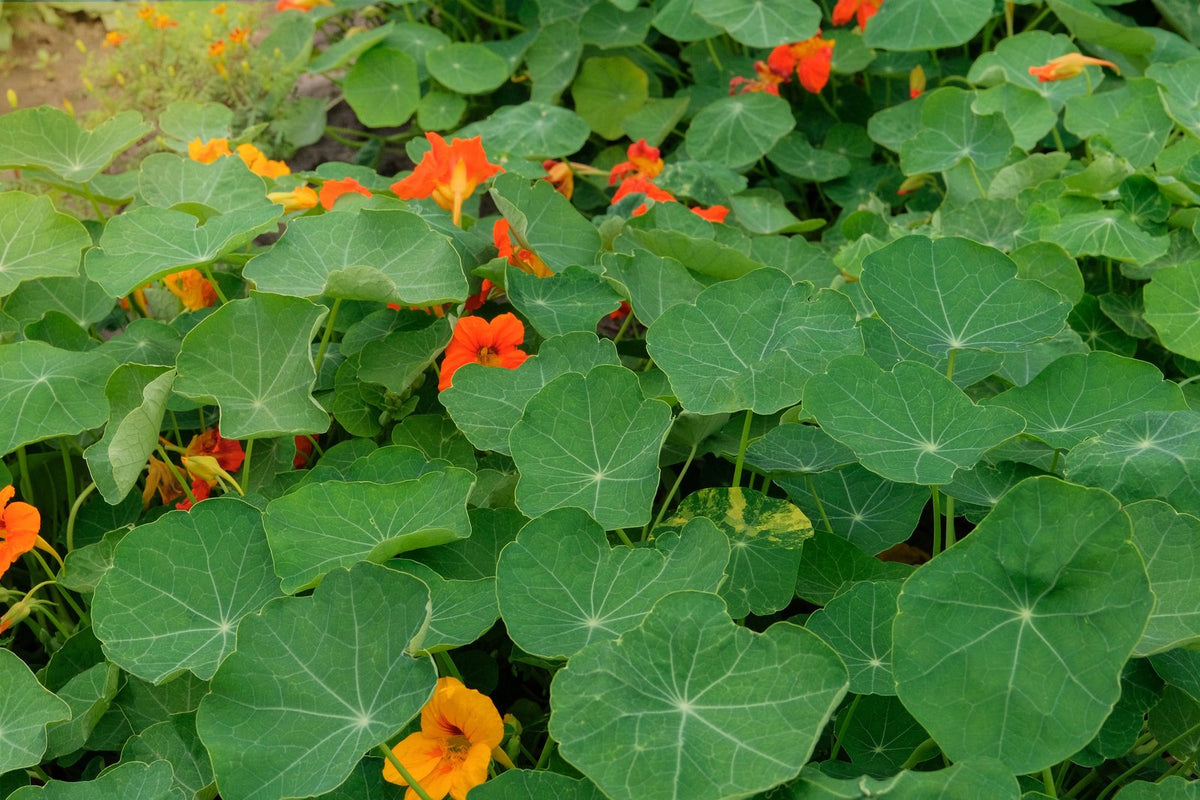
The short version: A trap crop is a plant you grow on purpose to lure a pest away from your main crop, so you can then destroy the pest along with the trap. It is not the same as companion planting. Used well, with the trap planted early and destroyed before the pests spread, it can take real pressure off a crop, but it is a variable tool that works best as one part of a wider approach. The classic home example is nasturtium planted to draw aphids.
Trap cropping is one of those ideas that sounds almost too neat: plant something the pest likes more than your crop, let them gather on it, and deal with them all in one place. It can genuinely work, but only if you treat the trap as something to be managed and removed, not just planted and forgotten.
It also gets muddled with companion planting, so it is worth being clear about what a trap crop actually is before you rely on one.
What a trap crop is, and is not
A trap crop is a plant grown specifically to attract and concentrate a pest onto itself, drawing it away from the main crop so the pest can then be destroyed with the trap. It is a decoy, a sacrifice.
That is different from companion planting, which aims for mutual benefit, such as repelling pests, masking a scent or feeding beneficial insects. It is also different from insectary or nectar plants, which are grown to feed and shelter the predators and parasitoids that eat pests. In short, a trap crop pulls the pest in, while an insectary plant pulls the pest's enemies in. Keeping those three ideas separate saves a lot of confusion.
How to use a trap crop
- Plant it early and ahead. Sow the trap earlier than, or around the perimeter of, the main crop, so it is larger and more attractive when the pest arrives. It needs to be well established before the main invasion.
- Monitor it. Watch for the pest to gather on the trap.
- Destroy the trap or its pests. Before the pests spill onto your main crop, pull up and bag or burn the trap, drown or squash the pests, or collect them with a handheld vacuum.
The timing and the destruction are the whole point. An unmanaged trap that you never deal with simply becomes a nursery, breeding up the very pest you wanted to remove. This is the single most common way trap cropping backfires.
Trap crops that are worth trying
Be honest with yourself about the evidence. Some pairings are well supported, others are traditional garden lore that may or may not work in your patch.
- Nasturtium for aphids is the classic home choice, reliable for the black bean aphid in particular, and it also draws cabbage white later in the season.
- Mustard, rocket and Chinese cabbage can act as traps for brassica pests such as aphids, harlequin bug and flea beetle.
- Sunflower, sorghum and millet are used to draw green vegetable bug and other stink bugs away from a crop.
- Radish can act as a trap for flea beetle, drawing them onto sacrificial plants you then remove or treat.
A couple of common claims need a caveat. Marigold is often called a trap crop, but its proven role is as a poor host for root-knot nematode, grown and dug in like a cover crop, rather than as an insect trap. And while land cress is a genuine dead-end trap for the diamondback moth, it does not reliably kill cabbage white caterpillars, so do not rely on it for that.
Being realistic about trap cropping
Trap cropping is variable in a home garden, with results that range from strong to negligible depending on the pest, the timing, the spacing and how attractive the trap is. It works best as one part of an integrated approach, alongside netting, good hygiene, crop rotation, encouraging beneficial insects and hand removal, rather than as a stand-alone fix. And it demands active management, because if you never destroy the trap or its pests, it makes things worse rather than better.
Trap crops across Australia's climate zones
Warm-season pest pressure dominates everywhere, so match your trap sowing to your zone's pest window and get the trap growing ahead of the main crop.
- Tropical (far north Queensland, the Northern Territory Top End, the Kimberley in Western Australia): pests are active nearly year round, so the timing gaps are short.
- Subtropical (south-east Queensland, the northern New South Wales coast): a long warm season, so stagger your trap plantings.
- Arid and semi-arid (inland New South Wales, South Australia and Western Australia, western Queensland, most of the Northern Territory): sow to the irrigated warm season.
- Temperate (coastal and southern New South Wales, Victoria, south-east South Australia): set traps out in spring, ahead of the summer pests.
- Cool and mountain (Tasmania, alpine New South Wales and Victoria, the ACT): a shorter season, so sow traps as soon as it warms.
- Mediterranean (south-west Western Australia, southern South Australia): time traps to the spring pest flush before the dry summer.
Frequently asked questions
What is a trap crop?
A plant grown to lure a pest onto itself and away from your main crop, so you can destroy the pest along with the trap.
How is a trap crop different from a companion plant?
A companion plant helps its neighbour, by repelling, masking or feeding beneficials. A trap crop deliberately attracts the pest, and is then removed or treated.
Do I have to remove it?
Yes. If you leave the pests on it, they breed and move to your crop, so destroy the trap or its pests before that happens.
What is the best trap crop for aphids?
Nasturtium is the classic choice, planted around or away from the crop, then hosed, squashed or pulled once the aphids gather.
Will it just attract more pests?
It can, if you do not monitor and destroy it. Managed properly, it concentrates the pests already around for removal rather than importing new ones.
Does it really work?
Sometimes well, sometimes not. It is a variable tool, most reliable when the trap is ahead in growth, well placed and actively managed alongside other methods.
Plant the decoy early, watch it, and pull it before the pests move on, and a trap crop can take real pressure off the plants you actually want to harvest.
Related growing guides
Ready to plant a decoy or two? Browse our flower seeds, including nasturtium, marigold and sunflower, and our vegetable seeds such as mustard and radish.