
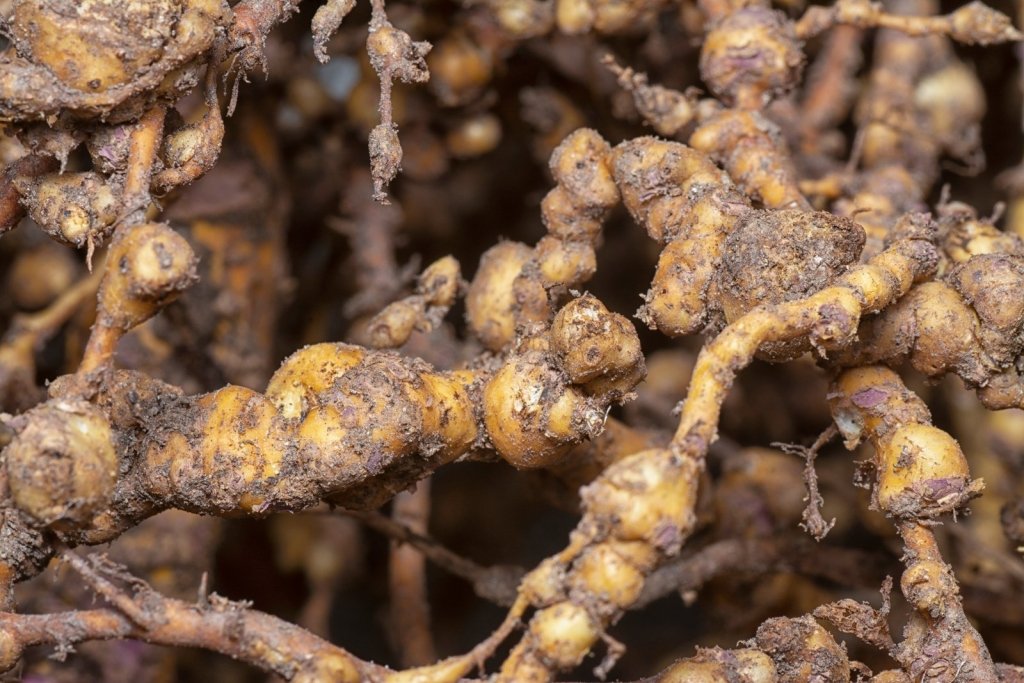
The short version: Root-knot nematodes are microscopic soil roundworms that swell the roots into knotty galls, so plants wilt in the heat even when the soil is moist, and carrots grow forked and hairy. There is no practical home chemical cure, so control is about prevention: rotate with resistant crops, lift the soil's organic matter, and use resistant varieties, biofumigant cover crops or summer solarisation on badly affected beds. The galls are not the helpful nitrogen nodules of peas and beans, which is an easy and important distinction to get right.
Root-knot nematode is a frustrating problem precisely because the cause is invisible. The plant looks thirsty on a warm afternoon despite a well-watered bed, the growth is stunted, and only when you pull it up do you find the knotted roots.
Once you know what you are looking at, though, it is manageable, and much of the fix is good soil husbandry you would want to do anyway.
What root-knot nematode is
Root-knot nematodes (Meloidogyne species) are tiny, worm-like animals that live in the soil and invade plant roots, where they cause the swellings, or galls, that give them their name. Fewer than ten species occur in Australia, and the most widespread in warmer areas are Meloidogyne javanica and Meloidogyne incognita.
One distinction is worth getting right straight away. The galls are not the same as the nitrogen-fixing nodules on the roots of peas, beans and other legumes. Those nodules are beneficial, sit on the surface of the root, rub off easily, and are pink or red inside when active. Nematode galls are swellings of the root itself, they encircle it, and they cannot be rubbed off.
How to recognise it
Above ground there is no single tell-tale symptom. The usual signs are wilting on warm days even when the soil is moist, stunting, yellowing and poor yields, and it is often patchy, with one plant struggling while its neighbour looks fine.
The confirmation is below ground. Gently lift an ailing plant and look for knots, beads or galls along the roots, anywhere from about one to ten millimetres across. On carrots and parsnips the damage shows as forking and fine hairy roots rather than clean, straight ones.
Which crops are affected
The host range is wide. Susceptible crops include tomato, capsicum, eggplant, potato, sweet potato, carrot, cucurbits such as cucumber, zucchini and pumpkin, beans, lettuce and celery.
Usefully, some crops are poor hosts and make good rotation partners: most brassicas such as cabbage, cauliflower and broccoli, along with onions, sweet corn, cereals and grasses, and asparagus. Building a rotation around these is one of the most practical tools you have.
How to manage it
There is no easy chemical cure for the home garden, so the work is prevention and steadily running the population down. No single method eradicates nematodes, but together these keep them below the level that does damage.
- Rotate with poor hosts and keep weeds down. Follow a susceptible crop with brassicas, onions, sweet corn or a cereal, and do not replant tomatoes or carrots into the same infested bed. Weeds keep the nematodes fed, so clear them too.
- Choose resistant varieties. On tomato seed, the "N" in a VFN rating means resistance to nematodes. It is a genuine help, though the resistance can weaken when the soil gets very hot, above about 28 degrees.
- Raise the organic matter. Regular compost feeds the predatory and parasitic soil life that keeps nematodes in check, and healthy, vigorous plants simply tolerate more damage. Our guide to understanding and improving your soil type is a good place to start, as light, sandy soils are the ones most at risk.
- Try biofumigant cover crops or solarisation on bad beds. Mustard and similar biofumigant green manures, chopped and dug in at flowering and kept moist, can reduce numbers, though they lower rather than eliminate them. Over a hot summer, solarising a cleared, moist bed under clear plastic for four to six weeks heats the top layer enough to knock the population back.
A word on marigolds, which are often recommended. French marigold (Tagetes patula) can suppress root-knot nematode, but only when grown as a dense, whole-season block and dug in as a green manure, not as a few plants dotted among the vegetables, and the effect varies with the nematode species. Our guide to brassica biofumigation covers this kind of natural soil treatment in more depth. What will not work is reaching for a home nematicide, so put the effort into rotation, soil life and hygiene instead. The Queensland Government guide to root-knot nematode sets out the same prevention-first approach.
Root-knot nematode across Australia's climate zones
Nematodes are most active in warm, moist, sandy soils, so the pressure is highest in warmer regions and lighter ground.
- Tropical (Darwin, Cairns): the highest pressure, with warm soils allowing near year-round activity and many generations.
- Subtropical (Brisbane, northern NSW): severe, especially in sandy coastal soils, over a long active season.
- Arid and semi-arid (Alice Springs, Mildura): mainly a risk under irrigation on sandy soils, and extreme heat can also defeat tomato resistance.
- Temperate (Sydney, Melbourne, Canberra): present but slower, worst in warm summers and on lighter soils.
- Mediterranean (Perth, southern WA and Adelaide): high risk on the region's sandy soils, though solarisation works well in the hot, dry summer.
- Cool and alpine (Tasmanian highlands, the tablelands): the lowest pressure, as the cold slows the lifecycle.
Frequently asked questions
How do I tell galls from nitrogen nodules?
Legume nodules rub off the root easily and are pink or red inside when active. Nematode galls are part of the root, cannot be rubbed off, and swell right around it. Nodules are good news, galls are not.
Is my soil ruined, and how long does it last?
No, it is not ruined. Populations fall away without host plants, but the eggs survive for many months, so plan at least one full season, and longer for a heavy infestation, of non-host crops, fallow or solarisation.
Can I eat vegetables from an affected plant?
Yes. Fruit such as tomatoes is not infested and is safe to eat. Galled root crops like carrots are also safe, but often distorted, so trim them and discard any rotted roots.
Will planting marigolds fix it?
Only as a dense, whole-season block dug in as a green manure, and even then not against every species. A few marigolds scattered among the vegetables will not do the job.
Can I compost affected roots?
Better not to. Bag and bin the infested roots, or burn them where that is allowed, rather than risk spreading eggs through a home compost heap.
Are all soil nematodes harmful?
No. Most soil nematodes are harmless or even beneficial, breaking down organic matter and preying on pests. Only the plant-parasitic types such as root-knot nematode damage crops.
Read the roots, build a rotation around resistant crops, and keep feeding the soil, and root-knot nematode becomes a slow problem you stay ahead of rather than one that decides your season.
Related growing guides
- Brassica biofumigation for natural soil disease control
- Sandy, clay or loam? Understanding and improving your soil type
- Why thinning is the step everyone skips
Ready to plant? Browse our tomato seeds, cover crop seeds and marigold seeds.