
How to Grow Kohl Rabi in Australia
Kohl rabi is a quick brassica grown for its swollen stem, which sits on top of the soil. Sow it 5 mm deep in the cooler months, every two to three weeks, and thin to 15 to 20 cm. Keep the soil evenly moist and net against caterpillars from sowing. Pick stems at 5 to 8 cm across, usually 8 to 10 weeks from sowing.

| Sun | Full sun, shade when hot |
|---|---|
| Water | Even moisture; dry spells make stems woody |
| Soil | Loose, fertile, free draining, pH 6.0 to 7.5 |
| Feed | Medium; fish and seaweed blend, fortnightly |
| Spacing | 15 to 20 cm |
| Depth | 5 mm |
| Germination | 3 to 10 days, soil 8 to 30°C |
| Harvest | 8 to 10 weeks |
| Container | Yes, 40 L or more, 30 cm deep |
| Frost | Copes with light frost, which sweetens stems |
| Use | Raw in slaws, stir-fried, roasted; leaves cooked |
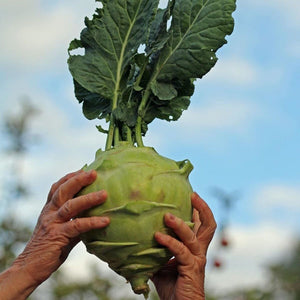
Kohl rabi (Brassica oleracea Gongylodes Group), of the cabbage family, Brassicaceae, is grown for the round, swollen stem that sits on top of the soil. It looks like a turnip but is a stem, crisp and mild, and often ready about two months after sowing in the cool months. Most gardeners who go wrong leave it in the ground until the stem turns woody.
Three mistakes that matter
- Picking too late. Past about 8 cm across, the Vienna types turn tough and fibrous, and nothing softens them again. Start checking at 5 cm and pick every stem by tennis-ball size. 'Superschmelz' is the exception, as set out in Thinning.
- Letting the soil dry out. The roots are shallow, so even a short dry spell checks growth and leaves the stem woody and tough. Mulch the bed and water deeply whenever the top few centimetres feel dry.
- Leaving the row crowded. Seedlings left too close together grow thin stems that never swell. Thin in stages to 15 to 20 cm apart, or 30 cm for 'Superschmelz', as set out in Thinning.
When to plant
Kohl rabi seed germinates in soil from about 8°C to 30°C, and fastest between 15°C and 25°C. Heat, rather than cold, closes most windows, because stems that swell in hot weather turn woody sooner. Sow a short row every two to three weeks through your window for a steady supply.
| Zone | Example cities | Sow | Harvest | Notes |
|---|---|---|---|---|
| Tropical | Darwin NT; Cairns, Townsville QLD; Broome WA | Apr-Jul | Jun-Oct | Sow in the dry season only; wet-season heat and humidity make stems woody and bring leaf disease. |
| Subtropical | Brisbane, Sunshine Coast, Bundaberg QLD; Coffs Harbour NSW | Mar-Aug | May-Nov | Winter is the main season; shade March sowings and pick spring crops young as the heat builds. |
| Arid and semi-arid | Alice Springs NT; Broken Hill NSW; Mildura VIC; Kalgoorlie WA | Feb-May and Aug-Sep | Apr-Aug and Oct-Nov | Autumn is the surer window; spring sowings must be picked before the summer heat hardens them. |
| Temperate | Sydney, Newcastle NSW; Melbourne, Geelong VIC | Jan-Apr and Aug-Oct | Mar-Jul and Oct-Dec | Shade January sowings; finish autumn sowing by Anzac Day and pick spring crops before summer heat. |
| Mediterranean | Perth, Bunbury WA; Adelaide SA | Feb-May and Aug-Sep | Apr-Aug and Oct-Nov | Wet winters suit autumn sowings; dry heat arrives early, so keep spring sowings small and watered. |
| Cool and alpine | Hobart TAS; Canberra ACT; Ballarat VIC; Orange NSW | Jan-Mar and Sep-Dec | Mar-Jun and Nov-Feb | Skip the coldest months; frost on autumn crops sweetens the stems once plants are well grown. |
Give sowings at the warm edge of a window some afternoon shade. At the cold edge, raise seedlings under cover and plant them out once days reach about 10°C and nights stay above -2°C.
Site, soil and setup
Pick a sunny spot with loose, fertile soil. Leave at least four years between brassica crops in the same bed, so clubroot (Plasmodiophora brassicae) cannot build up.
| Get the bed right | What to do |
|---|---|
| Sun | Full sun through the cool months; part shade is tolerated, and afternoon shade helps in hot weather |
| Soil | Dig in a 5 cm layer of compost, or 5 to 10 cm of well-rotted cow or horse manure, 4 to 6 weeks before sowing; keep the top layer loose for the shallow roots |
| pH | 6.0 to 7.5; below 6.0, garden lime or dolomite lime at 100 to 200 g per square metre, 4 weeks ahead; lift it to 7.0 to 7.5 in a bed that has had clubroot |
| Base feed | Pelletised chicken manure at 100 g per square metre, or blood and bone at 100 to 150 g per square metre, raked in at sowing |
| Drainage | On heavy clay, build the bed up; standing water in warm, acid soil suits clubroot |
Test before you lime: a home kit gives a reading in minutes. The soil pH article explains how.
Container growing
Kohl rabi grows well in a large pot or trough of at least 40 L and 30 cm deep. A 50 cm pot holds about 52 L, enough for four plants of 'White Vienna' or 'Purple Vienna'. Fill it with premium potting mix blended with compost. 'Superschmelz' grows too large for most pots.
- Water: feel the mix every day and water once the top is dry; pots lose moisture quickly on hot or windy days.
- Feed: fish and seaweed blend at 25 mL per 9 L, fortnightly, from the first true leaves.
- Position: full sun through the cool months, moved into afternoon shade on hot days.

Sowing Seeds
Kohl rabi does best sown straight into the bed, though it can also be raised in cell trays and planted out young.
Sowing direct
- Make shallow drills 30 cm apart and sow thinly, 5 mm deep.
- Cover, press the soil down gently and water with a fine rose.
- Keep the surface damp; seedlings usually appear in 3 to 10 days.
- Thin in stages to the final spacing, as set out in Thinning.
Gaps in the row usually trace back to seed sown too deep, or a surface that dried out before the seedlings emerged.
Starting under cover
- Fill cell trays with seed-raising mix and drop two or three seeds into each cell, 5 mm deep.
- When true leaves appear, keep the sturdiest seedling and snip the others off at the mix.
- Transplant at three or four true leaves, usually 3 to 4 weeks from sowing, disturbing the roots as little as possible.
- Harden off first (give seedlings a little more time outdoors each day for about a week).
Settle each transplant with seaweed solution at half strength, 15 mL per 9 L. Then mulch the bed to hold moisture and smother weeds.

Care by growth stage
Steady, unbroken growth decides kohl rabi. Even moisture and a moderate feed swell a tender stem, while too much nitrogen builds leaves at the stem's expense. Weeks count from sowing.
| Stage | Water | Feed | Watch for |
|---|---|---|---|
| Seedling, weeks 0 to 3 | Little and often, so the top of the soil stays damp | Nothing before the first true leaves; then seaweed solution at half strength, 15 mL per 9 L, fortnightly; or a controlled release all-purpose granular (NPK around 14-5-10) worked into the bed at sowing, at the label rate | Exclusion netting (fine insect mesh on hoops) over the row from sowing day; damping off in trays; snails and slugs on wet nights; in warm months, cabbage centre grub (Hellula hydralis) tunnelling into the growing point, with webbing and trapped soil |
| Leafy growth, weeks 3 to 5 | A deep soak at the base whenever the top few centimetres dry | Fish and seaweed blend at 25 mL per 9 L, fortnightly; or an all-purpose soluble (NPK around 23-4-18) at the label rate, fortnightly | Eggs and caterpillars under the leaves; grey aphid colonies; gaps in the mesh; weeds crowding the shallow roots |
| Stem swelling, weeks 5 to 8 | Evenly moist, mulch topped up; never dry then drenched | Sulphate of potash at 30 to 50 g per square metre, scattered beside the row as the stem starts to swell, with fish and seaweed blend at 25 mL per 9 L, fortnightly; or a high potassium soluble (0-0-41) at the label rate, fortnightly | Downy mildew in cool, damp spells; split stems after heavy rain; stems hardening in hot weather |
| Harvest, weeks 8 to 10 | Steady right up to picking; kohl rabi is never dried off | Fish and seaweed blend at 25 mL per 9 L, fortnightly, while later stems are still sizing; or the high potassium soluble at the label rate, fortnightly | Stems passing 8 cm across; a flower stem rising from the top |
Netting has a cost: the ladybirds, lacewings and small birds that clean up sap suckers are kept out too. Aphids, thrips and whitefly can multiply under a cover left on for weeks, so check beneath it every week. Pull weeds by hand near the plants, because a hoe can sever the shallow roots.
Thinning
Thinning decides whether the stems swell at all, and full spacing lets air move between plants, which slows downy mildew.
| Type | Varieties sold | Habit | What it changes |
|---|---|---|---|
| Green-white | 'White Vienna' | Pale green skin and crisp white flesh; ready in about 60 days | Thin to 15 to 20 cm; pick at 5 to 8 cm across |
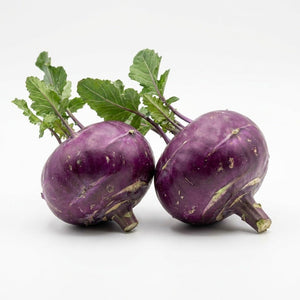
| Purple | 'Purple Vienna', 'Purple' (organic) | Purple skin over the same white flesh; ready in about 60 days and copes with light frost | Same spacing and picking size as 'White Vienna'; suits cool-season sowing |
| Giant | 'Superschmelz Giant White' | Light green; can grow to about 22 cm across without turning woody | Thin to 30 cm in rows 30 cm apart; pick at any size from tennis ball upwards |
| Mixed packs | 'Heirloom Mix', the white and purple two-pack | White and purple Vienna types together | Grow and pick as for the Vienna types |
- First pass: once the first true leaves show, thin seedlings to about 10 cm apart.
- Second pass: when the leaves of neighbouring plants touch, pull every second plant and cook its young leaves as greens.
- Final spacing: 15 to 20 cm for the Vienna types and 30 cm for 'Superschmelz'.

Companion planting
Low, quick crops that like the same steady watering sit well between kohl rabi rows, and flowering herbs feed the insects that hunt aphids.
Grows well with
- Onions and spring onions, slim enough to fill the space between rows.
- Beetroot, a low crop that shares the same even moisture.
- Dill left to flower, whose blooms feed adult hoverflies; their larvae eat aphids.
- Celery, which thrives in the same rich, moist soil.
Keep apart
- A solid block of broccoli, cabbage, cauliflower, kale, bok choy or Chinese cabbage, which invites the caterpillars, aphids and clubroot they all share.
- Mustard, a clubroot host that draws the same caterpillars.
- Climbing beans on the sunny side, which shade the low plants.
Harvesting Stems
Pick when the stem is 5 to 8 cm across, about the size of a tennis ball, usually 8 to 10 weeks from sowing.
- Start checking at 5 cm across and pick the largest stems first.
- Cut the stem just below the swelling with a sharp knife or secateurs.
- Pull the whole plant instead if you want the leaves as well.
- Pick sooner in warm weather, when stems harden faster.
- Let 'Superschmelz' grow on well past tennis-ball size for a bigger stem.

Cut the leaves off before storing, as they draw moisture from the stem. Kept in the fridge, stems usually stay crisp for up to two weeks, and peeled, diced stems freeze well. Peel older stems, grate them raw into slaws, stir-fry or roast them, and cook the young leaves like kale.
Common problems
Split stems. Irregular watering, such as a heavy soak or a downpour after a dry spell, can crack the swelling stem, so keep moisture even.
Stems that stay thin. Beyond crowding, covered in Three mistakes that matter, too much heat, freezing weather or too little water can stop a stem swelling.
Running to flower. Several weeks of cold after planting out can trigger bolting (sending up a flower stem), so avoid planting young seedlings into the coldest weeks.
Seedlings keeling over in the tray. Damping off (a rot caused by soil fungi and water moulds) thrives in wet, crowded trays with little air movement. Read more
Long, weak seedlings. Raised without enough light, seedlings stretch, then flop when moved outside. Read more
Ragged holes and silvery trails. Snails and slugs feed at night, chewing seedlings, leaves and even the stems. Go out with a torch about two hours after sunset, especially after rain, or set shallow beer traps. Read more
Pests and diseases
Caterpillars and aphids cause most of the damage, and the diseases follow cool, wet weather or acid, poorly drained soil.
Cabbage white butterfly (Pieris rapae). Accidentally introduced to Melbourne in 1929, it has since spread all over Australia, and each female can lay up to 800 eggs. The green caterpillars eat ragged holes and leave droppings behind. Pick them off, or spray Bacillus thuringiensis, a bacterial insecticide specific to caterpillars, while they are small, following the label. Read more
Diamondback moth (Plutella xylostella). Also called cabbage moth, its small caterpillars graze thin windows in the leaves that tear into holes as they grow. Caterpillars are abundant from spring to autumn, especially in dry summers. Netting and the same bacterial spray work against it. Read more
Cabbage aphid (Brevicoryne brassicae). These grey-green insects, no more than 3 mm long, form dense colonies coated in a whitish powder, and they can spread turnip mosaic virus. Knock them off with a jet of water, then treat the leaf undersides with insecticidal soap, following the label. Read more
Downy mildew (Hyaloperonospora parasitica). Yellowing, spotted patches on the upper leaf carry white, fluffy growth beneath, mostly in cool, rainy weather. Full spacing, covered in Thinning, keeps air moving and leaves drying. Read more
Clubroot (Plasmodiophora brassicae). Knobbly galls form on the roots, and the tops yellow, wilt on warm days and stop growing. Its spores stay alive in the soil for up to 20 years. Lift sick plants, roots and all, and put them in the rubbish rather than the compost, then wash the soil off tools.
Prevention first
- Check under a few leaves every week for eggs, caterpillars and aphid colonies.
- Remove shepherd's purse, wild mustard and other brassica weeds, which carry clubroot and downy mildew.
- Water the soil rather than the foliage, so leaves stay dry.
- Pull out finished plants promptly, as leaf diseases carry over on old crops.
Tips
- Never hill soil or pile mulch against the swelling stem. It is meant to sit on the surface, and a buried stem can rot.
- In frosty districts, time a sowing to size up in the cold months, since frost turns some starch to sugar and sweetens the stems.
- Every kohl rabi in the range is an heirloom, so seed can be saved. It crosses with cabbage, broccoli, cauliflower and kale. Let only one of them flower within 250 m, and leave at least five plants to flower together.
Questions
When should I plant kohl rabi in Australia?
Sow in the cooler part of the year. Tropical gardens sow April to July and subtropical gardens March to August. Temperate gardens sow January to April and August to October. Arid, Perth and Adelaide gardens sow February to May and August to September. Cool gardens sow January to March and September to December.
Is kohl rabi a root vegetable?
No. The round part is a swollen stem that grows on top of the soil, with leaf stalks sprouting from its sides. The flesh is white inside both green and purple types. The young leaves are edible too, cooked like kale.
How big should kohl rabi be when you pick it?
Pick most varieties at 5 to 8 cm across, about the size of a tennis ball, usually 8 to 10 weeks from sowing. Larger stems of the Vienna types turn tough and fibrous. 'Superschmelz' is the exception: it stays tender at a much larger size.
Why is my kohl rabi woody or split?
Woody stems usually come from picking too late, dry spells or hot weather. Splits follow irregular watering, such as a downpour after dry soil. Keep the soil evenly moist under mulch, and pick on time.
Can I grow kohl rabi in a pot?
Yes. Use a pot or trough of at least 40 L and 30 cm deep, such as a 50 cm pot, which holds four Vienna plants. Fill it with premium potting mix blended with compost. Water whenever the top feels dry and feed fortnightly with fish and seaweed blend at 25 mL per 9 L.
What is making holes in my kohl rabi leaves?
Usually green caterpillars of cabbage white butterfly or diamondback moth, which feed on the undersides by day. Ragged holes with slime trails point to snails and slugs, which feed at night. Fine insect mesh over hoops from sowing keeps the butterflies and moths off, and a torch patrol after dark finds the snails.
Grow it



More vegetable guides
All vegetables
Amaranth
How to grow leaf amaranth, or Chinese spinach, in Australia: sowing months for six climate zones, warm soil, thinning, picking, pests and cooking the leaves.
| Position | Full sun |
|---|---|
| Depth | 3 to 6 mm |
| Spacing | 15 cm apart |
| First pick | 4 to 8 weeks |

Artichoke
How to grow globe artichokes from seed in Australia: sowing, spacing, feeding, when to cut the buds, cutting back, cardoon, and sowing months for every zone.
| Position | Full sun |
|---|---|
| Depth | 10 mm |
| Spacing | 1 to 1.5 m apart |
| First pick | About 42 to 57 weeks |

Bean
How to grow beans in Australia: sowing months by climate zone, bush and climbing types, low-nitrogen feeding, watering, picking pods, plus bean fly and rust.
| Position | Full sun, at least six hours |
|---|---|
| Depth | 25 to 30 mm |
| Spacing | Bush 10 to 15, climbing 15 to 20 cm |
| First pick | 7 to 14 weeks |

Beetroot
How to grow beetroot in Australia: sowing months for all six climate zones, thinning the seed clusters, steady watering, harvest size and the pests that matter.
| Position | Full sun or part shade |
|---|---|
| Depth | 10 to 20 mm |
| Spacing | 10 cm apart after thinning |
| First pick | 7 to 12 weeks |