
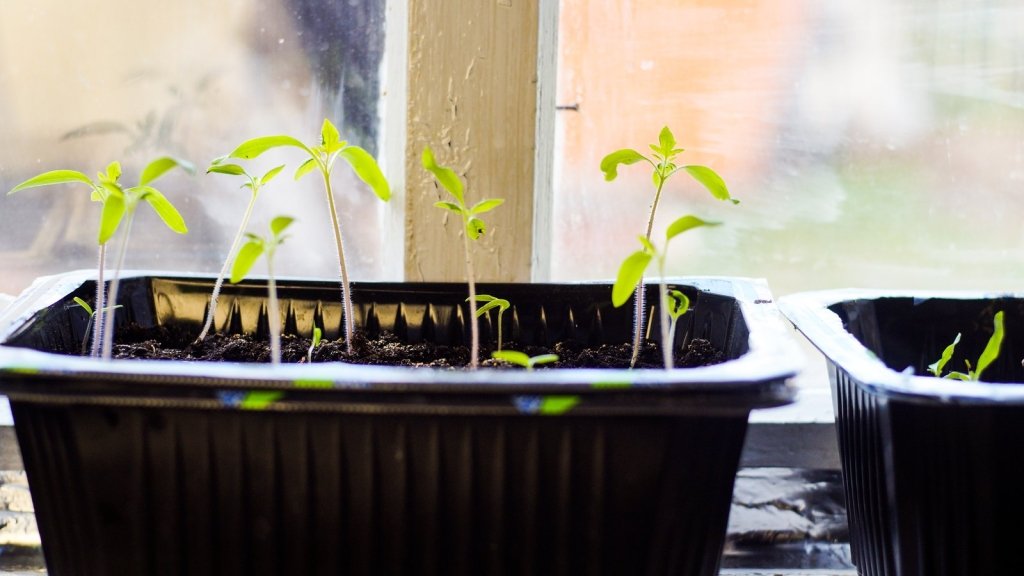
The short version: Leggy seedlings, the ones with long pale stems that flop over, are stretching for light. A windowsill is seldom bright enough, and warmth after the seeds come up makes the stretch worse. Fix it by moving them to the brightest spot or under a grow light 5 to 15 cm above the tops for 14 to 16 hours a day, cooling the room, thinning early and adding a little air movement. Tomatoes can be rescued by planting them deep; most other crops cannot. Seedlings less than a week old are usually quicker to resow.
Every gardener has done it. The tray of tomatoes goes on the kitchen windowsill in August, the first shoots appear, and within a week they are 8 cm of white thread leaning at the glass with two small leaves on top. They look like they are trying to leave. In a sense they are: they are spending every bit of stored energy looking for a sun that a window cannot deliver.
The good news is that the cause is nearly always the same, the fix is cheap, and the tomatoes at least can be saved.
What leggy means, and why it happens
A leggy seedling has a long, thin stem, a big gap between the soil and the seed leaves, small leaves and a lean toward the window. The scientific term is etiolation. When a seedling senses low light, the growth hormone auxin builds up on its shaded side and the stem cells lengthen, so it bends toward the brightest source and stretches upward. Crowded neighbours make it worse, because leaves reflect a particular red light that tells a seedling it is being shaded and should race for the canopy. The result is a plant that has put its energy into height instead of thickness, and it stays fragile for the rest of its life.
The causes, in order
Not enough light is the main cause, and the American extension services put it bluntly: light from a window is seldom enough for strong seedlings. In Australia the sun tracks across the northern sky, so the bright window is a north-facing one. A south-facing sill gets no direct sun at all in winter. In June a Hobart window sees about nine hours of low, weak daylight, where Darwin gets more than eleven. Warmth is the second cause. A heat mat is a gift to germinating seed and a curse once the shoots are up, because heat drives stem growth that the leaves cannot match. Overcrowding, over-watering, still humid air and sowing too early indoors all pile on, and too few hours of light finishes the job.

The fix, step by step
- Decide whether to rescue or resow. Seedlings under a week old, or badly collapsed, are quicker to resow. Seedlings several weeks old with roots are worth saving.
- Fix the light first. Move the tray to the brightest north-facing spot, or better, put a fluorescent or LED grow light 5 to 15 cm above the tops on a timer for 14 to 16 hours a day, raising it as they grow. If you rely on a window, turn the tray every day so the lean evens out.
- Cool them down. Take the tray off the heat mat once about half the seeds are up, and aim for about 18 to 21°C by day and 13 to 16°C at night. A cool, bright spot beats a warm, dim one every time.
- Thin early. Snip the extras off at soil level with scissors rather than pulling, so the keeper's roots stay put.
- Add movement. A small fan on low for an hour or two a day, or brushing the tops with your hand a couple of times a day, can make seedlings noticeably shorter and thicker. In one published trial on tomato transplants, brushed seedlings ended up about a third shorter than unbrushed ones.
- Water from below and let the surface dry between waterings. Wet, airless mix weakens seedlings and invites damping off.
- Do not feed them to make them strong. Nutrition is not the cause, and most seed-raising mixes carry enough for the first five or six weeks.
Rescuing them at planting: which crops can go deeper
Tomatoes are the happy exception to almost every rule. Plant a leggy tomato deep enough that only two or three sets of leaves show, or lay it in a shallow trench with the tip bent upward, and it grows roots along the whole buried stem. Capsicums and eggplants can go a little deeper than they grew, in warm soil. Brassicas can be set with the stem buried to just below the seed leaves for support, though do not count on new roots. Lettuce, silverbeet and other rosette crops keep their growing point above the soil, onions go no deeper than about 2.5 to 4 cm or they may not bulb well, and cucurbits can rot if their stems are buried. Our guide to planting out seedlings has the depth rules by crop.

Stopping it next time
Sow later. Most gardeners start too early and then hold seedlings indoors for months. Tomatoes need about five to six weeks from sowing to planting out, capsicums and eggplants eight to ten, brassicas four to six and leafy greens two to four. Count back from your plant-out date, not from the first cold morning you feel like sowing. Raise trays outdoors as soon as the season allows, in a warm, bright spot out of the wind; even a shaded bench outside gives more light than most windows. A clear storage tub with the lid propped open makes a cheap mini hothouse, and the lid comes off the day the seedlings show. And if you buy punnets, walk past the leggy, yellow ones on the discount table: stressed seedlings tend to bolt once planted.
Raising seedlings outside across Australia's climate zones
- Tropical (Darwin in the Northern Territory, Cairns and Townsville in Queensland): trays live outside all year, and tomatoes and capsicums are dry-season crops from about March to September. Legginess up north is usually a shade or overcrowding problem, not a light problem.
- Subtropical (Brisbane and south-east Queensland, northern New South Wales): frosts are rare, so a sheltered, shaded outdoor bench beats a windowsill from August, with only the June and July sowings needing cover.
- Arid and semi-arid (Alice Springs in the Northern Territory, Broken Hill in New South Wales, Mildura in Victoria, Kalgoorlie in Western Australia): start tomatoes and capsicums under cover from late July, move trays outside with wind shelter in September, and plant out late in the month. Dry air means daily watering.
- Temperate (Sydney and the New South Wales coast, Melbourne in Victoria): under cover from late July and August, outdoors in a sheltered sunny spot from September, planting out in October.
- Mediterranean (Perth and southern Western Australia, Adelaide in South Australia): the same dates as temperate, and autumn is a second good window for raising cool-season seedlings outside before the dry heat.
- Cool and alpine (Tasmania, Canberra in the ACT, Ballarat in Victoria, Orange and Armidale in New South Wales, Stanthorpe in Queensland): the indoor window from late July to September coincides with the lowest, shortest sun of the year, so this is the zone where a grow light or a proper cold frame is close to essential. Plant out after the last frost in October or November.
A note on safety
Grow lights, timers and heat mats live next to trays that get watered. Plug them into a circuit with a safety switch, keep leads and power boards above bench level and away from drip trays, and use a heat mat with a thermostat. Fluorescent tubes and seedling LEDs run cool enough for close spacing; hot bulbs do not, and no lamp should touch a plastic dome or bag. Clean reused trays in a weak bleach solution and rinse, because the wet surface leggy seedlings sit on is exactly where damping off starts.
Frequently asked questions
Can leggy seedlings be saved?
Usually, if they are a few weeks old: more light, cooler air, a fan and then a deeper planting for tomatoes. Very young or collapsed seedlings are quicker to resow.
My window faces north. Is that enough?
It is the best window in Australia, but window light is seldom enough on its own. Add a light, or move the trays outside during the day.
How close and how long for a grow light?
About 5 to 15 cm above the tops, for 14 to 16 hours a day on a timer. High-output panels need the maker's distance, lowered until the seedlings stop stretching.
Should I turn the heat mat off?
Yes, once about half the seeds are up. Warmth after emergence drives the stretch.
Does stroking seedlings really work?
Yes. Regular brushing or a gentle fan can noticeably shorten and thicken stems, and extension services recommend it.
Which crops can be planted deeper?
Tomatoes, deeply; capsicums and eggplants a little deeper in warm soil; brassicas to just below the seed leaves for support. Not lettuce, onions or cucurbits.
Bright, cool and a little breezy: give seedlings that and they grow like fence posts instead of fishing line.
Related growing guides
- A step-by-step guide to starting seeds indoors
- The benefits of using a seedling heat mat
- Hardening off seedlings before planting out
Sow again with fresh tomato seeds, capsicum seeds and the rest of our vegetable seeds.