
How to Grow Tomatillos in Australia
Tomatillo needs full sun, free-draining soil and at least two plants, because a single plant rarely sets fruit. Sow seed 4 to 6 mm deep in warm trays and plant out 50 to 90 cm apart after frost. Stake or cage each plant, water evenly and go easy on nitrogen. Pick when the fruit fills its husk and the husk turns tan and splits.

| Sun | Full sun, sheltered from wind |
|---|---|
| Water | Deep, even soaks; copes with short dry spells |
| Soil | Free-draining loam, pH 6.0 to 7.0 |
| Feed | Heavy; potash from first flowers, go easy on nitrogen |
| Spacing | 50 to 90 cm apart |
| Depth | 4 to 6 mm |
| Germination | 7 to 14 days at 21 to 27°C |
| Harvest | 10 to 14 weeks from sowing |
| Container | Pots of 20 L or more, two together |
| Frost | Frost tender; plant out after the last frost |
| Support | Stake and ties or tomato cage |
| Use | Salsa verde and sauces, raw or cooked |
Tomatillo (Physalis philadelphica) is a frost-tender annual in the nightshade family, Solanaceae, grown for tart green fruit wrapped in papery husks. It is the heart of Mexican salsa verde, grows much like a tomato, and has fruited prolifically in Queensland. Most failures trace back to one choice: planting a single tomatillo, which leaves its husks empty.
Three mistakes that matter
- Planting just one. A tomatillo rarely sets fruit with its own pollen, so a lone plant fills its branches with hollow husks. Plant at least two, and three is safer, close enough for bees to work between them.
- Feeding for leaves. Too much nitrogen grows a big, leafy bush that is slow to flower and slow to bear fruit. Follow the feeds in Care by growth stage, which switch to potassium once the first flowers open.
- Picking too late. Fruit left on the plant past its prime turns soft and loses its tang. Pick when the fruit fills its husk and still feels firm, as Harvesting Fruit describes.
When to plant
Sow seed in trays kept at a soil temperature of 21 to 27°C, and plant out once frost has passed and the ground has warmed. Plants flower and fruit until frost, so one sowing is usually enough. Flowers tend to drop on days above 32°C and nights below 13°C, so aim for plants that flower outside the fiercest heat.
| Zone | Example cities | Sow | Harvest | Notes |
|---|---|---|---|---|
| Tropical | Darwin, Katherine NT; Cairns, Townsville QLD; Broome WA | Apr-Jul | Jul-Nov | Grow through the dry season; wet-season heat above 32°C drops flowers, and humidity brings leaf disease. |
| Subtropical | Brisbane, Bundaberg, Rockhampton QLD; Coffs Harbour, Lismore NSW | Aug-Dec | Nov-Apr | Frost is rare, so start trays in August; shelter plants from wind, which snaps the brittle stems. |
| Arid and semi-arid | Alice Springs NT; Mildura VIC; Broken Hill, Dubbo NSW | Jul-Sep | Oct-Feb | Raise seedlings under cover from July, plant out after the last frost, and mulch deeply against summer heat. |
| Temperate | Sydney, Newcastle, Wollongong NSW; Melbourne, Geelong VIC | Sep-Dec | Dec-Apr | Start trays from September; in Melbourne, plant out around Melbourne Cup weekend in early November. |
| Mediterranean | Perth, Bunbury WA; Adelaide and the SA coast | Sep-Dec | Dec-Apr | Start trays from September; mulch and water deeply through the long dry summer, as heat drops flowers. |
| Cool and alpine | Canberra ACT; Hobart, Launceston TAS; Orange, Armidale NSW; Ballarat VIC | Oct-Nov | Feb-Apr | Raise seedlings indoors, plant out after the last frost, and pick every fruit before the first autumn frost. |
At the cool edge, raise seedlings on a seedling heat mat and cover young plants on cold nights, venting covers above 27°C. At the late edge, pick every fruit before the first autumn frost.
Site, soil and setup
| Get the bed right | What to do |
|---|---|
| Sun | Full sun, at least six hours a day, sheltered from strong wind, which snaps the brittle stems |
| Soil | Free-draining loam; plants do poorly in heavy, wet clay, so build a raised bed there |
| pH | 6.0 to 7.0; below 6.0, dolomite lime at 100 to 200 g per square metre, 4 weeks before planting |
| Bed preparation | Dig in 5 to 10 cm of well-rotted cow or horse manure and a 5 cm layer of compost, 4 to 6 weeks ahead |
| Base feed | Pelletised chicken manure at 100 g per square metre, raked in at planting |
| Room | 50 to 70 cm apart when staked or caged, up to 90 cm when left to sprawl; plant in a block, not a long row, so bees move between plants |
Rotate beds: do not plant where tomato, capsicum, eggplant or potato grew the year before, because they share soil-borne diseases.
Container growing
Tomatillos, 'Verde Puebla' included, grow well in a pot of at least 20 L, about 30 cm across, with one plant to each pot. Set two pots side by side for pollination, fill them with premium potting mix, and push in a stake or small cage at planting.
- Watering: check pots daily in hot weather and water deeply whenever the top 2 to 3 cm is dry. See watering pots in summer.
- Feeding: mix a controlled release fertiliser for containers into the mix at planting. Then water on fish and seaweed blend at 25 mL per 9 L fortnightly.
- From first flowers: add liquid potash at the label rate, fortnightly.
- Position: full sun, out of strong wind.
Sowing Seeds
Start tomatillos in trays under cover and plant them out 4 to 6 weeks later.
Starting in trays
- Sow seed 4 to 6 mm deep in seed-raising mix, and keep it moist and at the warmth When to plant gives.
- Seedlings usually appear in 7 to 14 days.
- Once true leaves show, move each seedling to its own small pot, or thin to one per cell.
- Give seedlings bright light so they grow stocky, not leggy.
The seed comes treated with the fungicide thiram. Wear gloves, wash your hands with soap and water afterwards, keep the seed away from children and animals, and never eat it.
Planting out
- Plant out when seedlings are 5 to 10 cm tall or a little more, and before they flower, since flowering transplants establish slowly.
- Harden off (get seedlings used to sun and wind outdoors) over one to two weeks first.
- Set each plant deeper than it grew in its pot: the buried stem grows extra roots, as a tomato does.
- Drive in its stake or set its cage at the same time, as Pruning and Training describes.
- Water in well, then mulch with straw.
Pollination
Each tomatillo flower carries both pollen and stigma, yet the plant largely rejects its own pollen. Bagged away from insects, flowers set no fruit. Bees must bring pollen from another plant, and two 'Verde Puebla' plants pollinate each other.
| Cause of poor fruit set | What happens | Fix |
|---|---|---|
| A single plant | Husks form with nothing inside | Grow two or three plants |
| Plants far apart | Bees rarely carry pollen between them | Plant in a block, or pots side by side |
| Heat above 32°C or nights below 13°C | Flowers drop before setting | Time sowing as When to plant sets out |
| Dry soil at flowering | Flowers are poorly fertilised | Water evenly, as Care by growth stage describes |
| Few bees | Pollen stays where it formed | Hand-pollinate, and grow bee flowers nearby |
Where bees are scarce, move pollen by hand between flowers on different plants.
- Dab a small soft brush or cotton bud in the centre of an open flower on one plant.
- Touch it to the centre of open flowers on a second plant.
- Repeat in the other direction every few days while plants bloom.
Care by growth stage
Even moisture and a light hand with nitrogen decide the crop, though established plants cope with short dry spells. Weeks count from sowing and shift with zone and weather.
| Stage | Water | Feed | Watch for |
|---|---|---|---|
| Seedling, weeks 1 to 5 | Keep the mix just moist, never soggy | Nothing until the first true leaves, then seaweed solution at half strength, 15 mL per 9 L, fortnightly | Damping off (a fungal rot of young stems); stretching in poor light |
| Establishing, weeks 5 to 8 | Deep soaks once or twice a week, about 25 to 40 mm a week in dry weather; water the soil, not the leaves | Fish and seaweed blend at 25 mL per 9 L, fortnightly | Cutworms at the stem base; slugs and snails; aphids on new growth |
| Flowering, weeks 7 to 10 | Steady; do not let more than the top 2 to 3 cm dry out | Sulphate of potash at 30 to 50 g per square metre once, at first flowers, then liquid potash at the label rate, fortnightly | Few bees; flowers dropping in heat or cold; whitefly under leaves |
| Fruiting and picking, week 10 onwards | Deep and even, under a straw mulch | Fish and seaweed blend at 25 mL per 9 L, fortnightly, plus pelletised chicken manure at 100 g per square metre once, mid-season | Fruit fly in mid and late summer; powdery mildew; possums, rats and birds at the fruit |
| End of season, the last 3 to 7 days before the final picking | Reduce to just enough to stop wilting | Nothing | Frost forecasts: pick every fruit before the first one |
If you prefer a conventional feed, mix a controlled release granular (NPK around 14-5-10) into the bed at planting. While plants establish, water on an all-purpose soluble (NPK around 23-4-18) fortnightly at half the label rate. From first flowers, switch to a fruiting and flowering soluble (NPK around 15-4-26) at the label rate.
Pruning and Training
Plants grow about 1 to 1.2 m tall and spread 1 to 1.5 m, and any stem that touches the soil takes root. Support keeps fruit clean and air moving; flowers form along every branch, so trim lightly.
- At planting, drive a stake about 1.2 m long some 45 cm into the soil beside each plant.
- Tie the main stem loosely with soft ties, adding more as the plant grows.
- Or set a tomato cage over the plant: tomatillos weigh less than tomatoes, so a standard cage copes.
- Pinch out growing tips to limit spread where space is short.
- Cut back branches that crowd a neighbouring plant, so air keeps moving.
- Lift or trim stems that lie on the soil before they root.
Companion planting
Every tomatillo fruit depends on bees, so the best neighbours are flowers that feed them.
Grows well with
- Sunflower, whose pollen-bearing varieties are excellent bee plants through the season.
- Basil, whose summer flowers give bees nectar if a few plants are left to bloom.
- Marigold, whose small, shallow flowers suit short-tongued bees.
Keep apart
- Tomato, capsicum and eggplant, which share aphids, whitefly and fruit fly with tomatillo.
- Potato, which shares soil-borne wilt diseases.
Harvesting Fruit
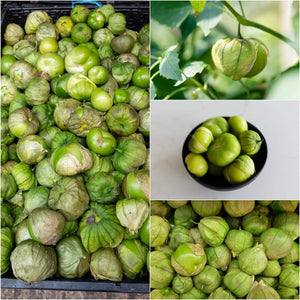
Picking usually starts 10 to 14 weeks after sowing. The fruit is ready once it fills its husk and the husk fades from green to tan and splits.
- Pick while the fruit is firm; soft fruit is past its best.
- Snip the stalk with scissors or secateurs, or twist gently: ripe fruit comes away easily.
- Pick every week, since plants keep setting fruit until frost.
- Gather fallen fruit, which keeps ripening in its husk.
- Before the first autumn frost, pick every fruit, ripe or not.

Keep fruit in its husk, one layer deep, somewhere cool and airy, ideally 10 to 15°C, where it can keep for weeks and sometimes months. In the fridge, a paper bag holds fruit for one to two weeks before the skin pits, while sealed plastic rots it fast. Store it away from apples and bananas, whose ethylene shortens its life, or husk, wash and freeze it.
To use, peel off the husk, rinse away the sticky film, then roast or boil the fruit and blend it into salsa verde. Eat only the fruit: the husks, leaves and stems are not edible.
Common problems
Husks with nothing inside. Too few plants, plants set too far apart, or heat, cold or drought at flowering; see Three mistakes and Pollination.
Dark, sunken patch at the flower end of the fruit. This is blossom end rot: calcium reaches fruit only in water, so swings in soil moisture starve it, and even watering is the fix. Read more
White powdery patches on older leaves. Powdery mildew spreads through crowded plants; stake them for airflow and, at the first spots, spray 1 part full-cream milk to 10 parts water. Read more
Plants wilting in moist soil. Roots rot where soil stays wet long after watering; water less often, and grow the next crop in a raised bed.
Pests and diseases
Tomatillos have few serious pests, and the husk shields most fruit.
Queensland fruit fly (Bactrocera tryoni). This native pest of eastern Australia is worst in mid and late summer, after rain. Females sting ripening fruit, and white maggots tunnel through the flesh, which rots. The husk protects only partly, so net plants with fine insect mesh from fruit set and pick up fallen fruit. Read more
Green peach aphid (Myzus persicae). Colonies under the leaves crinkle and curl them and leave them sticky, and aphids can spread viruses that mottle and stunt plants. Hose them off with a strong jet, or spray insecticidal soap. Read more
Silverleaf whitefly (Bemisia tabaci). Clouds of tiny white insects rise when leaves are disturbed, and their sticky honeydew grows black sooty mould. Clear weeds and spent crops that carry it between seasons. Read more
Cutworms (Agrotis species). These grey to black caterpillars hide in the soil by day and feed at night, cutting young plants off at soil level. Scratch around the base of a felled plant and pick out the curled caterpillars. Read more
Verticillium wilt (Verticillium dahliae). Leaves yellow, then plants wilt and die back. This soil-borne fungus infects over 400 plant species in Australia and can survive more than 10 years in soil. No spray cures it, so bin affected plants and rotate beds.
Prevention first
- Rotate beds as Site, soil and setup describes, and clear old plants and fallen fruit after the last picking.
- Water the soil in the morning, keeping leaves dry, and keep plants staked for airflow.
- Check leaf undersides, new growth and stem bases every week.
- Spare the bees that set every fruit: if you must use pyrethrum, spray late in the day, away from open flowers.
Tips
- A rooted cutting is the same plant as its parent and cannot pollinate it, so raise pollen partners from seed.
- At season's end, hang a whole laden plant upside down in a dry shed, where the fruit can keep for months.
- Tomatillos self-sow freely, and Physalis species are environmental weeds in parts of Australia, so clear every fallen fruit when the season ends.
- To save seed true to type, grow plants 240 to 800 m from other tomatillo varieties, since bees cross them.
Questions
Do I need two tomatillo plants to get fruit?
Yes. A tomatillo largely rejects its own pollen, so a single plant grows husks with little or nothing inside. Plant at least two, and three is safer, close together so bees move between them. Two plants of the same variety pollinate each other, so one packet of seed is enough.
When do I plant tomatillos in Australia?
Sow in trays and plant out after frost, once the soil is warm. Tropical gardens sow April to July, in the dry season, and subtropical gardens August to December. Arid gardens raise seedlings from July. Temperate and Mediterranean gardens sow September to December, and cool gardens October to November.
How do I know when tomatillos are ready to pick?
Pick when the fruit fills its husk and the husk turns from green to tan and starts to split. The fruit should still feel firm. Ripe fruit comes away easily with a gentle twist. Fruit left too long turns soft and loses its tangy flavour.
Is a tomatillo the same as a cape gooseberry?
No. Both belong to the genus Physalis and grow inside papery husks, but they are different species. Tomatillo is Physalis philadelphica, a tart fruit cooked as a vegetable. Cape gooseberry is Physalis peruviana, eaten mostly as a fruit. Check the botanical name on the packet before you sow.
How do you store tomatillos after picking?
Leave them in their husks, one layer deep, somewhere cool and airy, around 10 to 15°C. They can keep for weeks and sometimes months. In the fridge, keep them in a paper bag for one to two weeks. For longer storage, husk, wash and freeze them.
Can you grow tomatillos in pots?
Yes. Use a pot of at least 20 L, about 30 cm across, with one plant in each. Grow two pots side by side so bees can cross-pollinate them. Give each plant a stake or small cage, full sun and shelter from strong wind.
Grow it
More vegetable guides
All vegetables
Amaranth
How to grow leaf amaranth, or Chinese spinach, in Australia: sowing months for six climate zones, warm soil, thinning, picking, pests and cooking the leaves.
| Position | Full sun |
|---|---|
| Depth | 3 to 6 mm |
| Spacing | 15 cm apart |
| First pick | 4 to 8 weeks |

Artichoke
How to grow globe artichokes from seed in Australia: sowing, spacing, feeding, when to cut the buds, cutting back, cardoon, and sowing months for every zone.
| Position | Full sun |
|---|---|
| Depth | 10 mm |
| Spacing | 1 to 1.5 m apart |
| First pick | About 42 to 57 weeks |

Bean
How to grow beans in Australia: sowing months by climate zone, bush and climbing types, low-nitrogen feeding, watering, picking pods, plus bean fly and rust.
| Position | Full sun, at least six hours |
|---|---|
| Depth | 25 to 30 mm |
| Spacing | Bush 10 to 15, climbing 15 to 20 cm |
| First pick | 7 to 14 weeks |

Beetroot
How to grow beetroot in Australia: sowing months for all six climate zones, thinning the seed clusters, steady watering, harvest size and the pests that matter.
| Position | Full sun or part shade |
|---|---|
| Depth | 10 to 20 mm |
| Spacing | 10 cm apart after thinning |
| First pick | 7 to 12 weeks |