
How to Grow Tatsoi in Australia
Tatsoi is a fast, frost-tolerant Asian green that forms a flat rosette of glossy, spoon-shaped leaves. Sow it 6 mm deep, mainly in autumn, once the soil sits between 10°C and 30°C. Thin to 15 to 25 cm and keep the soil evenly moist. Pick baby leaves from about 3 weeks and whole rosettes from 30 to 60 days.

| Sun | Full sun to part shade |
|---|---|
| Water | Even moisture; never let the soil dry |
| Soil | Fertile, well drained, pH 6.0 to 7.5 |
| Feed | Light; fish and seaweed blend fortnightly |
| Spacing | 15 to 25 cm |
| Depth | 6 mm |
| Germination | 4 to 12 days, soil 10 to 30°C |
| Harvest | 3 to 9 weeks |
| Container | Yes, 25 cm pot, about 8 L |
| Frost | Frost tolerant; shield young spring plants |
| Use | Raw baby leaf, stir-fries, soups, microgreens |
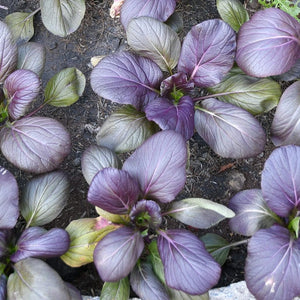
Tatsoi (Brassica rapa subsp. narinosa) is a quick leafy green in the cabbage family, Brassicaceae, grown for its flat rosette of glossy, spoon-shaped leaves. A close cousin of bok choy, it gives baby leaf in about three weeks and whole rosettes soon after, and it copes with frost. The usual mistake is sowing it into lengthening spring days, when it often runs to seed before the rosette fills out.
Three mistakes that matter
- Sowing into lengthening spring days. Rapidly lengthening days and hot spells trigger bolting (running to flower), which ends the leaf harvest. Make autumn the main sowing, and pick spring rows young as baby leaf.
- Letting the soil dry out. Water stress makes the leaves bitter and can push plants to flower early. Water before the surface dries, and mulch between the rows once seedlings are up.
- Setting young plants out into a cold snap. Young plants of this species held below about 10°C for long spells can flower early instead of building a rosette. Sow spring rows after the last frost, or keep them under cover until frosts end.
When to plant
Tatsoi seed germinates in soil between 10°C and 30°C, and the plants do best through the cool, short-day months. In most zones the main sowing runs from late summer into autumn, with a second, shorter window as winter ends. Sow a short row every few weeks for a steady supply of young leaves.
| Zone | Example cities | Sow | Harvest | Notes |
|---|---|---|---|---|
| Tropical | Darwin, Katherine NT; Cairns, Townsville QLD | Apr-Jul | May-Sep | A dry-season crop only; wet-season heat sends it quickly to seed. |
| Subtropical | Brisbane, Bundaberg QLD; Coffs Harbour, Lismore NSW | Mar-Jul | Apr-Sep | Sow once autumn nights cool; mild winters suit it, and late rows bolt as days lengthen. |
| Arid and semi-arid | Alice Springs NT; Broken Hill NSW; Mildura VIC; Kalgoorlie WA | Mar-Aug | Apr-Oct | March rows need shade and daily water until the heat breaks; winter frost does little harm. |
| Temperate | Sydney, Newcastle, Wollongong NSW; Melbourne, Geelong VIC | Mar-May and Aug-Sep | Apr-Jul and Sep-Nov | Autumn is the main window; pick spring rows young, before lengthening days bring flower stalks. |
| Mediterranean | Perth, Bunbury WA; Adelaide and the SA coast | Mar-May and Aug-Sep | Apr-Jul and Sep-Nov | Sow as the summer heat breaks; spring rows need steady water because the dry heat arrives early. |
| Cool and alpine | Hobart, Launceston TAS; Canberra ACT; Orange NSW | Feb-Apr and Sep-Nov | Mar-Jul and Oct-Jan | Sow autumn rows by April, before daylight falls under 10 hours; cover September rows until frosts end. |
At the warm edge of a window, cover young plants with shade cloth through a hot spell. At the cold edge, sow early enough in autumn for plants to size up before the short days of midwinter.
Site, soil and setup
Being a brassica, tatsoi inherits clubroot (Plasmodiophora brassicae), a soil disease that thrives in acid ground, so pH and rotation matter as much as richness.
| Get the bed right | What to do |
|---|---|
| Sun | Full sun in autumn and winter; part shade for late sowings as spring warms |
| Soil | Fertile and well drained; dig in a 5 cm layer of compost before sowing |
| pH | 6.0 to 7.5; below that, garden lime or dolomite lime at 100 to 200 g per square metre, 4 weeks ahead |
| Clubroot history | Lime towards pH 7.0 or a little above, and improve drainage in wet corners |
| Base feed | Pelletised chicken manure at 100 g per square metre, raked in at sowing |
| Rotation | Keep brassicas out of the same bed for at least 4 years where clubroot has appeared |

Container growing
A pot at least 25 cm wide and 20 cm deep, about 8 L, grows one full rosette or a dense patch of baby leaf. A 33 cm pot of about 18 L fits three rosettes. Fill it with premium potting mix, never garden soil. The varieties 'Black Knight', 'Red' and 'Deep Purple F1' all suit pots, and the upright habit of 'Red' makes it easier to pick.
- Water: check daily and water before the mix dries, because pots dry fast and a dry pot turns the leaves bitter.
- Feed: worm casting liquid diluted to weak tea colour, every week or two from the first true leaves.
- Position: full sun in winter; move the pot into afternoon shade once spring warms.
Sowing Seeds
Sow direct where the plants will grow, or raise seedlings in cells and move them with the root ball intact.
Sowing direct
- Water the bed the day before, then sow 6 mm deep in rows 25 to 40 cm apart.
- Drop a seed every few centimetres, and thin later.
- Keep the surface damp; seedlings usually appear in 4 to 12 days.
Starting in cell trays
Cells suit a small bed, or a start while the previous crop finishes.
- Sow one or two seeds per cell of seed-raising mix, at the same depth, and keep the strongest.
- Plant out at three or four true leaves, usually 3 to 4 weeks after sowing, without breaking the root ball.
- Harden off (accustom seedlings to sun and wind over about a week) before planting 15 to 25 cm apart.
- Water in with seaweed solution at half strength, 15 mL per 9 L.
Some packets hold seed treated with a fungicide, thiram, and it may be dyed. Wear gloves to sow it, wash your hands afterwards, and keep it away from children and animals.
| Group | Leaf | Habit and use | Varieties |
|---|---|---|---|
| Green tatsoi | Glossy, dark green spoons on pale stems | Flat rosette; baby leaf, whole heads, cut-and-come-again | 'Green Leaf', 'Black Knight' (very dark, mild) |
| Red and purple tatsoi | Red-violet to deep purple, some with a green underside | Mostly grown for baby leaf and salad colour; purple deepens in cool weather | 'Red' (upright), 'Deep Purple F1', 'Viola F1' (keeps its purple in warm weather) |
| Tatsoi and pak choi cross | Round, dark green | Upright, larger plant; space about 30 cm apart | 'Da Cheong Chae F1' |
The variety 'Viola F1' carries the trade name oriental mustard. Its botanical name, Brassica rapa var. rosularis, is a synonym of tatsoi, so it grows exactly as tatsoi does. The variety 'Da Cheong Chae F1' is sold as a pak choi, and is a hybrid of tatsoi and pak choi.
Care by growth stage
Steady moisture and a light hand with nitrogen decide this crop: dry soil turns it bitter, and soft, sappy growth draws aphids. Weeks count from sowing.
| Stage | Water | Feed | Watch for |
|---|---|---|---|
| Germination, weeks 0 to 2 | Keep the surface damp with a fine spray | None | Slow, patchy emergence in soil too cold or too hot (see When to plant) |
| Seedling and thinning, weeks 2 to 4 | Water whenever the surface starts to dry | Seaweed solution at half strength, 15 mL per 9 L, fortnightly from the first true leaves | Cabbage white butterflies (Pieris rapae) and small grey diamondback moths (Plutella xylostella) laying eggs; aphids under the leaves |
| Rosette growth, weeks 4 to 6 | Deep, regular soaks so the root zone never dries | Fish and seaweed blend at 25 mL per 9 L, fortnightly | Yellow patches or white blisters in cool, wet weather; bug swarms as nearby weeds dry off |
| Picking, weeks 3 to 9 | Keep moisture steady right through picking; never let plants dry out | Fish and seaweed blend at 25 mL per 9 L, fortnightly, for plants picked over several weeks | The centre lifting into a flower stalk: harvest the whole plant |
If growth stalls in poor soil, a light dose of all-purpose controlled release granular (NPK around 14-5-10), scratched in at the label rate, can help.

Thinning
Crowded rosettes stay small, stretch upwards and catch leaf diseases in damp weather, so thin in two passes. Eat the first thinnings only from untreated seed, as for microgreens in Tips.
- Thin once the first true leaves show, keeping the strongest seedling at each spot.
- Thin again as the leaves begin to touch, to 15 to 25 cm for full rosettes.
- Snip unwanted seedlings at soil level, so the keepers' roots stay undisturbed.
- Leave rows grown only for baby leaf unthinned, and cut them young.
Companion planting
Good neighbours grow in the cool season, sit low or slim beside a flat rosette, or keep brassica pests busy elsewhere.
Grows well with
- Culinary chrysanthemum, which lures Rutherglen bugs (Nysius vinitor) and thrips (order Thysanoptera) from Asian greens and shelters parasitic wasps. Leave it standing, since the bugs move onto nearby greens when it is cut.
- Lettuce, a quick cool-season leaf from another family that the brassica caterpillars pass over.
- Onions and spring onions, slim and upright, so they cast little shade over a low rosette.
- Beetroot and carrots, whose roots work the soil below while tatsoi covers the surface.
Keep apart
- Bok choy, since tatsoi draws diamondback moth, thrips and leaf miners (Liriomyza betae and Scaptomyza flava), and the pests spill across into rows alongside.
- Mizuna, mustard and komatsuna, brassicas that share the same caterpillars, aphids and clubroot.
Harvesting Leaves
Start picking once the outer leaves are big enough to use: baby leaf from about 3 weeks, larger leaves from 4 to 5 weeks.
- Cut baby leaves with scissors, taking a few from each plant.
- On larger plants, take the outer leaves and leave the centre to keep growing.
- For a whole head, cut the rosette low at the base with a sharp knife, usually 30 to 60 days from sowing.
- Pick in the morning, when leaves are crisp; leaves cut in the heat of the day often taste bitter.
Refrigerate picked leaves straight away, and use them within a week. Eat young leaves raw in salads, or add larger ones to stir-fries and soups at the very end of cooking, so they keep their crunch.
Common problems
Running to seed. A stalk rises from the centre and the leaves shrink and toughen; timing, water and cold shocks are the causes, set out in Three mistakes.
Bitter or tough leaves. Heat, dry soil and age all sharpen the flavour, so pick leaves young.
Patchy germination. Seed sown into soil hotter than the range in When to plant, or into a surface that dried out, comes up thinly. Wait for cooler weather, or sow into a shaded, well-watered drill.
Pale, stretched seedlings. Seedlings raised on a dim windowsill stretch for light, and warmth after emergence makes it worse. Read more
Pests and diseases
Trials on baby-leaf farms near Bairnsdale, in Victoria, found tatsoi prone to many pests. It was harder hit than pak choy by downy mildew, and seemed more prone to thrips, which silver and distort the leaves.
Cabbage white butterfly (Pieris rapae) and diamondback moth (Plutella xylostella). Their green caterpillars chew holes and leave droppings in the leaves. Rub off eggs from the leaf undersides, pick off caterpillars, and use a Bacillus thuringiensis (Bt) spray if numbers build. In warm weather, cabbage centre grub (Hellula species), a small striped caterpillar, webs young leaves together and bores into the heart. With any spray, follow the label, including its withholding period before picking. Read more
Cabbage aphid (Brevicoryne brassicae). Colonies cluster under the leaves and stunt young plants. Hose them off or spray insecticidal soap, and let ladybirds and lacewings do the rest. Read more
Rutherglen bug (Nysius vinitor). A small native seed bug that breeds on weeds and swarms into leafy crops as the weeds dry off, sucking the leaves dry. Slash or clear weeds well before they dry out. Read more
Snails and slugs (class Gastropoda). The worst pests of Asian greens in many gardens, they shred seedlings and baby leaf overnight in damp weather, leaving slime trails. Hunt them by torchlight after rain, set beer traps, and pull mulch back from seedling stems. Read more
Downy mildew (Hyaloperonospora parasitica) and white blister (Albugo candida). Both spread in cool, wet weather with heavy dews. Downy mildew leaves pale yellow, angular patches above with a grey fuzz beneath. White blister raises small white blisters under older leaves, which burst into powdery spores. Thin crowded plants, pick off and bin affected leaves, and clear plant debris after harvest. Read more
Clubroot (Plasmodiophora brassicae). Swollen, distorted roots, stunted plants and wilting on warm afternoons, worst in acid soil. Pull and bin affected plants, never compost them, and lime and rotate as set out in Site, soil and setup. Spores survive in soil for up to 20 years, so clean soil off tools and boots after working an affected bed.
Prevention first
- Check the leaf undersides and the heart of each plant daily for eggs, caterpillars and aphids.
- Pull self-sown brassica weeds, which keep the caterpillars going between crops.
- Water in the morning at the base of the plants, not over the leaves.
- Keep plants at the spacing in Thinning, so the leaves dry quickly after rain.
Tips
- Tatsoi makes quick microgreens in a shallow tray. Grow them only from untreated seed sold for sprouting or microgreens, since garden seed may carry a fungicide dressing.
- Anzac Day is a fair marker for the main autumn sowing in the southern zones; rows sown then crop through winter, ahead of spring bolting.
- In frosty districts such as Canberra, cover autumn rows with a hoop tunnel of horticultural plastic. It protects the leaves from frost and stretches the picking season.
Questions
What is the difference between tatsoi and bok choy?
They are the same species, Brassica rapa, in different groups. Tatsoi forms a flat rosette of small, glossy, spoon-shaped leaves on short stems. Bok choy grows upright, with longer, thicker leaf stalks. Tatsoi is also called Chinese flat cabbage or rosette pak choi.
When do you plant tatsoi in Australia?
Sow mainly in autumn, once the soil sits between 10°C and 30°C. Most southern gardens also get a short window in late winter to early spring. Subtropical gardens sow from March to July, and the tropics sow in the dry season, from April to July.
Why is my tatsoi going to seed?
Lengthening spring days, hot weather, dry soil and long cold spells on young plants all trigger flowering. Make autumn the main sowing, keep the soil evenly moist, and sow spring rows after the last frost. Pick spring rows young as baby leaf.
Can you eat tatsoi raw?
Yes. Young leaves are mild enough for salads, and the whole plant can be eaten. Larger leaves suit stir-fries and soups: add them at the very end of cooking so they keep their crunch.
Can you grow tatsoi in a pot?
Yes. A pot at least 25 cm wide and 20 cm deep, about 8 L, grows one full rosette or a patch of baby leaf. Use premium potting mix, water before it dries out, and feed worm casting liquid, diluted to weak tea colour, every week or two.
Is Viola oriental mustard a mustard or a tatsoi?
It is a purple tatsoi. Its botanical name, Brassica rapa var. rosularis, is a synonym of tatsoi, and it grows the same way. Oriental mustard is a trade name; tatsoi is also known as spoon mustard.
Grow it




More vegetable guides
All vegetables
Amaranth
How to grow leaf amaranth, or Chinese spinach, in Australia: sowing months for six climate zones, warm soil, thinning, picking, pests and cooking the leaves.
| Position | Full sun |
|---|---|
| Depth | 3 to 6 mm |
| Spacing | 15 cm apart |
| First pick | 4 to 8 weeks |

Artichoke
How to grow globe artichokes from seed in Australia: sowing, spacing, feeding, when to cut the buds, cutting back, cardoon, and sowing months for every zone.
| Position | Full sun |
|---|---|
| Depth | 10 mm |
| Spacing | 1 to 1.5 m apart |
| First pick | About 42 to 57 weeks |

Bean
How to grow beans in Australia: sowing months by climate zone, bush and climbing types, low-nitrogen feeding, watering, picking pods, plus bean fly and rust.
| Position | Full sun, at least six hours |
|---|---|
| Depth | 25 to 30 mm |
| Spacing | Bush 10 to 15, climbing 15 to 20 cm |
| First pick | 7 to 14 weeks |

Beetroot
How to grow beetroot in Australia: sowing months for all six climate zones, thinning the seed clusters, steady watering, harvest size and the pests that matter.
| Position | Full sun or part shade |
|---|---|
| Depth | 10 to 20 mm |
| Spacing | 10 cm apart after thinning |
| First pick | 7 to 12 weeks |