
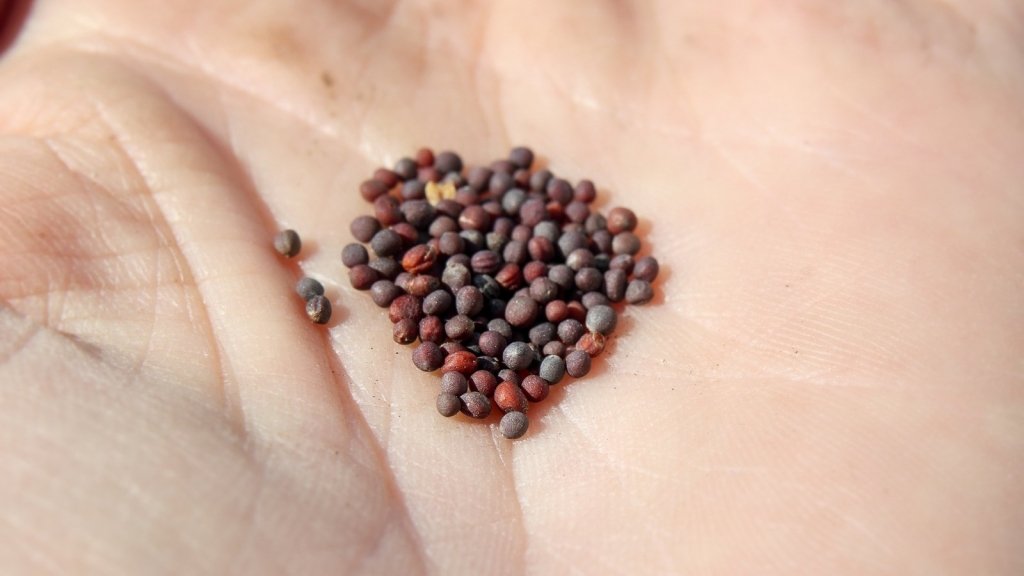
The short version: Dust-fine seed such as lettuce, carrot, celery, thyme, poppy, snapdragon and petunia is easy to lose, easy to oversow and easy to bury too deep. Mix it with four to ten parts of dry, washed propagating sand so you can spread it thinly and see where it lands, press it onto the surface rather than covering it, water from below or with a mist, keep the surface damp until the seedlings show, then thin early with scissors. A few of these seeds need light to germinate, so surface sowing covers every case.
Tip a packet of poppy seed into your palm and you are holding a small crowd: around ten thousand seeds to the gram. Thyme runs to several thousand, lobelia to tens of thousands, and a single sneeze over a tray of petunia seed is a genuine horticultural event. Seed this small asks for a different technique from a bean, and once you have the technique it is no harder.
The whole method comes down to four things: bulk it up, keep it on the surface, keep it damp, and thin without mercy.
Why tiny seeds are tricky
Small seed sits on or just under the surface, so it dries out within hours on a warm day. As Gardening Australia's Tino Carnevale puts it, if they dry out even once you can lose them very quickly. A careless splash from the hose washes a whole sowing into one corner. A pinch holds hundreds, so oversowing is the norm, and crowded seedlings stretch and damp off. And some of these seeds, including petunia, begonia, snapdragon, foxglove and chamomile, need light to germinate and fail if buried, while lettuce germinates better with light than without. One caution before you start pinching seed: foxglove seed, like every part of the plant, is poisonous if eaten, so wash your hands after handling it and keep it away from children and pets. The general rule is to sow at about twice the seed's width, and for dust-fine seed that means no covering at all.

The sand trick

Mixing seed with sand is the oldest fix and still the best. In a dry jar, combine one part seed with four to ten parts dry, washed propagating sand, sometimes sold as horticultural or coarse washed sand, and shake. The sand bulks the seed so a pinch spreads along a whole row, and its pale colour shows you exactly where you have sown. The sand must be dry or it clumps. Avoid play sand, fine bricklayer's sand and beach sand: the first two pack into an airless crust when wet, beach sand can carry salt, and none of them is washed. Dry sand of any kind, propagating sand included, throws up fine silica dust, so wear a mask when you tip or shake it. For a wildflower patch, Perth-based presenter Josh Byrne mixes the seed with about a kilogram of sand per square metre and tickles it in by hand.
Five other ways to place a seed you cannot see
- Pinch and sprinkle. Take a pinch, hold your fingers high, and rub them together as you move along the row. Then thin. This is how most gardeners sow lettuce and carrots.
- The folded card. Tip the seed into the crease of a folded piece of card and tap it gently so the seeds walk down the fold one at a time.
- A damp toothpick or fine tweezers lifts a single seed and sets it exactly where you want it, which suits punnets and expensive seed.
- A salt shaker passes seed and sand evenly over a tray or along a drill, though the very finest seed slips through too fast, so mix it with plenty of sand.
- Home-made seed tape. Dab a flour-and-water paste along a strip of paper towel or toilet paper at the final spacing, drop a seed on each dab, let it dry, then lay the strip in a shallow furrow. The paper rots away and the carrots come up in a line.
Sowing, watering and covering

Fill a punnet or tray with fine seed-raising mix, sieved if it is lumpy, and stand it in water until the surface darkens before you sow; our guide to seed-raising mix explains what to look for. Spread the seed and sand thinly, then press the surface gently with a flat block so the seed touches the mix. Leave the light-needers uncovered. Dust the rest with a bare 2 to 5 mm of vermiculite or sieved mix, which holds moisture and lets the seedlings through. Water by standing the tray in water again or with a fine mist, never with a can that has no rose. Cover with a clear lid, a sheet of glass or a bag propped open for air, keep it at the crop's germination temperature, and take the cover off the day the first seedlings show. Then move them into bright light at once and ease off the watering, because a wet surface is where damping off starts.
Thinning and pricking out
Thin as soon as you can see crowding, snipping the extras off at soil level with small scissors so the keepers' roots are undisturbed. Prick out into individual cells or pots once the seedlings have their first true leaves, holding each by a leaf and never by the stem. Lettuce and celery are ready to move at about 5 to 10 cm tall. Carrots and parsnips resent transplanting, so sow those where they will grow, and shade a carrot row with a board or a strip of hessian until the seedlings appear, then uncover it the same day.
Temperature: the quiet reason lettuce fails in January
Tiny seed has its own thermometer. Lettuce germinates from about 8°C and does best around 16 to 20°C, and it germinates poorly once the soil passes about 24 to 27°C, which is why midsummer sowings so often come to nothing. Carrots want 10 to 30°C, poppies about 16 to 24°C, thyme and oregano around 18 to 21°C, and petunias 21 to 28°C. In summer, sow lettuce in the cool of the evening in a shaded tray, or simply wait for autumn.
Trays or direct, zone by zone
- Tropical (Darwin in the Northern Territory, Cairns and Townsville in Queensland): sow lettuce, carrot and other cool-season fine seed only in the dry season, roughly April to August, in trays under shade cloth so the surface does not bake; carrots go direct. Leaf amaranth is the tiny seed for the wet season.
- Subtropical (Brisbane and south-east Queensland, northern New South Wales): autumn to spring is the long window for carrot, lettuce, celery, petunia, poppy and snapdragon. Direct-sow carrots and poppies, use trays for celery, petunia and thyme, and shade summer lettuce.
- Arid and semi-arid (Alice Springs in the Northern Territory, Broken Hill in New South Wales, Mildura in Victoria, Kalgoorlie in Western Australia): autumn is the main sowing season, with a second run in late winter. Dry wind empties a surface sowing in hours, so trays under a lid, watered from below, beat direct sowing for everything except carrots under hessian.
- Temperate (Sydney and the New South Wales coast, Melbourne in Victoria): poppies, snapdragons and foxgloves in autumn, lettuce and carrots most of the year with heat-tolerant lettuce in summer, and celery, petunia and thyme raised in trays on a sheltered bench in August and September.
- Mediterranean (Perth and southern Western Australia, Adelaide in South Australia): the same two windows, but autumn is the safer one for surface-sown seed because the soil stays damp. In spring keep trays out of drying easterlies.
- Cool and alpine (Tasmania, Canberra in the ACT, Ballarat in Victoria, Orange and Armidale in New South Wales, Stanthorpe in Queensland): trays under cover for nearly all tiny seed from late winter, then outdoor sowing of carrot, lettuce and alyssum from September. Lettuce germinates from 8°C, so it can go out early; carrots wait for the soil to reach 10°C.
Frequently asked questions
Which tiny seeds need light?
Petunia, begonia, snapdragon, foxglove and chamomile, and lettuce does better with it. Surface-sow every dust-fine seed and the question takes care of itself.
How much sand?
One part seed to four to ten parts dry sand by volume, or a pinch of seed in a couple of teaspoons of sand for a short row.
Which sand?
Washed, coarse propagating sand from a nursery. Not play sand, fine bricklayer's sand or beach sand.
How do I water without moving the seed?
Stand the tray in water until the surface darkens, or use a mist sprayer. Never a jet.
When do I thin or prick out?
Thin with scissors as soon as you see crowding. Prick out at the first true leaves, holding each seedling by a leaf.
Why did my lettuce not come up in summer?
Heat. Lettuce germinates poorly above about 24 to 27°C. Sow in the evening in a shaded tray, or wait for autumn.
Bulk it, surface it, keep it damp and thin it: four small habits, and the smallest seeds in the packet become the easiest crops in the bed.
Related growing guides
- How deep seeds really want to go
- What makes a good seed raising mix?
- A beginner's guide to growing annual flowers from seed
Small seed, big harvests: browse our lettuce seeds, carrot seeds, poppy seeds and thyme seeds.