
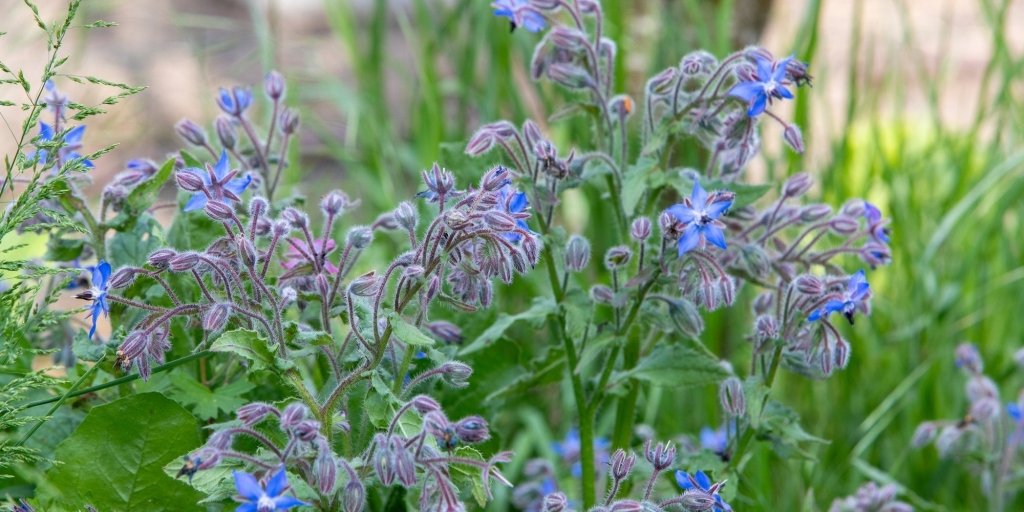

Why grow borage
Borage (Borago officinalis) is a fast, shaggy annual with grey green bristly leaves and bright blue star flowers, and it is one of the best things you can put in a vegetable garden for bees. The flowers refill with nectar quickly, so they are worked from early morning until late in the day, and a single plant will keep flowering for months. Hoverflies and small parasitic wasps come for it too: many hoverfly larvae eat aphids, and some of the wasps lay their eggs in budworm (Helicoverpa) and cabbage white caterpillars.

Sowing borage
Borage does not like having its roots disturbed, so direct sow it where it is to grow. Sow borage seed 10 to 15mm deep, water it in, and thin the seedlings to 45 to 60cm apart, because a well fed plant gets large and floppy and often reaches close to a metre tall. Full sun gives the most flowers, and part shade is fine in hot districts. If you have to raise seedlings, use newspaper or coir pots that can go into the ground whole, and plant them out while they are small.
When to sow around Australia
- Tropical (Darwin, Cairns, Townsville, Broome, the Top End and far north Queensland): Apr to Jul, in the dry season.
- Subtropical (Brisbane, the south east Queensland coast, Coffs Harbour and the NSW north coast): Mar to May, and again Aug to Sep.
- Arid and semi-arid (Alice Springs, Broken Hill, Kalgoorlie, Mildura and most of the inland): Mar to Apr and Aug to Sep, with water in reserve.
- Temperate (Sydney, Melbourne, Newcastle, Geelong and coastal southern Australia): Sep to Dec.
- Mediterranean (Perth, the south west of WA, Adelaide and the SA gulf country): the temperate months, at the early end, because the dry summer shortens the season.
- Cool and alpine (Hobart, Canberra, Ballarat, Armidale and the Tasmanian and mainland tablelands): Oct to Dec, once frost has finished.
These are broad groupings, so gardeners between zones should lean on their own frost dates. Borage is a hardy annual, not a frost tender one, so a light frost will not finish it.
In the vegetable garden
Borage has very hairy leaves, and slugs and snails do not appear fond of them. A border of borage is not a barrier, though, so keep your usual slug and snail controls going rather than relying on it. Some gardeners believe borage improves the growth and flavour of nearby strawberries. There is no good evidence for that, but the two grow happily together and the bees the borage brings in will not hurt the berry crop.

Self seeding
Borage self seeds freely and comes up year after year, which is welcome in a working vegetable patch and less welcome elsewhere. Seedlings pull out easily while they are small and they compost well. If you garden near bushland, a creek or a roadside verge, cut the spent flower heads off before the seed drops so the plant stays where you put it.

Eating borage
The flowers are the part most people eat. They have a light cucumber flavour and look good scattered over salads and cakes, or frozen into ice cubes for a cold drink, but they are no safer than the leaves. The whole plant, flowers included, contains pyrrolizidine alkaloids, compounds that can damage the liver. Overseas food authorities advise against drinking borage leaf tea. Keep the flowers to an occasional garnish, a few at a time, treat the leaves as a garden plant rather than a vegetable, and leave borage out of the kitchen altogether if you are pregnant or breastfeeding.
At the end of the season
Borage grows a lot of soft leaf in a hurry. When the plants finish, cut them down and either compost them or leave them on the soil as a cover-crop mulch. They break down quickly and add organic matter, although they are not a fertiliser in their own right. If you keep chickens, compost the borage rather than feeding it to the hens, because pyrrolizidine alkaloids from plants that hens eat can pass into their eggs.
Related growing guides
- The patch that helps itself: gardening for bees and beneficial insects
- Stop Growing Vegetables On Their Own: The Flowers That Bring The Bees Your Zucchini Needs
- Companion planting in Australia: what really helps, and what is folklore
Ready to plant? Browse our borage seeds.
2 comments
Vicki
I learnt some new benefits for borage so thanks for the article. They are also great for attracting bees, and in our cool temperate area their long flowering season gives bees a flower supply at times when bee food sources are lower.
Julia
Handy to know about them being beneficial to the garden. I have had a few grow up in a Winter flower seed set, & definitely will use them for composting purposes when they die back