

Why grow chives
Chives (Allium schoenoprasum) are a hardy perennial in the onion genus, Allium, and one of the easiest herbs to start with. They grow in tidy clumps of fine hollow leaves, come back every year and take almost no room. Their onion scent is thought to put aphids off what grows behind them, and the mauve flowers bring bees and hoverflies through spring and summer.

Sowing
Chives want full sun to light shade and soil that drains freely. Dig a shallow trench, sow the seed about 1cm deep, firm the soil over it and water gently. Sow in clumps of eight to ten seeds about 20cm apart, or sow a row and thin the seedlings to 15 to 20cm between clumps. Germination is slow, usually one to three weeks, so keep the bed damp. Mulch after sowing, but keep the mulch off the seed line or the shoots may struggle through; cover the row properly, with at least 3cm of compost or coir, once the seedlings are up.
When to sow around Australia
- Tropical (Darwin, Cairns, Townsville, Broome, the Top End and far north Queensland): late Mar to Aug, in the dry season.
- Subtropical (Brisbane, the south east Queensland coast, Coffs Harbour and the NSW north coast): Jan to Sep, easiest Mar to Aug.
- Arid and semi-arid (Alice Springs, Broken Hill, Kalgoorlie, Mildura and most of the inland): Mar to May and Jul to Sep.
- Temperate (Sydney, Melbourne, Newcastle, Geelong and coastal southern Australia): almost any month, best Mar to May and Aug to Oct.
- Mediterranean (Perth, the south west of WA, Adelaide and the SA gulf country): the temperate months, leaning on autumn ahead of the dry summer.
- Cool and alpine (Hobart, Canberra, Ballarat, Armidale and the Tasmanian and mainland tablelands): Aug to Sep and Jan to Mar, and divide clumps in May or Jul.
These are broad groupings. If you garden between two of them, your local frost dates are the better guide.
Feeding
Chives are grown for their leaves, so nitrogen matters more to them than phosphorus. Compost or aged manure dug in before sowing carries a clump a long way, and a liquid feed of fish emulsion or seaweed concentrate every few weeks keeps the leaves coming. Older advice to bury a fish head under each plant is better skipped: it takes months to break down, and while it does it draws rats, foxes and dogs into the bed.

Companion planting
Gardeners have long said alliums should be kept away from beans and peas, on the grounds that they interfere with the nitrogen-fixing bacteria on legume roots. That has not been demonstrated, but if you would rather not test it, give the chives their own end of the bed. Lettuce and most leafy crops make good neighbours. Some gardeners say chives improve the flavour of carrots; treat that as folklore, though the two share a bed happily enough.
Harvesting and dividing
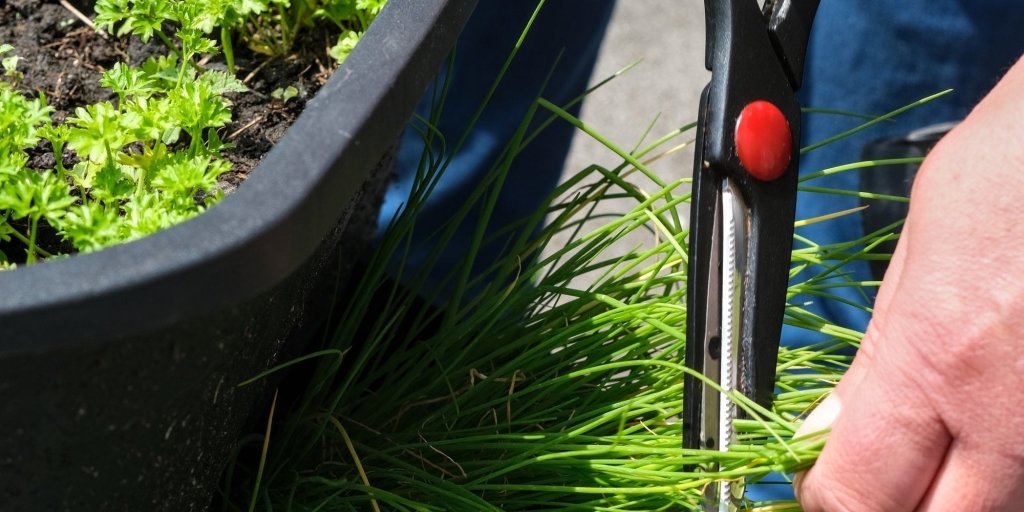
There is no single harvest. Cut leaves with scissors as you need them, taking them from the outside of the clump and leaving about 5cm behind, which keeps the new growth tender. The flowers are edible, and can be steeped in white vinegar to flavour and colour it for dressings. Every few years, when a clump crowds itself, lift it in autumn or winter, pull it into smaller pieces and replant them.
Garlic chives
Garlic chives (Allium tuberosum) are a different species with flat leaves, white star flowers and a mild garlic flavour, sown and grown the same way. They self seed freely, so cut the spent heads off before the seed drops unless you would like a patch of them.

Related growing guides
- Herbs to Sow in September: Scatter Now, Pick All Summer
- Herbs on a Sunny Windowsill: Fresh Pickings All Year
- Companion planting in Australia: what really helps, and what is folklore
Ready to plant? Browse our chives seeds.