
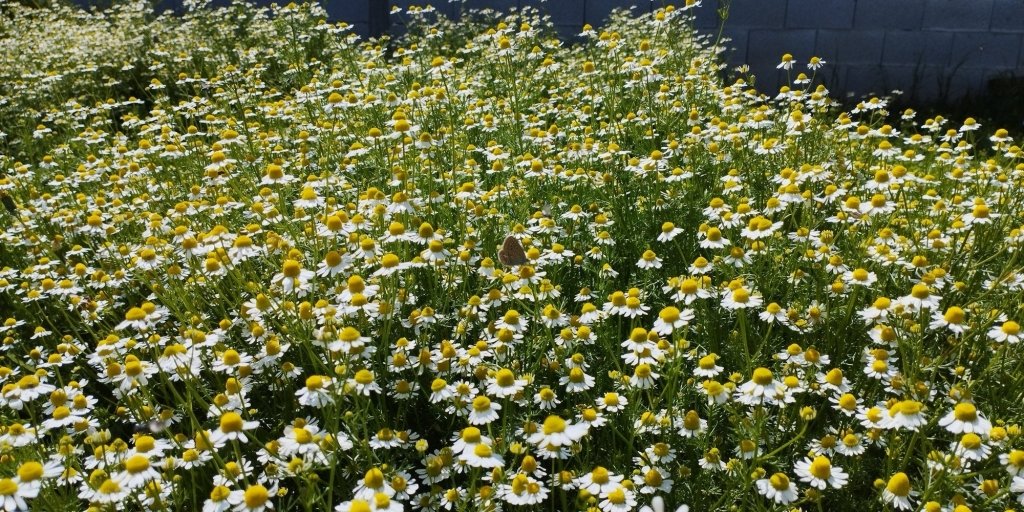

Which chamomile should you grow?
Several different plants are sold as chamomile: Roman, German, Moroccan, Cape and pineapple weed. For a herb or tea garden the two worth the space are Roman and German. They are used in much the same way, and what separates them is how they grow, so the choice comes down to where the plant is going.
Moroccan and Cape chamomile are grown commercially for essential oil, and pineapple weed (Matricaria discoidea) is a low wild plant naturalised in southern Australia rather than a garden crop. The range also includes Golden Chamomile (Kelwayi), another daisy for the herb bed.

Roman chamomile
Roman chamomile (Chamaemelum nobile) is a low perennial native to western Europe and north west Africa. It grows like a ground cover, spreading by stems that take root as they run, and sits at about 30cm tall. Each stem carries a single flower, and the feathery leaves look much like German chamomile.
Choose it if you have room to let it spread and want a soft, scented mat instead of bare mulch. It is often described as a lawn substitute, which oversells it: chamomile lawns use a non-flowering cultivar, Treneague, grown from divisions rather than seed, and even that takes only light foot traffic. A seed-raised patch will flower, so treat it as a fragrant edging or a filler between stepping stones.
German chamomile
German chamomile (Matricaria chamomilla, also sold as M. recutita) is an annual and grows about twice as tall, to roughly 60cm. It does not creep. It branches instead, carries many flowers on each stem, and self seeds so freely that it usually returns by itself. If you want flowers to pick rather than ground to cover, this is the one.

Position, soil and sowing
Chamomile likes cool conditions, free draining soil and part shade, although in temperate, Mediterranean and cool districts it will take full sun. Anywhere warmer, keep it out of the hottest corner. Once established it thrives on neglect.
The seed is tiny and needs light to germinate, so sow on the surface or barely cover it, press it down for good contact and keep it damp until it is up. Around 15 to 20°C suits it. Thin German chamomile to about 20cm and Roman chamomile to about 30cm.
When to sow around Australia
- Tropical (Darwin, Cairns, Townsville, Broome and the Top End): Apr to Jun, in the dry season.
- Subtropical (Brisbane, the south east Queensland coast, Coffs Harbour and the NSW north coast): Mar to May.
- Arid and semi-arid (Alice Springs, Broken Hill, Kalgoorlie, Mildura and the inland): Mar to May, so plants flower before the heat.
- Temperate (Sydney, Melbourne, Newcastle, Geelong and coastal southern Australia): Aug to Oct, late winter into spring.
- Mediterranean (Perth, the south west of WA, Adelaide and the SA gulf country): the temperate months, at the early end, ahead of the dry summer.
- Cool and alpine (Hobart, Canberra, Ballarat, Armidale and the tablelands): Sep to Nov, once the hardest frosts have passed.
These are broad groupings, so lean on your own frost dates. In cold districts Roman chamomile usually holds a low mat of leaves through winter, though a very cold or wet winter can leave dead patches, and it grows away again in early spring, while German chamomile finishes after flowering and returns from its own seed.
Harvesting and drying
Pick the flowers when they are fully open, before the petals wilt, on a dry morning. Dry them in a dehydrator on its lowest setting, or one layer deep on a rack somewhere warm, airy and shaded. Do not use a car dashboard: it gets far hotter than the flowers can take. They are ready when the heads crumble between your fingers. Store them in an airtight jar out of the light, and steep a teaspoon in hot water.

Chamomile belongs to the daisy family, Asteraceae. If you react to other daisies, treat it with the same caution the first time you try it.
Related growing guides
- Sowing in August for a Summer Full of Herbs
- Herbs to Sow in September: Scatter Now, Pick All Summer
- Lavender from Seed in Australia: Is It Worth It, and How Do You Actually Do It?
Ready to plant? Browse our Roman chamomile seeds and German chamomile seeds.