
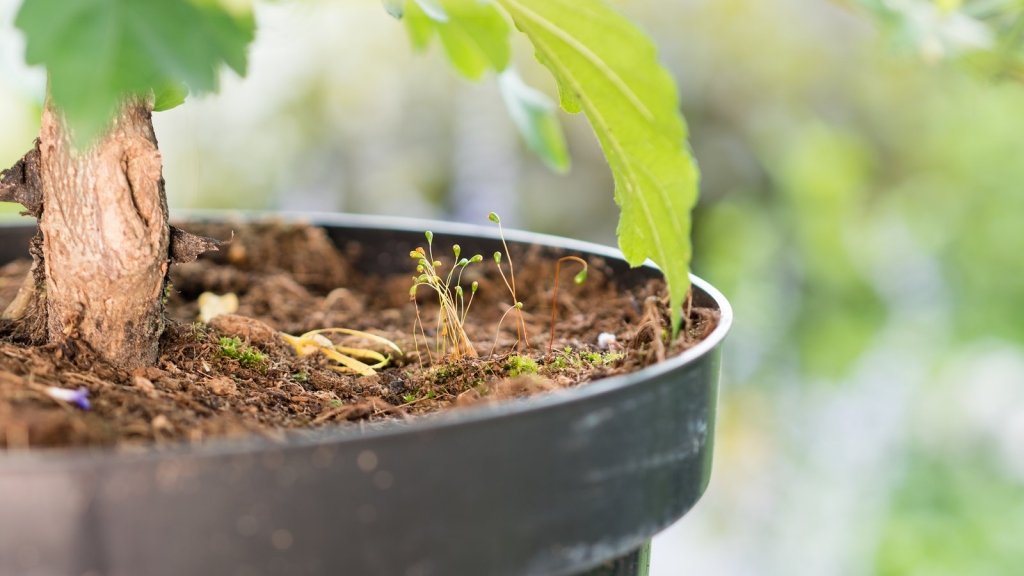
The short version: A green film, a mossy carpet or flat green lobes on top of your seed-raising mix all mean the same thing: the surface has stayed wet, still and dim for too long. None of them attack seedlings directly, but a thick mat competes for water and nutrients, repels water once it dries and can hold fine seedlings back, and the conditions that grow it are the same ones that breed fungus gnats and damping off. Scrape it off, top the tray with vermiculite or coarse sand, water from below, let the surface dry between waterings, take the lid off as soon as seedlings appear, give them more light and moving air, and start every batch in clean trays and fresh mix.
Almost everyone who raises seedlings meets it eventually: a tray sown a fortnight ago, and instead of a neat crop there is a science experiment across the surface. It is not a sign of bad seed or a bad mix. It is feedback about water and light, and once you read it that way it is easy to fix.

What the green stuff actually is
- Algae form a thin green or blackish film or slime over the mix. They are simple photosynthesising organisms with no roots or leaves, and they need light, warmth and constant moisture.
- Moss is a soft green carpet with tiny leaves and stems. It spreads by spores and loves damp, shady, humid corners.
- Liverwort is the flat, branching, rubbery green lobe, sometimes with little cups on top. Those cups hold buds that splash out with overhead watering, which is why it spreads so fast in nurseries and why bottom watering slows it down.
- Green jelly blobs are usually a cyanobacterium called Nostoc. It turns up on poorly drained, nutrient-rich surfaces and survives drying out.
- White fluff on the mix is normally a harmless saprophytic fungus feeding on the organic matter in the mix. It is not damping off, but it grows in the same damp, still conditions and is a warning to change them.
You do not need to identify which one you have, because the cause and the cure are the same.
Why it grows in seed trays
A seed tray is close to a perfect home: a fine, nutrient-rich mix, a surface that is watered every day, warmth from a heat mat or a windowsill, and light. Four things tip it over into a green mat. The surface never dries out, because the tray is watered from the top little and often or left standing in water. The air is still and humid, especially under a propagator lid left on after the seedlings are up. The light is weak, which slows the seedlings but not the algae. And the seed is slow to germinate, so the surface sits bare and wet for weeks. Trays kept outside in cool weather, or sown with slow seed such as parsley, carrot or many perennials, are the classic cases.

Does it hurt seedlings?
Usually it is more nuisance than killer. A light film on a tray of radish or lettuce that is up in a week does no measurable harm. A dense mat is a different matter. It competes with tiny seedlings for water and nutrients, it can repel water once it dries so that irrigation runs off rather than soaking in, and fine seedlings can struggle to push through it. It also feeds fungus gnats, whose larvae chew seedling roots and can carry root-rot organisms from tray to tray. So it is worth dealing with, but it is not the thing to fear.
The thing to fear is damping off
Damping off is caused by water moulds and fungi in the mix, mainly Pythium and Rhizoctonia, and it can wipe out a whole tray. Seedlings either never emerge, or they come up, develop a pinched, water-soaked stem at soil level, topple over and rot, often with a fine white fuzz around them. It is worst in cold, wet, crowded trays with poor air movement and low light, which are often the same trays that grow moss. The difference is easy to see: moss, algae and liverwort sit on the surface while the seedlings above them stand up straight; damping off attacks the seedling itself. Our guide to damping off covers it in full, and everything below helps prevent both.
Clearing a tray that already has it
- Wear gloves and a mask for this job, and dampen the fresh mix you will top up with before you handle it, because dry seed-raising mix and potting mix can carry the bacterium Legionella longbeachae. Never breathe the dust.
- Scrape the green layer off with a paddle-pop stick, an old butter knife or a strip cut from a plastic bottle, taking a few millimetres of mix with it and working around the seedlings rather than through them.
- Top the tray back up with a thin layer of fresh mix, then a dusting of vermiculite, coarse washed sand or fine grit. The topping drains fast, keeps the surface dry and stops the spores landing on wet mix.
- Let the surface dry before you water again, then water from below.
- If the seedlings are big enough, prick them out into clean pots of fresh mix and throw the old tray's mix onto the garden, not into the next tray.

Keeping it away next time
- Water from below and let the surface dry. Stand the tray in a few centimetres of water until the mix is dark and damp, then lift it out and let it drain. Never leave trays sitting in water. Between waterings, wait until the surface looks dry and the tray feels light. Damp like a wrung-out sponge is right; glistening is too much.
- Use clean water. Tank water from open tanks or old barrels can carry algae and root-rot spores. Mains water, or tank water from a covered, clean tank, is safer for seedlings.
- Sow thinly. Crowded seedlings shade the surface and trap humidity. Four to twelve plants in a punnet is plenty, and thinning early does more for the survivors than any spray.
- Take the lid off at emergence. A propagator lid, plastic wrap or a sheet of glass is for germination only. The day the first seedlings show, it comes off for good.
- Give them light. Move trays to the brightest spot you have as soon as they are up, or run grow lights about 14 to 16 hours a day. Weak light makes leggy seedlings and a green surface at the same time.
- Move the air. A small fan on low, or an open window, dries the surface, stiffens the stems and takes away the still humidity that moss, algae and damping off share.
- Turn the heat mat down. Bottom heat is for germination. Once seedlings are up, most vegetables are happier cooler, and a warm wet surface is what algae like best.
- Start clean. Fresh seed-raising mix every batch, never garden soil or a reused tray of last season's mix, and trays scrubbed in hot soapy water. After a bout of damping off, soak trays in one part household bleach to nine parts water for 10 to 30 minutes, then rinse well. Do it outdoors with gloves and eye protection, and never mix bleach with vinegar or other cleaners.

Fungus gnats, the other sign of a wet tray
Small black flies drifting up when you touch the tray are fungus gnats, and they arrive for the same reason the algae did. Their larvae live in the top few centimetres of constantly wet mix, feed on algae and fungi, and will chew seedling roots and stems if there are enough of them. Letting the surface dry between waterings breaks their cycle. Squares of yellow sticky trap on a skewer catch the adults, a layer of coarse sand or vermiculite on the surface makes it hard for them to lay eggs, and beneficial nematodes (Steinernema feltiae) or predatory soil mites sold as Hypoaspis, both available from Australian biocontrol suppliers, attack the larvae. Bti, the bacterial larvicide often suggested overseas, is registered here for mosquito larvae; its use on fungus gnats is covered only by an APVMA minor-use permit for crops grown under cover, so read the permit conditions before you use it. Our guide to fungus gnats has the detail.

Cinnamon, chamomile tea and other folklore
A sprinkle of cinnamon or a spray of cooled chamomile tea is often recommended against mould and damping off. Cinnamon extracts do show antifungal activity in laboratory dishes, but we could not find a study that tested the dry powder on a seed tray, and there is no good evidence for chamomile tea either. Neither will hurt, and neither replaces the three things that work: a drier surface, more light and moving air.

Trays across Australia's climate zones
- Tropical (Cairns and far north Queensland, Darwin and the Top End of the Northern Territory, the Kimberley in Western Australia): wet-season humidity means trays need shelter from rain, a fan or a breezy spot, and a coarse topping, or algae will win in a week.
- Subtropical (Brisbane and coastal Queensland, Coffs Harbour and northern New South Wales): humid summers and mild winters keep the surface wet. Bottom watering and air movement matter all year.
- Arid and semi-arid (inland Queensland, Broken Hill and Dubbo in New South Wales, Mildura in Victoria, inland South Australia and Western Australia, Alice Springs in the Northern Territory): the dry air is on your side. Overwatering to compensate for heat is the usual mistake; shade the trays instead.
- Temperate (Sydney and New South Wales, Melbourne and Victoria): the winter and early spring windowsill, with low light and slow germination, is where most trays go green. Use a heat mat for germination only and the brightest window you have.
- Mediterranean (Perth and southern Western Australia, Adelaide and the Adelaide Plains in South Australia): mild wet winters and slow-germinating autumn sowings make trays kept outside the problem. Cover them from rain and keep the lid off once seedlings are up.
- Cool and alpine (Hobart and Tasmania, Canberra and the ACT, Ballarat in Victoria, Orange and Armidale on the New South Wales tablelands, and the alpine country of the Snowy Mountains and the Victorian high country): cold, dim conditions slow everything except the moss. Bottom heat, extra light and patience with thinning make the difference.
Frequently asked questions
Is the green film harmful to the seedlings?
A light film is mostly cosmetic; a thick mat is worth removing for the reasons above. Scrape it off and change the watering.
Can I reuse seed-raising mix that had moss on it?
Not for seedlings. Spread it on the garden or the compost and start the next batch in fresh mix and a clean tray. Old mix is how damping off travels between batches.
Is the white fluffy mould dangerous?
Usually not. It is a harmless fungus feeding on the mix, but it grows in the same damp, still air that damping off likes, so treat it as a warning: dry the surface, remove the lid and add air.
Do I need a mask to clean seed trays?
Not for washing trays, but yes whenever you handle dry seed-raising mix, potting mix or compost. Dampen it first, wear a P2 mask and gloves, keep the bag away from your face and wash your hands afterwards.
A green tray is a nudge, not a failure. Dry the surface, open it up to light and air, and the next batch will come up clean. The RHS page on algae and moss in containers and NSW Health's potting mix precautions are worth a read.
Related growing guides
- Damping off: what is it and how to prevent it?
- Fungus gnats: how to get rid of them in seedlings and pots
- What makes a good seed raising mix?
Clean trays, fresh mix, and a packet to fill them: browse our vegetable seeds and herb seeds.