
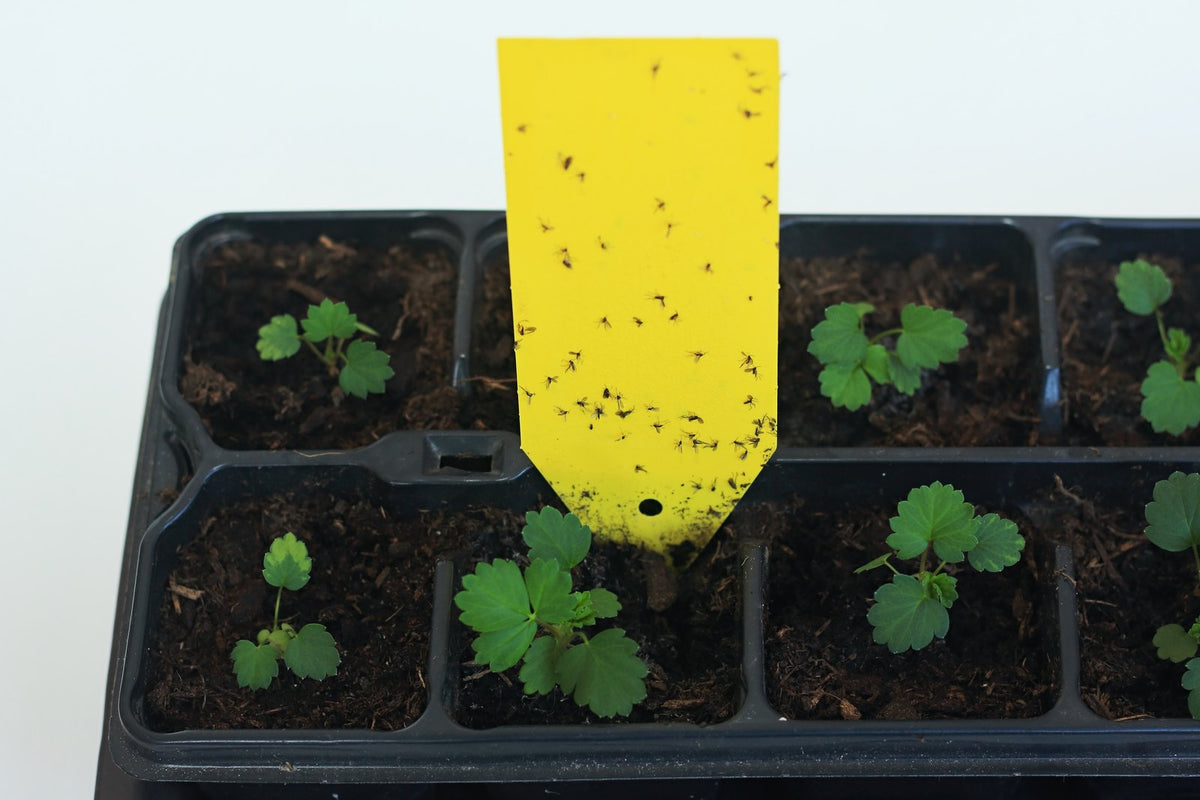
The short version: Fungus gnats are the small dark flies that run and flit across damp potting mix and seed trays. The adults are a nuisance, but the larvae in the mix are the real problem, chewing at roots and root hairs and stalling or killing seedlings. The single most effective fix is to let the top of the mix dry out between waterings, backed up by bottom-watering, yellow sticky traps and a BTi drench. They are mainly a problem in seed-raising, propagation and indoor pots.
Anyone who raises seedlings or keeps indoor plants meets fungus gnats sooner or later. A little cloud of tiny flies lifts off the potting mix when you water, and the seedlings never quite take off.
The adults are harmless in themselves, but they point to larvae in the mix, and it is the larvae that hold your seedlings back. Fixing the moisture usually fixes the gnats.
How to spot fungus gnats
Fungus gnats are small dark flies, about two to four millimetres long, delicate and mosquito-like, with long legs and antennae longer than the head. They are weak fliers, so they tend to run and make short flights across the surface of damp mix and cluster around pot rims. The larvae are legless, translucent to whitish with a glossy black head, up to about five millimetres, and live in the top few centimetres of moist mix.
The damage comes from those larvae, which eat fungi, organic matter and the fine roots and root hairs of seedlings. In numbers they strip roots and tunnel into soft stems, so seedlings establish poorly, yellow, wilt or collapse. Do not confuse them with fruit flies, which are tan with red eyes and swarm around fermenting fruit, or with shore flies, which are stouter and feed on algae without harming roots.
Why they take hold
Fungus gnats thrive wherever mix stays constantly moist and is rich in organic matter, which describes most seed trays, propagation setups and over-watered indoor pots. The females lay their eggs in the top layer of damp mix, the larvae feed for about two weeks, then pupate, and adults emerge within days. Indoors and in a glasshouse the generations overlap and continue year round.
They often arrive in a bag of potting mix or on a new plant, and a film of algae on constantly wet mix gives the larvae extra food. The larvae can also spread soil-borne fungi and are linked to damping off, which is another reason to keep seedling mix on the drier side.
How to control fungus gnats organically
- Let the surface dry between waterings. This is by far the most effective single step. Allowing the top couple of centimetres to dry kills the eggs and young larvae and deters the females from laying, which breaks the cycle.
- Water from below. Bottom-watering keeps the surface drier, and emptying saucers and improving drainage all help.
- Hang yellow sticky traps. Laid flat or standing over the mix, they catch and monitor the adults, though they do not deal with the larvae.
- Add a dry surface layer. A one to two centimetre topping of coarse sand, grit or fine gravel blocks egg-laying and traps emerging adults.
For a larval knockdown, a drench of BTi (Bacillus thuringiensis subspecies israelensis) targets fly larvae specifically and is safe for plants, people and pets, repeated weekly. An APVMA-registered eco-neem drench is another option, used as directed. Predatory mites and beneficial nematodes are available in Australia for persistent cases. On established plants the gnats are mostly a nuisance rather than a killer, so there is no need to reach for harsh broad-spectrum sprays, and the cider-vinegar traps that catch fruit flies do not work on gnats because they breed in the mix, not in fruit.
How to keep fungus gnats down
- Use fresh, good-quality mix, avoid reusing old mix, and store opened bags sealed and dry.
- Never let seed trays sit constantly wet, and water only when the surface has dried.
- Inspect and isolate new plants before adding them to a collection.
- Clear algae and fallen leaves off the surface of pots, since they feed the larvae.
Fungus gnats across Australia's climate zones
Indoors and in a heated glasshouse fungus gnats breed year round in every zone, so moisture control matters more than climate. Outdoors they are worst where it is warm and humid, and least of a problem in dry heat unless things are irrigated.
- Tropical (far north Queensland and the Northern Territory Top End, including Cairns and Darwin): high pressure for most of the year, easing in the dry season.
- Subtropical (Brisbane and northern New South Wales): high from spring to autumn, worst through humid, wet summers.
- Arid and semi-arid (inland New South Wales, South Australia and Western Australia, and the Northern Territory around Alice Springs): lowest outdoors, with problems mostly in irrigated pots, propagation and indoors.
- Temperate (New South Wales, Victoria and the ACT, including Sydney, Melbourne and Canberra): peaks in spring and autumn, and continues year round indoors.
- Mediterranean (Perth and southern Western Australia, and Adelaide in South Australia): wet winter and spring lift the pressure, while dry summers lower it outdoors.
- Cool and alpine (Tasmania, the highlands): outdoor pressure mainly in spring and autumn, with winter problems shifting indoors and into the glasshouse.
Frequently asked questions
Is it a fungus gnat or a fruit fly?
Fungus gnats are dark and mosquito-like with long legs and live over the potting mix. Fruit flies are tan with red eyes and swarm around fermenting fruit. Vinegar traps catch fruit flies, not gnats.
Do fungus gnats harm plants and seedlings?
The adults are a nuisance, but the larvae do the damage, chewing root hairs and roots. Seedlings and cuttings are most at risk and can be killed, while established plants usually just look stressed.
How do I clear them from my seed trays?
Let the surface dry out, water from below, add sticky traps and drench with BTi, then repeat and sow into fresh mix.
Why does letting the mix dry out work?
The eggs and young larvae need constant surface moisture, so a dry top couple of centimetres kills them and stops the females laying. It is the most effective single step.
Do sticky traps fix the problem?
They catch and monitor the adults, but they do not kill the larvae in the mix, so pair them with drying out and a larval treatment.
Did they come in my bag of potting mix?
They can. Gnats often arrive in mix or on new plants, so buy fresh, store bags sealed and dry, and let opened mix dry a little before use.
Keep the surface of the mix dry, water from below, and treat the larvae, and fungus gnats should fade out well before they threaten a tray of seedlings.
Related growing guides
Ready to plant? Browse our vegetable seeds and herb seeds for your next sowing.