
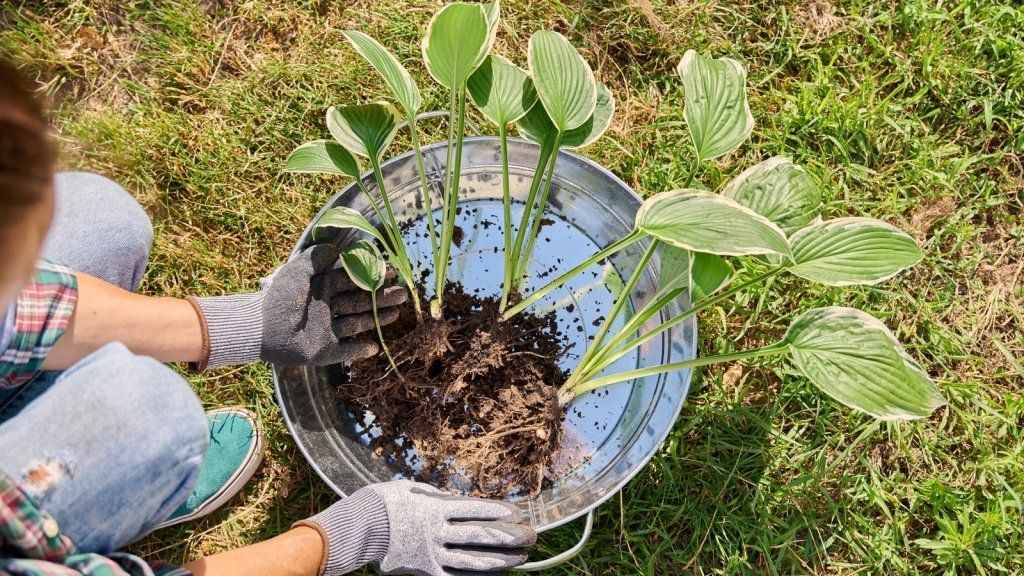
The short version: Dividing means lifting a clump-forming perennial, splitting it into pieces that each have roots and a few shoots, and replanting them. It rejuvenates a crowded clump that has stopped flowering or cropping well, and it gives you new plants for free. Most perennials are divided every three to five years, in autumn or late winter rather than in the heat. Rhubarb, chives, lemongrass, mint, daylilies, agapanthus and native grasses all divide easily; woody herbs such as lavender and rosemary and tap-rooted plants do not.
There is a morning in autumn when the rhubarb crown, which has been quietly sulking all summer, looks ready to be dug. The leaves are smaller than they were, the middle of the clump has gone woody, and the stalks are thin. It is not dying. It is crowded, and the cure is a spade.
Division is the least glamorous propagation method and the one that pays best. One tired clump can become three or four vigorous plants, and the parent often comes back stronger for the disturbance.
Why dividing works
A perennial clump grows outward, and as it does the centre gets old, woody and hungry, competing with itself for water and nutrients. Gardening Australia's advice is to lift and divide most perennials every three to four years to revitalise them, and the American extension services put it at three to five. The signs are easy to read: a dead or hollow centre, fewer and smaller flowers, thin stalks, yellowing leaves, and a plant that has outgrown its spot. Dividing removes the exhausted middle, gives the young outer pieces room, and lets air and light back in, which can mean fewer pest and disease problems too.
Edible clumps worth dividing
Rhubarb is divided in winter while dormant, every three to five years or so. Lift the whole crown, cut it so each piece has two or three fat buds and some root, and replant with the buds just proud of the soil, 60 to 80 cm apart. Chives and garlic chives are split every three to four years, mint every couple of years before it fills its pot, and oregano and thyme by pulling a rooted clump from the edge of the parent. Lemongrass is divided in spring, each section with its own roots, and cut back to about 10 cm. Globe artichokes throw offsets that are tugged apart every couple of years and replanted about a metre apart. Horseradish and Jerusalem artichokes regrow from any root or tuber left behind, which makes them easy to divide and hard to get rid of, so give them a contained bed. Asparagus can be divided every four or five years if a clump is crowded, but it does not need to be, and an undisturbed bed can crop for 15 to 20 years.
In the flower garden, daylilies, agapanthus, dianella, lomandra and ornamental grasses are divided every two or three years. Bearded iris rhizomes are snapped apart after flowering and replanted barely covered, with no more than 1 to 2 cm of soil over them, because deeply buried rhizomes tend not to flower. Cannas are lifted every second year with the crown barely covered. Dahlia tubers are divided in winter, and every piece must carry a bit of the old stem, the neck, and an eye, or it will never shoot. Our guide to dahlias from seed or tubers covers the rest.

Plants that resent the spade
Woody herbs and shrubs such as lavender, rosemary and sage do not divide; take cuttings or layer them instead. Tap-rooted and single-crowned perennials, including oriental poppies, aquilegia, euphorbia and baby's breath, can go into shock when split. Hellebores tolerate division but sulk and can take a season or two to flower again. If a plant has one thick root going straight down rather than a mat of fibrous roots, leave it alone.
How to divide a clump, step by step
- Water the clump thoroughly a day or two before, and pick a cool, cloudy day.
- Cut the foliage back first: by about half on most perennials, by two thirds on agapanthus, to a third of its length on lomandra and dianella, and to about 15 cm on soft-stemmed plants. Strip old leaves from rhubarb.
- Lift with a garden fork, starting outside the drip line and working in, to keep as much root as you can.
- Shake or hose off the soil so you can see the growing points.
- Split by the gentlest method that works: tease apart by hand, then an old bread knife or pruning saw, then two forks back to back for a big fibrous clump, and a sharp spade only for the toughest.
- Keep pieces with good roots and three to five shoots, and discard the woody, dead centre and anything small and weak.
- Keep the divisions shaded and moist while you work, in a bucket or a wet bag. Roots left in the sun dry out fast.
- Replant at the original depth into soil improved with compost, spacing the pieces so they have room to grow, and firm gently.

Aftercare
Water the divisions in with seaweed solution, mulch around them without burying the crowns, and keep the soil evenly moist for a few months while the roots rebuild. Shade them for a few days if the sun turns fierce. Hold off on strong fertiliser until you see new growth, because damaged roots cannot use it and it can burn them. Spare pieces can go into pots of good potting mix; native grasses and strappy plants are usually ready to plant out in six weeks to six months.
When to divide across Australia's climate zones
- Tropical (Darwin in the Northern Territory, Cairns and Townsville in Queensland): divide comfrey, gingers and other tropical clumpers as the wet season begins. Rhubarb does not go dormant here and is usually grown as an annual rather than divided.
- Subtropical (Brisbane and south-east Queensland, northern New South Wales): autumn, from March to May, ahead of a cool wet spell, and again in late winter for gingers, cannas and asparagus.
- Arid and semi-arid (Alice Springs in the Northern Territory, Broken Hill in New South Wales, Mildura in Victoria, Kalgoorlie in Western Australia): once the heat breaks in April or May, or in late winter, and never in summer.
- Temperate (Sydney and the New South Wales coast, Melbourne in Victoria): autumn is the main season for evergreen perennials and native clumpers, winter for rhubarb, dahlias and asparagus, and spring for bearded iris after flowering.
- Mediterranean (Perth and southern Western Australia, Adelaide in South Australia): autumn after the break of season is safest, when the rains do the watering; lomandra and dianella also divide well in late winter.
- Cool and alpine (Tasmania, Canberra in the ACT, Ballarat in Victoria, Orange and Armidale in New South Wales, Stanthorpe in Queensland): rhubarb, globe artichokes and comfrey are divided through winter, avoiding soil that is frozen or waterlogged; daylilies wait for spring.
Safety, and a few rules
Lifting a wet clump is heavier than it looks. Bend at the knees, swap tasks every quarter hour, and wear gloves, leather ones for anything thorny. Rhubarb leaves are poisonous to eat, though safe to handle and fine in the compost; if a child or pet eats them, ring the Poisons Information Centre on 13 11 26. Euphorbia sap can burn skin and seriously injure eyes, so wear eye protection when dividing it and wash any contact off with soap and water. Never dump surplus divisions of spreaders such as agapanthus, mint, horseradish or Jerusalem artichoke in bushland. And before you post a division interstate, check with your state's quarantine authority, because most states restrict pot plants and soil, and fire ant and phylloxera zones have their own rules. Named cultivars under Plant Breeder's Rights can be divided for your own garden but not sold.
Frequently asked questions
How often should I divide?
Every three to five years for most perennials, every couple of years for mint, cannas and agapanthus, every three to five for rhubarb, and every three to four for chives. Judge by the plant, not the calendar.
How big should each piece be?
Good roots plus three to five shoots. Rhubarb pieces want two or three buds, and dahlia pieces need a neck and an eye.
Can I divide in summer?
Avoid hot, sunny days. Bearded iris is the exception, divided after flowering from spring into autumn.
Should I cut the leaves back?
Yes, by about half on most plants, and by two thirds on agapanthus. It cuts water loss while the roots recover.
Can I divide lavender, rosemary or sage?
No. Woody plants do not divide. Take cuttings or layer a low branch instead.
My divisions wilted the next day. Have I lost them?
Usually not. Shade them, keep the soil moist and give them a few weeks. Wilting after division is common, and new growth is the sign they have taken.
One crowded clump, an afternoon with a fork, and the bed has three plants where it had one. The rhubarb, for its part, will forgive you by spring.
Related growing guides
- Perennial vegetables: plant once, harvest for years
- Dahlias from seed or tubers
- Regrowing vegetables from kitchen scraps
Starting a clump from scratch? Browse our rhubarb seeds, chives seeds, asparagus seeds and perennial flower seeds.