

What a seedling needs
Seedlings are the most fragile stage in the life of a plant, and a few days of the wrong conditions can undo weeks of work. Nearly every failure comes back to the same short list: growing medium, warmth, moisture, light, air movement, and protection from whatever wants to eat them. The seed packet gives the sowing depth and spacing for each variety, and our Australian Sowing Almanac gives the months for your zone.
The growing medium
Seedlings want a fine, light, free-draining medium that holds moisture without staying sodden and is free of weed seed and soil-borne disease. Garden soil is none of those things in a tray: it carries weed seed and disease, and it sets hard. Use a fresh seed raising mix, or a home blend based on coir or finely composted bark. Perlite and coarse sand are added to a mix for drainage and vermiculite to hold water and nutrients, but they are components, not media to sow into on their own. Wash trays and pots in hot soapy water between batches.
Warmth for germination
Temperature decides whether seed germinates at all. Warm season crops such as tomato, capsicum, chilli, eggplant and cucumber want the mix between 20°C and 30°C and will sit and rot below about 15°C. Cool season crops such as lettuce, the brassicas, peas and spinach are happy between 10°C and 20°C, and lettuce germinates poorly once the mix stays above about 25°C. In late winter a warm spot indoors, or a seed starter heat mat, is often the difference between a full tray and an empty one.
Water, air and light
Keep the top centimetre or two evenly damp and check with a finger rather than by the clock. Water from below where you can. Misting fine seed is normal and safe: the risk is not water on the leaves, it is leaves that stay wet for hours in still, humid air. Water in the morning, lift the lid off a propagator once most of the seed is up, and thin crowded seedlings early.
Too little light and seedlings stretch and flop, too much heat and glare and they cook. Through summer, and for much of the year in the tropical, subtropical and arid zones, they do best with morning sun and shade from midday through the afternoon. In a cool or temperate winter they want every hour of sun they can get. Facing trays north or north east gives the most even light through the day, and under artificial lights a hand width between lamp and leaves avoids scorching.
Damping off
Damping off is the classic seedling killer: stems pinch and collapse at soil level, often overnight and often across a whole tray. It is not one disease. Several soil fungi and water moulds cause it, including Pythium, Phytophthora, Rhizoctonia and Fusarium, and cold, poorly drained, overwatered and crowded conditions favour all of them. Fresh mix, clean trays, restrained watering, warmth and air movement prevent far more of it than any treatment cures.
Physical protection

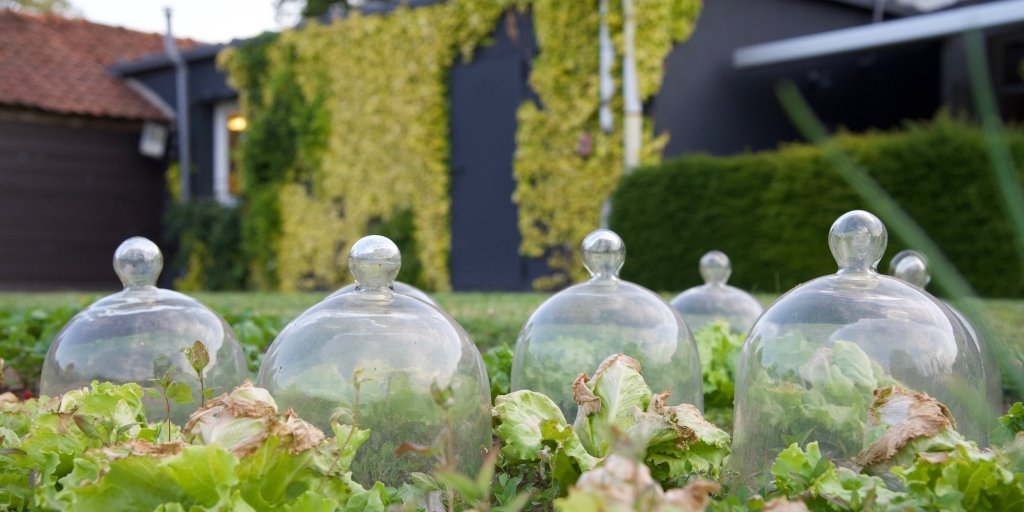
Seedlings are also food. Birds pull them out, snails and slugs mow them off at ground level overnight, possums and rats take whole trays, and chickens and cats treat soft soil as an invitation. A cut down plastic bottle with the cap left off makes a cloche that holds a little warmth on a cold night and keeps snails off a single plant.

A wire cage or a frame of hoops over the bed handles birds and larger animals, and doubles as a frame for shade cloth or frost cloth.

Netting is the reliable answer for birds and possums, which are protected wildlife, so exclusion rather than harm is the only option worth considering. Use white netting with a mesh of 5mm or smaller at full stretch, which is required by law in Victoria and the ACT and is a sensible rule anywhere, because loose wide mesh catches birds, flying foxes, possums and snakes. Pull it tight over a frame rather than draping it on the plants.
For snails and slugs, a torch and a bucket after dark does more than anything in a bottle. Clear away hiding places along the bed edge, try beer traps or a copper band on pots, and if you do bait, choose an APVMA-registered product for snails and slugs and use it exactly as the label says.
Feeding and hardening off
Seed raising mix holds very little food, by design. Once the first true leaves open, a weak feed every week or two, such as half strength fish emulsion or seaweed, keeps growth steady without forcing soft stems.
Seedlings raised indoors or under glass have thin leaves and no wind training, so take 7 to 10 days over the move outside. Start with an hour or two of morning sun in a sheltered spot, then lengthen the exposure each day until they can take a full day and then a night outdoors. Ease back slightly on water that week. Plant out late in the afternoon or on an overcast day, not at midday and not just before a frost.
When to raise seedlings in your zone
- Tropical (Darwin, Cairns, Townsville and the Top End): March to August for the dry season. Through the wet, protection means shelter from rain rather than cold.
- Subtropical (Brisbane, the Gold and Sunshine Coasts, Bundaberg and the NSW north coast): February and March for the long autumn run, and again in August. Shade matters more than warmth.
- Arid and semi-arid (Alice Springs, Broken Hill, Kalgoorlie, Mildura and Longreach): February to March, and July to August for the September window. Watch late frosts and overheating pots.
- Temperate (Sydney, Melbourne, Newcastle, Geelong and coastal southern Australia): February for autumn crops, August to September for the spring run.
- Mediterranean (Perth, Adelaide, the south west of Western Australia and the South Australian gulf country): the temperate months, with March to May the more reliable window ahead of the long dry summer.
- Cool and alpine (Hobart, Canberra, Ballarat, Armidale and the tablelands): sow warm season crops under cover in August and September, and plant out once frosts have finished, sometimes not until November.
These are broad groupings, so gardeners between two zones should lean on local frost dates rather than the calendar.
Related growing guides
- What Makes a Good Seed Raising Mix?
- Stop planting seedlings straight from the windowsill: a week of half days first
- Damping Off: What Is It and How to Prevent It?
Ready to plant? Browse our lettuce seeds, one of the easiest crops to practise on.