
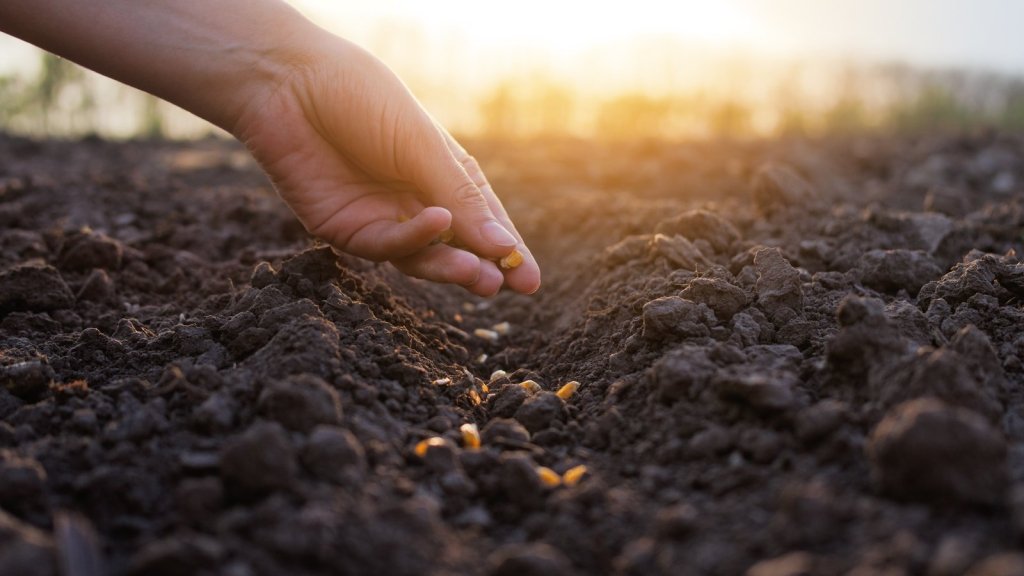
The short version: Direct sowing means putting seed straight into the bed where the plant will live, instead of raising seedlings in trays. It suits beans, peas, corn, root crops, pumpkins and their relatives, and herbs such as coriander and dill, because those plants dislike having their roots disturbed. It works only when the soil is warm enough for that crop, and it asks you to keep the surface moist and the slugs off until the seedlings are up. Tomatoes, capsicums, celery and leeks are usually better started in trays.
The seed tray has its place, but a surprising amount of the vegetable garden would rather skip it. Carrots sown in a punnet fork the moment you move them. Beans and pumpkins sulk after transplanting and then race ahead when sown where they are to grow. Half the skill of direct sowing is knowing which crops belong in the ground from day one.
The other half is patience with the soil. A calendar says September. The soil says whatever the thermometer says, and the seed listens to the soil.
What direct sowing means, and why it suits so many crops
Direct sowing is the simplest way to raise a plant: seed goes into prepared garden soil at its final spacing, germinates there and never moves. There are four reasons it can be the better method. It saves the seed-raising mix, the trays and the daily fussing over seedlings. It leaves the root system untouched, which matters most for tap-rooted crops that can end up forked or stunted when transplanted. There is no transplant shock, because there is no transplant. And the seedlings are acclimatised from the start, so hardening off is not needed. Sustainable Gardening Australia makes the same point about legumes and root vegetables, which do not transplant well.
The trade-offs are real, though. Seed in an open bed is exposed to slugs, snails, cutworms, birds and mice at its most vulnerable stage. Weed seed wakes up in freshly worked soil and competes with your crop. And the bed sits occupied while you wait for germination, where a tray of ready seedlings would fill it in an afternoon.
Which seeds to sow in place, and which to raise first
Sow direct:
- beans, peas and broad beans
- carrots, parsnips, beetroot, radishes and turnips
- sweet corn, which is wind pollinated and does best in a block rather than a single row
- pumpkins, zucchini, cucumbers and melons
- coriander, dill, parsley and fennel, and spinach
- larger flower seeds such as sunflowers, nasturtiums and calendula
Raise in trays first: tomatoes, capsicums, chillies and eggplants, which need warm soil and a long season; celery and leeks, which are slow and tiny at the start; onions; and fine-seeded flowers such as petunias. Brassicas and lettuce are genuinely either-way crops. The reason to transplant them is space and slug protection, not root sensitivity.
Cool climates bend the rules. Zucchini and pumpkin can be started indoors four to six weeks before the last expected frost, and if you sow each seed in a coir or peat pot and bury the whole pot, well wetted, the roots are barely disturbed.
The soil temperature test that decides everything
Seed germinates by soil temperature, not by the date, and the minimums vary a lot by crop. Beans, cucumbers, pumpkins and zucchini want the soil at about 16°C or more before they will germinate reliably, and they rot in cold, wet ground. Sweet corn can start from around 10°C but is far faster and safer in warmer soil. Carrots and peas can germinate from about 4°C, though slowly: at 5°C a carrot can take seven weeks to emerge, at 20°C about a week. Lettuce and spinach run the other way and often refuse to germinate once the soil passes the high twenties, which is why summer sowings of leafy crops fail in hot districts.
The test is easy. Push a thermometer 3 to 4 cm into the prepared bed, read it in the morning and again in the late afternoon, and average a few days. Our guide to the kitchen thermometer test walks through it. No thermometer? Weed seedlings appearing across the bed in spring are a fair sign the soil is ready for direct sowing.
How to direct sow, step by step

- Prepare a fine, crumbly, weed-free bed. Remove stones and clods, add compost if the soil is tired, and avoid deep digging, which brings up more weed seed than it buries.
- Water the bed the day before so it is damp rather than muddy.
- Mark rows or stations. Draw a drill 1 to 5 cm deep with a stick or the corner of a hoe and dampen the base of it.
- Sow at two to three times the seed's width. Large seed such as beans, corn and pumpkin goes in at final spacing, two or three seeds per station. Small seed goes thinly along the drill. Very fine seed is pressed onto the surface and barely covered.
- Cover, firm lightly with the back of the rake, and water with a fine rose so nothing washes out.
- Keep the surface moist every day until the seedlings are up. Small seed should not be allowed to dry out in the first ten days, and carrots and parsnips can take three or four weeks.
- Thin once the seedlings have two sets of true leaves, pulling every second or third one to the packet spacing. Radish, beetroot and lettuce thinnings are the first harvest.
- Mulch only after the seedlings are well up, and keep it clear of the stems.

Keeping the seedlings alive in the first fortnight

Most direct-sown crops are lost in their first two weeks, and usually overnight. Walk the bed with a torch about two hours after dark and pick off slugs and snails, or use a bait based on iron EDTA sprinkled thinly at dusk rather than in piles. Iron baits are far safer around pets and wildlife than metaldehyde products, which can be fatal to dogs. Our guide to slugs and snails covers the options.
Cutworms fell seedlings at soil level. A collar cut from a drink bottle, pushed 5 cm into the soil and standing 5 cm above it, keeps them off, and clearing weeds a few weeks before sowing removes their food. Birds and mice dig for large seed, so lay wire mesh over the bed until the plants are up, or cover it with white netting of 5 mm mesh or finer. Loose black bird netting tangles birds, lizards and flying foxes, and in Victoria mesh larger than 5 mm on fruiting plants now carries a fine.
Once the seedlings are through, ease the watering back to deeper, less frequent soaks so the roots follow the moisture down.
Direct sowing across Australia's climate zones
These are broad groupings, so let local soil temperature and frost dates overrule the month.
- Tropical (Darwin in the Northern Territory, Cairns and Townsville in Queensland): warm-season crops such as beans, corn and zucchini can be sown direct for most of the year, while peas, cabbage, spinach and coriander belong to the dry season from about March to August.
- Subtropical (Brisbane and south-east Queensland, northern New South Wales): beans and corn from August to December and again in late summer, cucurbits from August, and the cool-season crops from about March to August.
- Arid and semi-arid (Alice Springs in the Northern Territory, Broken Hill in New South Wales, Mildura in Victoria, Kalgoorlie in Western Australia, inland Queensland): two seasons, autumn and spring, and never the midsummer furnace. Spring sowings need shade cloth and daily watering.
- Temperate (Sydney and the New South Wales coast, Melbourne in Victoria): beans, corn and cucurbits from September or October once soil holds 16°C, root crops most of the year, peas and spinach from late summer to spring. Melbourne gardeners should treat themselves as cool for the frost-tender crops.
- Mediterranean (Perth and southern Western Australia, Adelaide in South Australia): follow the temperate windows, but sow heat-sensitive seed such as coriander, spinach, lettuce and peas in autumn to early spring, and expect spring sowings of small seed to need water every day.
- Cool and alpine (Tasmania, Canberra in the ACT, Ballarat in Victoria, Orange and Armidale in New South Wales, Stanthorpe in Queensland): frost-tender crops go in only after the last frost, often late October or November, and short-season corn and pumpkin varieties are the safer choice.
Frequently asked questions
Can I direct sow tomatoes, capsicums and eggplants?
Yes, where the soil is already above about 21°C, which is common in the subtropics and tropics. In temperate and cool zones you lose four to six weeks of season, so start them in trays and plant out later.
How deep should I sow?
Two to three times the width of the seed. If in doubt, shallower, and press fine seed onto the surface instead of burying it. Our guide to sowing depth has the detail.
Should I soak the seed first?
Not usually. Large seed such as peas and beans can be soaked for a few hours to speed things up, but it is optional, and soaked seed must be sown straight away.
My carrot seed has done nothing after two weeks. Is it dead?
Probably not. In cool soil carrots can take three weeks or more, and parsnips longer. Keep the surface moist and wait before resowing.
Do floating seeds mean dead seeds?
No. Floating is not a reliable test of viability for most seed, and in simple trials floaters have germinated about as well as sinkers. A paper-towel germination test is the reliable check.
When should I thin, and can I eat the thinnings?
Thin at two sets of true leaves to the packet spacing, then again later for root crops. Radish, beetroot and lettuce thinnings are good in a salad.
Get the soil temperature right, keep the surface damp and the slugs off for a fortnight, and direct sowing stops being a gamble and becomes the easiest way to fill a bed.
Related growing guides
- How deep seeds really want to go
- The kitchen thermometer test: when your soil is ready
- A step-by-step guide to starting seeds indoors
Ready to sow? Browse our vegetable seeds, including bean seeds and carrot seeds that do best sown where they will grow.