
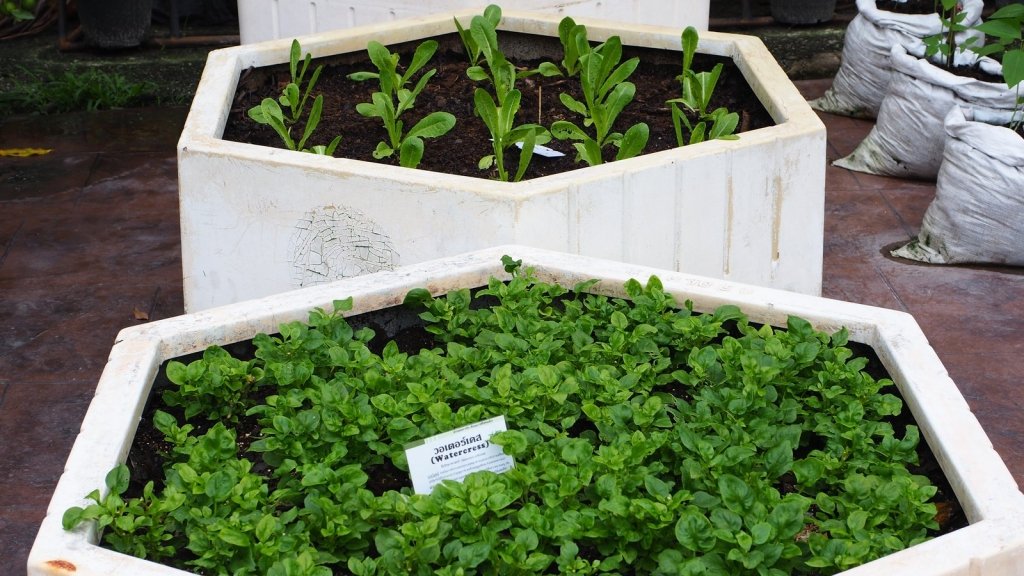
The short version: A wicking bed is a raised bed or box with a sealed water reservoir underneath, so plants draw water up through the soil by capillary action instead of relying on you to pour it on top. Built well, one needs topping up about once a week in summer, keeps leafy crops and herbs going through heat that would wilt an ordinary bed, and suits balconies, rentals and busy people. The rules are few: a reservoir 10 to 30 cm deep of coarse scoria with a fill pipe and an overflow, a layer of fabric, no more than about 30 cm of soil on top, a capped inlet so mosquitoes cannot breed, food-grade materials, shallow-rooted crops, and a flush with fresh water once a year so the reservoir does not turn sour and salty.
Wicking beds were devised by an Australian engineer, Colin Austin, for a climate where summer evaporation outruns the watering can, and they have become one of the most popular ways to grow vegetables in small spaces. This guide explains how they work, what to grow in them, how to build one from a tub or a bed, and the handful of problems worth designing out at the start.

How wicking works
Think of a giant self-watering pot. At the bottom sits a waterproof reservoir filled with coarse scoria or gravel; above it, separated by a layer of geotextile fabric, sits the soil the plants grow in. Water in the reservoir moves upward into the soil by capillary action, the same force that draws water up a paper towel, and the plant roots take it from there. The soil, not the scoria, does the wicking, which is why the fabric needs to dip into the water somewhere, either as a soil-filled fold or by letting the soil sit on the reservoir with the water level just touching it. Soil can only lift water about 30 cm by capillary action, so the growing layer is usually kept to roughly that depth; some builders go to 40 cm for deeper-rooted crops, accepting that the top few centimetres will run dry. Because the surface stays dry while the root zone stays moist, evaporation drops and weeds are slower to germinate.
When a wicking bed beats an ordinary bed
Wicking beds shine wherever consistent moisture is the problem: leafy greens and herbs that wilt and bolt the moment an ordinary bed dries out, gardens that are left alone for a week at a time, balconies and courtyards where every pot dries in a day, and sandy soils that will not hold water. Lettuce and Asian greens, which suffer badly in heat, are the crops that benefit most. They are also a way around bad ground soil, and in the tropics a way around soil-borne bacterial wilt, since the bed holds whatever mix you put in it. They are a poor fit for deep-rooted crops and anything that dislikes constantly moist feet: carrots and parsnips want more depth than a wicking bed offers, and rosemary, lavender and the drier Mediterranean herbs generally do better in a free-draining bed or pot, although thyme and oregano have been grown successfully in wicking beds, and pumpkins and sweet corn simply need more room than a box can give.

What to build it from
Anything waterproof or lined will do as long as it is safe for food. Food-grade plastic tubs and crates, a halved 200-litre food drum, a wine barrel, a large pot or an old washing machine drum all make good small beds. A timber or steel raised bed can be lined with a pond liner; the black PVC liners are cheap but not food grade, while butyl rubber and food-grade liners cost more and are the safer choice for edibles. Polystyrene foam boxes work for a season or two but crumble in sunlight and are best treated as temporary. Whatever the container, drill or fit the overflow before you fill it, and put the bed where it will live, because a full wicking bed is heavy.
Building one, step by step
1. Line and fit the fill pipe
Line the container if it needs it. Lay a length of slotted agricultural pipe, or 50 mm PVC pipe with holes drilled along it, across the base for half to three-quarters of the bed's length, and join it to a vertical riser that will stand above the finished soil. This is how you fill the reservoir. Cap the top of the riser or cover it with fine mesh so mosquitoes cannot get in to breed.
2. Fit the overflow
Drill an overflow hole in the side of the container at the height you want the water to reach, commonly 10 to 20 cm above the base and up to 30 cm in designs where a bigger reserve matters more than soil depth, and fit a short length of pipe or an elbow so water runs clear of the bed. The overflow sets the reservoir depth and stops the bed flooding in rain. An adjustable elbow lets you raise or lower the water level later.
3. Fill the reservoir
Fill to just below the overflow with coarse scoria of about 20 mm. Scoria is porous, holds far more water than solid gravel, and weighs roughly half as much, which matters on a balcony. Plain gravel works but the reservoir will need topping up more often.
4. Lay the fabric
Cover the scoria with geotextile fabric, or a doubled layer of heavy shade cloth, running it up the sides. Push a fold of fabric down into the scoria in one or two places and pack it with soil, so the soil makes contact with the water and wicking starts reliably.
5. Add the soil
Fill with about 25 to 30 cm of a mix that wicks and feeds well: ABC Gardening Australia uses a 50/50 blend of good soil and compost, and Deep Green Permaculture uses half premium soil, a quarter compost and a quarter aged cow manure; either works. Pure potting mix wicks poorly once dry; pure compost slumps. Water the surface thoroughly the first time to settle everything and start the wick, then fill the reservoir through the pipe until water runs from the overflow.

Running the bed
Water new seedlings and seed from the top for the first week or two, until their roots reach the moist zone; after that, the reservoir does the work. Top it up through the fill pipe whenever a stick dipped down the riser comes up dry, which in summer is usually about once a week and in winter far less. Mulch the surface lightly to slow the little evaporation that remains. Feed sparingly and from the top, with compost, worm castings or a diluted liquid feed on the soil, rather than tipping fertiliser into the reservoir, because the reservoir has no drainage and everything you add stays there. That is the one real weakness of a wicking bed: left alone, salts from fertiliser and hard water build up, the reservoir goes stagnant and the bed can, in Sustainable Gardening Australia's words, turn into a sludgy, smelly, salty, unproductive mess. The fix is routine. Clear the overflow every few months so it cannot block, and once a year, twice if the bed is under cover and never rained on, flush the reservoir by running the hose down the fill pipe until clean water has poured from the overflow for several minutes. Never put greywater into a wicking bed.
Wicking boxes for balconies
The same design scaled down to a tub or a large pot is a wicking box, and it is the best way to keep salad greens, herbs and even a chilli or a dwarf tomato alive on a hot balcony. A deep 60-litre storage tub with a 10 cm scoria base, an overflow drilled just above it, a cut-down drink bottle or short pipe as a filler and 25 cm of mix on top makes a productive box for well under the price of a fancy planter. Two or three boxes let you rotate sowings so something is always ready. A full wicking box is heavy, so on a balcony keep boxes small, stand them near the wall or over a beam, and check the balcony's load limit before adding several. Keep the fill hole covered, and empty and flush the boxes at the end of each summer.

Wicking beds across Australia's climate zones
- Tropical (Cairns and far north Queensland, Darwin and the Top End of the Northern Territory, the Kimberley in Western Australia): a way to grow tomatoes and eggplant above wilt-infested soil, and to keep greens going through the dry. In the wet season, make sure the overflow is generous, since a flooded bed drowns roots.
- Subtropical (Brisbane and coastal Queensland, Coffs Harbour and northern New South Wales): ideal for summer greens under shade cloth; flush twice a year because warm reservoirs sour faster.
- Arid and semi-arid (inland Queensland, Broken Hill and Dubbo in New South Wales, Mildura in Victoria, inland South Australia and Western Australia, Alice Springs in the Northern Territory): the climate the system was invented for. Expect weekly top-ups in summer, shade the bed in the afternoon, and flush regularly because hard bore water leaves salts.
- Temperate (Sydney and New South Wales, Melbourne and Victoria): excellent for anyone who travels or forgets; in a wet Melbourne winter the overflow does most of the work.
- Mediterranean (Perth and southern Western Australia, Adelaide and the Adelaide Plains in South Australia): the answer to sandy soil and dry summers; a wicking bed on Perth sand will grow lettuce in January that the ground never could.
- Cool and alpine (Hobart and Tasmania, Canberra and the ACT, Ballarat in Victoria, Orange and Armidale on the New South Wales tablelands, and the alpine country of the Snowy Mountains and the Victorian high country): useful in a dry summer, less so in winter, when cold, saturated soil slows growth; drain the reservoir down in the coldest months.
In every zone, a capped fill pipe and a yearly flush are what separate a bed that keeps working for years from one that is abandoned after a summer.
Frequently asked questions
How much water does a wicking bed save?
Gardeners consistently report needing to water far less often, because evaporation from the surface is low and nothing runs off, but no reliable Australian trial gives a fixed percentage. Treat the saving as real but unquantified.
Why does my wicking bed smell?
The reservoir has gone stagnant, usually from too much fertiliser, a blocked overflow or no flushing. Clear the overflow and flush with fresh water until it runs clean.
Can I grow tomatoes in a wicking bed?
Yes, especially bush and dwarf types in a deep box, but they want the full 30 cm of soil, a stake, and slightly drier conditions than lettuce, so let the reservoir run lower between top-ups.
Do wicking beds breed mosquitoes?
Only if the fill pipe is left open. Cap it, or cover it with fine mesh, and there is no exposed water for them to reach.
A reservoir, a pipe, a layer of fabric and 30 cm of good soil are the whole recipe, and the reward is a bed that keeps the salad growing while you are away. ABC Gardening Australia's wicking bed build shows the method on a full-sized bed.
Related growing guides
- Raised garden beds in Australia: are they worth it, and how to build one
- Watering Pots in an Australian Summer Without Losing the Crop
- Water-wise gardening: getting more from every drop in a dry climate
Fill the box with the crops that love it: browse our lettuce seeds, Asian vegetable seeds, herb seeds and compact vegetables for pots.